1906 · CLOSE READING
Collected Works (Vol. II)
Collected Works (Vol. II) (1906), PDF p. 284
Original page
Enlarge ↗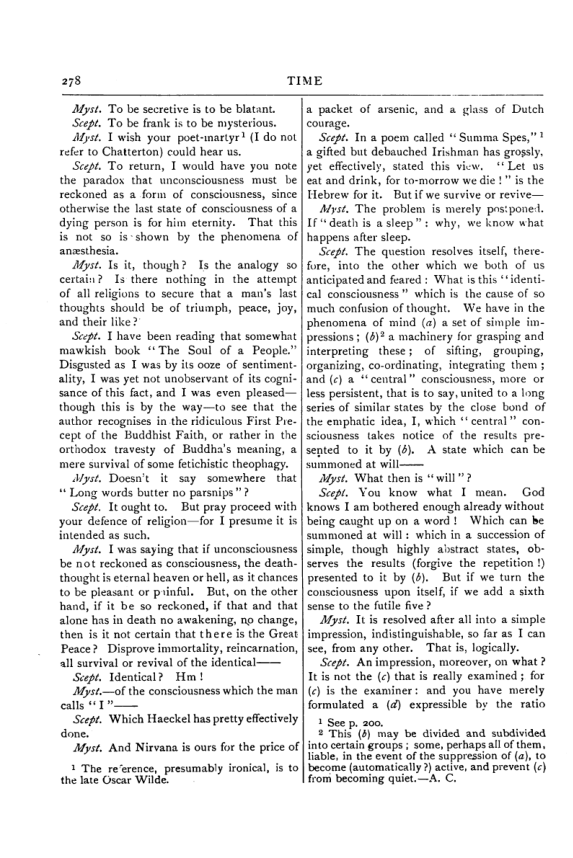
Highlights use the original PDF text layer. OCR-only matches may not be visible on the scan.
Transcription
Download text ↓raw extractionoriginal embedded textReview: unreviewed
278
TIME
Myst. To be secretive is to be blatant.
Scept. To be frank is to be mysterious.
Adyst. I wish your poet-martyr! (I do not
refer to Chatterton) could hear us.
Scept. To return, I would have you note
the paradox that unconsciousness must be
reckoned as a-form of consciousness, since
otherwise the last state of consciousness of a
dying person is for him eternity. That this
is not so is-shown by the phenomena of
anzesthesia.
Myst. Is it, though? Is the analogy so
certain? Is there nothing in the attempt
of all religions to secure that a man’s last
thoughts should be of triumph, peace, joy,
and their like ?
Scept. I have been reading that somewhat
mawkish book ‘‘The Soul of a People.”
Disgusted as I was by its ooze of sentiment-
ality, I was yet not unobservant of its cogni-
sance of this fact, and I was even pleased—
though this is by the way—to see that the
author recognises in-the ridiculous First Pre-
cept of the Buddhist Faith, or rather in the
orthodox travesty of Buddha's meaning, a
mere survival of some fetichistic theophagy.
Myst, Doesn’t it say somewhere that
‘* Long words butter no parsnips” ?
Scept. It ought to. But pray proceed with
your defence of religion—for I presume it is
intended as such.
Myst. I was saying that if unconsciousness
be not reckoned as consciousness, the death-
thought is eternal heaven orhell, as it chances
to be pleasant or prinful. But, on the other
hand, if it be so reckoned, if that and that
alone has in death no awakening, no change,
then is it not certain that there is the Great
Peace? Disprove immortality, reincarnation,
all survival or revival of the identical
Scept. Identical? Hm!
Myst.—of the consciousness which the man
calls “I”
Scept. Which Haeckel has pretty effectively
done.
Myst. And Nirvana is ours for the price of
1 The re’erence, presumably ironical, is to
the late Oscar Wilde.
a packet of arsenic, and a glass of Dutch
courage.
Scept. In a poem called ‘‘ Summa Spes,”’?
a gifted but debauched Irishman has grossly,
yet effectively, stated this view. ‘‘ Let us
eat and drink, for to-morrow we die!”’ is the
Hebrew for it. Butif we survive or revive
Myst, The problem is merely postponed.
If ‘death is a sleep”: why, we know what
happens after sleep.
Scept. The question resolves itself, there-
fore, into the other which we both of us
anticipated and feared : What is this ‘‘identi-
cal consciousness” which is the cause of so
much confusion of thought. We have in the
phenomena of mind (a) a set of simple im-
pressions; (4)? a machinery for grasping and
interpreting these; of sifting, grouping,
organizing, co-ordinating, integrating them;
and (c) a *‘central’’ consciousness, more or
less persistent, that is to say, united to a long
series of similar states by the close bond of
the emphatic idea, I, which ‘‘ central” con-
sciousness takes notice of the results pre-
sented to it by (4). A state which can be
summoned at will
Myst. What then is ‘‘ will” ?
Scept. You know what I mean. God
knows I am bothered enough already without
being caught up on a word! Which can be
summoned at will: which in a succession of
simple, though highly abstract states, ob-
serves the results (forgive the repetition !)
presented to it by (4). But if we turn the
consciousness upon itself, if we add a sixth
sense to the futile five?
Myst. It is resolved after all into a simple
impression, indistinguishable, so far as I can
see, from any other. That is, logically.
Scept. Animpression, moreover, on what?
It is not the (c) that is really examined ;. for
(c) is the examiner: and you have merely
formulated a (@) expressible by the ratio
1 See p. 200.
2 This (4) may be divided and subdivided
into certain groups ; some, perhaps all of them,
liable, in the event of the suppression of (a), to
become (automatically ?) active, and prevent (c)
from becoming quiet.—A. C.
Page provenance & review flags
Stable page ID: 59a930c2e614ddb0b1a2a000:p00284
Line breaks are preserved. Reading order and OCR accuracy may need review.
Printed page label has not been verified.
- No automated review flags. This does not establish transcription accuracy.