1906 · CLOSE READING
Collected Works (Vol. II)
Collected Works (Vol. II) (1906), PDF p. 277
Original page
Enlarge ↗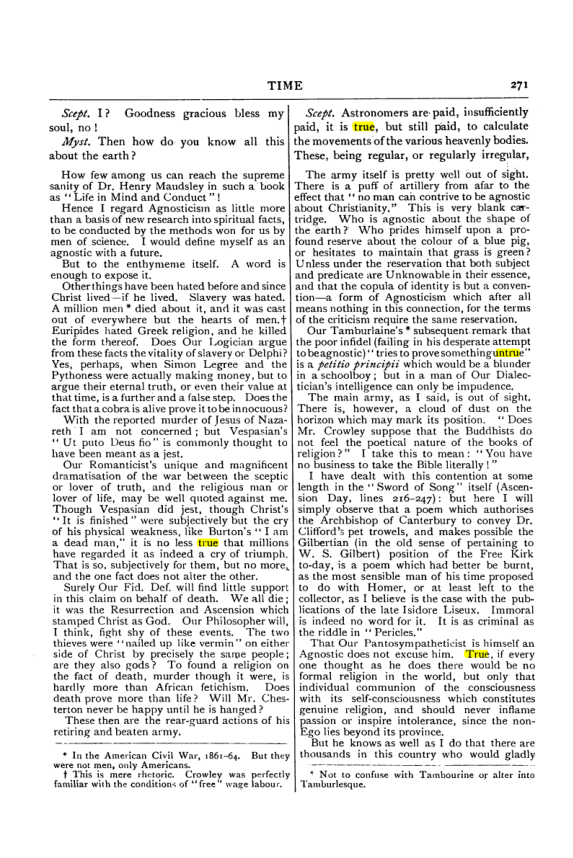
Highlights use the original PDF text layer. OCR-only matches may not be visible on the scan.
Transcription
Download text ↓raw extractionoriginal embedded textReview: unreviewed
TIME
271
Scept, 1?
soul, no!
Myst. Then how do you know all. this
about the earth?
Goodness gracious bless my
How few among us can reach the supreme
sanity of Dr. Henry Maudsley in such a book
‘¢ Life in Mind and Conduct ”!
” Hence I regard Agnosticism as little more
than a basis of new research into spiritual facts,
to be conducted by the methods won for us by
men of science. I would define myself as an
agnostic with a future.
But to the enthymeme itself.
enough to expose it.
Other things have been hated before and since
Christ lived —if he lived. Slavery was hated.
A million men* died about it, and it was cast
out of everywhere but the hearts of men.t
Euripides hated Greek religion, and he killed
the form thereof. Does Our J.ogician argue
from these facts the vitality of slavery or Delphi?
Yes, perhaps, when Simon Legree and the
Pythoness were actually making money, but to
argue their eternal truth, or even their value at
that time, is a further and a false step. Does the
fact that a cobra is alive prove it tobe innocuous?
With the reported murder of Jesus of Naza-
rethI am not concerned; but Vespasian’s
‘*Ut puto Deus fio” is commonly thought to
have been meant as a jest.
Our Romanticist’s unique and magnificent
dramatisation of the war between the sceptic
or lover of truth, and the religious man or
lover of life, may be well quoted against me.
Though Vespasian did jest, though Christ’s
‘‘It is finished” were subjectively but the cry
of his physical weakness, like Burton's ‘‘ I am
a dead man,” it is no less true that millions
have regarded it as indeed a cry of triumph.
That is so, subjectively for them, but no more,
and the one fact does not alter the other.
Surely Our Fid. Def. will find little support
in this claim on behalf of death. We all die;
it was the Resurrection and Ascension which
stamped Christ as God. Our Philosopher will,
I think, fight shy of these events. The two
thieves were ‘‘nailed up like vermin”’ on either
side of Christ by precisely the same people;
are they also gods? To found a religion on
the fact of death, murder though it were, is
hardly more than African fetichism. Does
death prove more than life? Will Mr. Ches-
terton never be happy until he is hanged?
These then are the rear-guard actions of his
retiring and beaten army.
A word is
* In the American Civil War, 1861-64.
were not men, only Americans.
t Thisis mere rhetoric. Crowley was perfectly
familiar with the conditions of ‘‘ free” wage labour.
But they
Scept. Astronomers are: paid, insufficiently
paid, it is true, but still paid, to calculate
the movements
of the various heavenly bodies.
These, being regular, or regularly irregular,
The army itself is pretty well out of sight.
There is a puff of artillery from afar to the
effect that ‘‘no man can contrive to be agnostic
about Christianity.” This is very blank car-
tridge. Who is agnostic about the shape of
the earth? Who prides himself upon a pro-
found reserve about the colour of a blue pig,
or hesitates to maintain that grass is green?
Unless under the reservation that both subject
and predicate are Unknowable in their essence,
and that the copula of identity is but a conven-
tion—a form of Agnosticism which after all
means nothing in this connection, for the terms —
of the criticism require the same reservation.
Our Tamburlaine’s * subsequent.remark that
the poor infidel (failing in his desperate attempt
to beagnostic) ‘‘ tries to provesomethinguntrue”’
is a petitio principiz which would be a blunder
in a schoolboy; but ina man of Our Dialec-
tician’s intelligence can only be impudence.
The main army, as I said, is out of sight.
There is, however, a cloud of dust on the
horizon which may mark its position. ‘‘ Does
Mr. Crowley suppose that the Buddhists do
not feel the poetical nature of the books of
religion?” I take this to mean: ‘‘ You have
no business to take the Bible literally !”
I have dealt with this contention at some
length in the ‘‘Sword of Song”’ itself (Ascen-
sion Day, lines 216-247): but here I will
simply observe that a poem which authorises
the Archbishop of Canterbury to convey Dr.
Clitford’s pet trowels, and makes possible the
Gilbertian (in the old sense of pertaining to
W. S. Gilbert) position of the Free Kirk
to-day, is a poem which had better be burnt,
as the most sensible man of his time proposed
to do with Homer, or at least left to the
collector, as I believe is the case with the pub-
lications of the late Isidore Liseux. Immoral
is indeed no word for it. It is as criminal as
the riddle in ‘‘ Pericles.”
That Our Pantosympatheticist is himself an
Agnostic does not excuse him. True, if every
one thought as he does there would be no
formal religion in the world, but only that
individual communion of the consciousness
with its self-consciousness which constitutes
genuine religion, and should never inflame
passion or inspire intolerance, since the non-
Ego lies beyond its province.
But he knows as well as I do that there are
thousands in this country who would gladly
* Not to confuse with Tambourine or alter into
Tamburlesque.
Page provenance & review flags
Stable page ID: 59a930c2e614ddb0b1a2a000:p00277
Line breaks are preserved. Reading order and OCR accuracy may need review.
Printed page label has not been verified.
- No automated review flags. This does not establish transcription accuracy.