1906 · CLOSE READING
Collected Works (Vol. II)
Collected Works (Vol. II) (1906), PDF p. 276
Original page
Enlarge ↗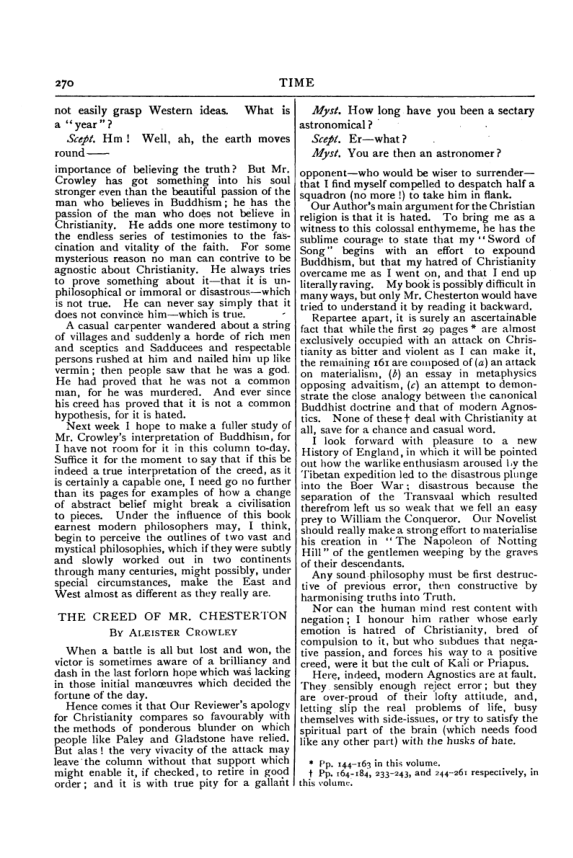
Highlights use the original PDF text layer. OCR-only matches may not be visible on the scan.
Transcription
Download text ↓raw extractionoriginal embedded textReview: unreviewed
270
TIME
not easily grasp Western ideas. What is
a “year”?
Scept. Hm! Well, ah, the earth moves
round
importance of believing the truth? But Mr.
Crowley has got something into his soul
stronger even than the beautiful passion of the
man who believes in Buddhism; he has the
passion of the man who does not believe in
Christianity. He adds one more testimony to
the endless series of testimonies to the fas-
cination and vitality of the faith. For some
mysterious reason no man can contrive to be
agnostic about Christianity. He always tries
to prove something about it—that it is un-
philosophical or immoral or disastrous—which
is not true. He can never say simply that it
does not convince him—which is true. -
A casual carpenter wandered about a string
of villages and suddenly a horde of rich men
and sceptics and Sadducees and respectable
persons rushed at him and nailed him up like
vermin; then people saw that he was a god.
He had proved that he was not a common
man, for he was murdered. And ever since
his creed has proved that it is not a common
hypothesis, for it is hated.
Next week I hope to make a fuller study of
Mr. Crowley’s interpretation of Buddhism, for
I have not room for it in this column to-day.
Suffice it for the moment to say that if this be
indeed a true interpretation of the creed, as it
is certainly a capable one, I need go no further
than its pages for examples of how a change
of abstract belief might break a civilisation
to pieces. Under the influence of this book
earnest modern philosophers may, I think,
begin to perceive the outlines of two vast and
mystical philosophies, which if they were subtly
and slowly worked out in two continents
through many centuries, might possibly, under
special circumstances, make the East and
West almost as different as they really are.
THE CREED OF MR. CHESTERTON
By ALEISTER CROWLEY
When a battle is all but lost and won, the
victor is sometimes aware of a brilliancy and
dash in the last forlorn hope which was lacking
in those initial manoeuvres which decided the
fortune of the day.
Hence comes it that Our Reviewer’s apology
for Christianity compares so favourably with
the methods of ponderous blunder on which
people like Paley and Gladstone have relied.
But alas! the very vivacity of the attack may
leave the column without that support which
might enable it, if checked, to retire in good
order; and it is with true pity for a gallant
Myst. Wow long. have you been a sectary
astronomical? oo |
Scept. Exr—what?
Myst, You are then an astronomer?
opponent—who would be wiser to surrender—
that I find myself compelled to despatch half a
squadron (no more !) to take him in flank.
Our Author’s main argument for the Christian
religion is that it is hated. To bring me as a
witness to this colossal enthymeme, he has the
sublime courage to state that my ‘‘ Sword of
Song” begins with an effort to expound
Buddhism, but that my hatred of Christianity
overcame me as I went on, and that I end up
literally raving. My book is possibly difficult in
many ways, but only Mr. Chesterton would have
tried to understand it by reading it backward.
Repartee apart, it is surely an ascertainable
fact that while the first 29 pages* are almost
exclusively occupied with an attack on Chris-
tianity as bitter and violent as I can make it,
the remaining 161 are composed of (a) an attack
on materialism, (4) an essay in metaphysics
opposing advaitism, (c) an attempt to demon-
strate the close analogy bétween the canonical
Buddhist doctrine and that of modern Agnos-
tics. None of these+ deal with Christianity at
all, save for a chance and casual word.
I look forward with pleasure to a new
History of England, in which it will be pointed
out how the warlike enthusiasm aroused liv the
Tibetan expedition led to the disastrous plunge
into the Boer War; disastrous because the
separation of the Transvaal which resulted
therefrom left us so weak that we fell an easy
prey to William the Conqueror. Our Novelist
should really makea strong effort to materialise
his creation in ‘‘ The Napoleon of Notting
Hill” of the gentlemen weeping by the graves
of their descendants.
Any sound.-philosophy must be first destruc-
tive of previous error, then constructive by
harmonising truths into Truth.
Nor can the human mind rest content with
negation; I honour him rather whose early
emotion is hatred of Christianity, bred of
compulsion to it, but who subdues that nega-
tive passion, and forces his way to a positive
creed, were it but the cult of Kali or Priapus.
Here, indeed, modern Agnostics are at fault.
They. sensibly enough reject error; but they
are over-proud of their lofty attitude, and,
letting slip the real problems of life, busy
themselves with side-issues, or try to satisfy the
spiritual part of the brain (which needs food
like any other part) with the husks of hate.
* Pp. 144-163 in this volume.
t Pp. 164-184, 233-243, and 244~261 respectively, in
this volume.
Page provenance & review flags
Stable page ID: 59a930c2e614ddb0b1a2a000:p00276
Line breaks are preserved. Reading order and OCR accuracy may need review.
Printed page label has not been verified.
- No automated review flags. This does not establish transcription accuracy.