1906 · CLOSE READING
Collected Works (Vol. II)
Collected Works (Vol. II) (1906), PDF p. 274
Original page
Enlarge ↗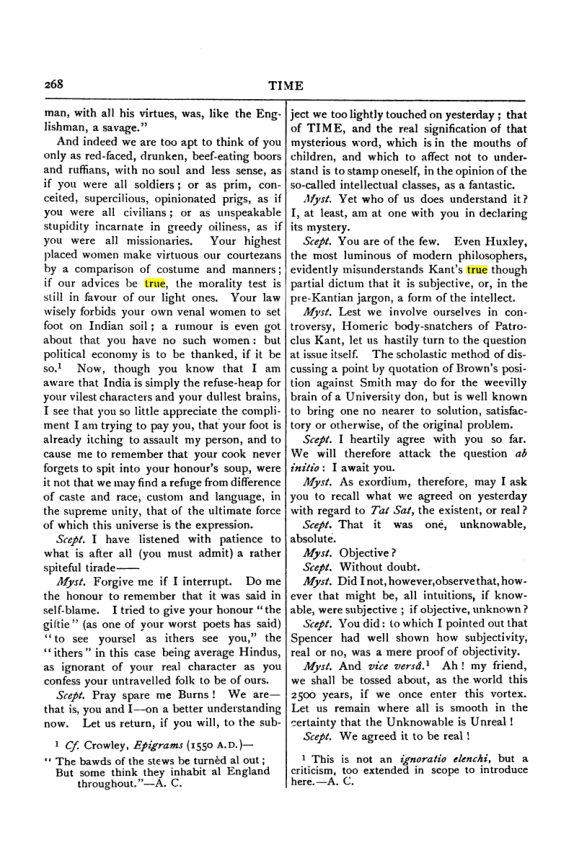
Highlights use the original PDF text layer. OCR-only matches may not be visible on the scan.
Transcription
Download text ↓raw extractionoriginal embedded textReview: unreviewed
268
TIME
man, with all his virtues, was, like the Eng-
lishman, a savage.”
And indeed we are too apt to think of you
only as red-faced, drunken, beef-eating boors
and ruffans, with no soul and less sense, as
if you were all soldiers; or as prim, con-
ceited, supercilious, opinionated prigs, as if
you were all civilians; or as unspeakable
stupidity incarnate in greedy oiliness, as if
you were all missionaries. Your highest
placed women make virtuous our courtezans
by a comparison of costume and manners;
if our advices be true, the morality test is
suill in favour of our light ones. Your law
wisely forbids your own venal women to set
foot on Indian soil; a rumour is even got
about that you have no such women: but
political economy is to be thanked, if it be
so. Now, though you know that I am
aware that India is simply the refuse-heap for
your vilest characters and your dullest brains,
I see that you so little appreciate the compli-
ment I am trying to pay you, that your foot is
already itching to assault my person, and to
cause me to remember that your cook never
forgets to spit into your honour’s soup, were
it not that we may find a refuge from difference
of caste and race, custom and language, in
the supreme unity, that of the ultimate force
of which this universe is the expression.
Scept. I have listened with patience to
what is after all (you must admit) a rather
spiteful tirade——
Myst. Forgive me if I interrupt. Do me
the honour to remember that it was said in
self-blame. I tried to give your honour “the
giltie’’ (as one of your worst poets has said)
‘“to see yoursel as ithers see you,” the
‘‘ithers”’ in this case being average Hindus,
as ignorant of your real character as you
confess your untravelled folk to be of ours.
Scept. Pray spare me Burns! We are—
that is, you and I—on a better understanding
now. Let us return, if you will, to the sub-
1 Cf. Crowley, Epigrams (1550 A.D.)—
‘¢ The bawds of the stews be turned al out ;
But some think they inhabit al England
throughout.”—A. C.
ject we too lightly touched on yesterday ; that
of TIME, and the real signification of that
mysterious word, which isin the mouths of
children, and which to affect not to under-
stand is to stamp oneself, in the opinion of the
so-called intellectual classes, as a fantastic.
Myst. Yet who of us does understand it?
I, at least, am at one with you in declaring
its mystery.
Scept. You are of the few. Even Huxley,
the most luminous of modern philosophers,
evidently misunderstands Kant’s true though
partial dictum that it is subjective, or, in the
pre-Kantian jargon, a form of the intellect.
Myst. Lest we involve ourselves in con-
troversy, Homeric body-snatchers of Patro-
clus Kant, let us hastily turn to the question
at issue itself. The scholastic method of dis-
cussing a point by quotation of Brown's posi-
tion against Smith may do for the weevilly
brain ofa University don, but is well known
to bring one no nearer to solution, satisfac-
tory or otherwise, of the original problem.
Scept. I heartily agree with you so far.
We will therefore attack the question ad
tnttio: I await you. .
Myst. As exordium, therefore, may I ask
you to recall what we agreed on yesterday
with regard to Zat Sat, the existent, or real?
Scept. That it was one, unknowable,
absolute.
Myst. Objective?
Scept. Without doubt.
Myst. Did Inot, however,observe that, how-
ever that might be, all intuitions, if know-
able, were subjective ; if objective, unknown?
Scept. You did: to which I pointed out that
Spencer had well shown how subjectivity,
real or no, was a mere proof of objectivity.
Myst. And vice versé.! Ah! my friend,
we shall be tossed about, as the world this
2500 years, if we once enter this vortex.
Let us remain where all is smooth in the
certainty that the Unknowable is Unreal !
Scept. We agreed it to be real!
1 This is not an ignoratio elenchi, but a
criticism, too extended in scope to introduce
here.—A. C.
Page provenance & review flags
Stable page ID: 59a930c2e614ddb0b1a2a000:p00274
Line breaks are preserved. Reading order and OCR accuracy may need review.
Printed page label has not been verified.
- No automated review flags. This does not establish transcription accuracy.