1906 · CLOSE READING
Collected Works (Vol. II)
Collected Works (Vol. II) (1906), PDF p. 273
Original page
Enlarge ↗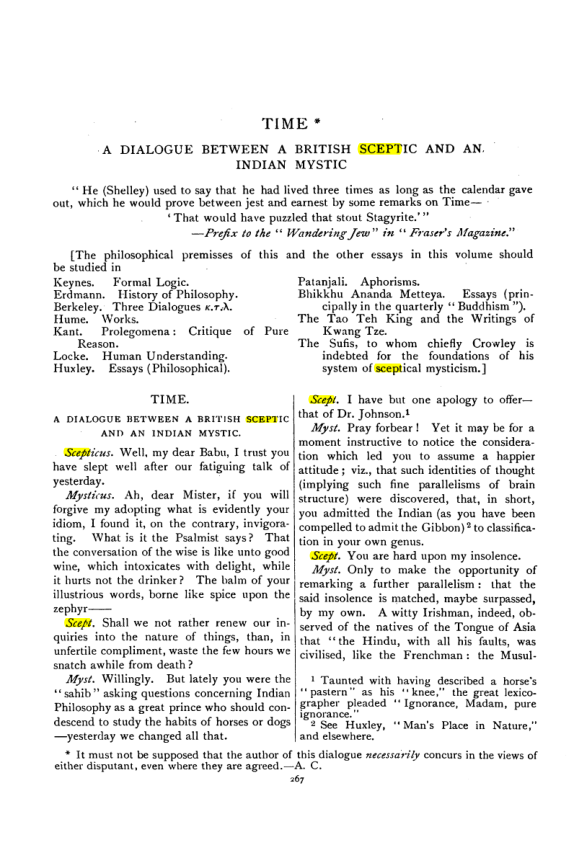
Highlights use the original PDF text layer. OCR-only matches may not be visible on the scan.
Transcription
Download text ↓raw extractionoriginal embedded textReview: unreviewed
TIME *
-A DIALOGUE BETWEEN A BRITISH SCEPTIC AND AN. |
INDIAN MYSTIC
‘‘ He (Shelley) used to say that he had lived three times as long as the calendar gave
out, which he would prove between jest and earnest by some remarks on Time— ~~
‘That would have puzzled that stout Stagyrite.
>)?
—Prefix to the ‘‘ Wandering Jew” in “ Fraser's Magazine.”
[The philosophical premisses of this and the other essays in this volume should
be studied in ;
Keynes. Formal Logic.
Erdmann. History of Philosophy.
Berkeley. Three Dialogues «.r-.A.
Hume. Works.
Kant. Prolegomena:
Reason.
Locke. Human Understanding.
Huxley. Essays (Philosophical).
Critique of Pure
TIME.
A DIALOGUE BETWEEN A BRITISH SCEPTIC
AND AN INDIAN MYSTIC.
. Scepticus. Well, my dear Babu, I trust you
have slept well after our fatiguing talk of
yesterday. |
Mysticus. Ah, dear Mister, if you will
forgive my adopting what is evidently your
idiom, I found it, on the contrary, invigora-
ting. What is it the Psalmist says? That
the conversation of the wise is like unto good
wine, which intoxicates with delight, while
it hurts not the drinker? The balm of your
illustrious words, borne like spice upon the
zephyr |
Scept. Shall we not rather renew our in-
quiries into the nature of things, than, in
unfertile compliment, waste the few hours we
snatch awhile from death?
Myst. Willingly. But lately you were the
‘‘sahib”’ asking questions concerning Indian
Philosophy as a great prince who should con-
descend to study the habits of horses or dogs
—yesterday we changed all that.
Patanjali. Aphorisms.
Bhikkhu Ananda Metteya. Essays (prin-
cipally in the quarterly ‘‘ Buddhism ”’).
The Tao Teh King and the Writings of
Kwang Tze.
The Sufis, to whom chiefly Crowley is
indebted for the foundations of his
system of sceptical mysticism.]
Scept. I have but one apology to offer—
that of Dr. Johnson.!
Myst. Pray forbear! Yet it may be for a
moment instructive to notice the considera-
tion which led you to assume a happier
attitude; viz., that such identities of thought
(implying such fine parallelisms of brain
structure) were discovered, that, in short,
you admitted the Indian (as you have been
compelled to admit the Gibbon)? to classifica-
tion in your own genus.
Scept. You are hard upon my insolence.
Myst. Only to make the opportunity of
remarking a further parallelism: that the
said insolence is matched, maybe surpassed,
by my own. A witty Irishman, indeed, ob-
served of the natives of the Tongue of Asia
that ‘‘the Hindu, with all his faults, was
civilised, like the Frenchman: the Musul-
1 Taunted with having described a_ horse's
‘*pastern’’ as his ‘‘knee,’’ the great lexico-
grapher pleaded ‘‘ Ignorance, Madam, pure
ignorance.”
2 See Huxley, ‘‘Man’s Place in Nature,”
and elsewhere.
* It must not be supposed that the author of this dialogue ecessarzly concurs in the views of
either disputant, even where they are agreed.—A. C.
267
Page provenance & review flags
Stable page ID: 59a930c2e614ddb0b1a2a000:p00273
Line breaks are preserved. Reading order and OCR accuracy may need review.
Printed page label has not been verified.
- No automated review flags. This does not establish transcription accuracy.