1906 · CLOSE READING
Collected Works (Vol. II)
Collected Works (Vol. II) (1906), PDF p. 256
Original page
Enlarge ↗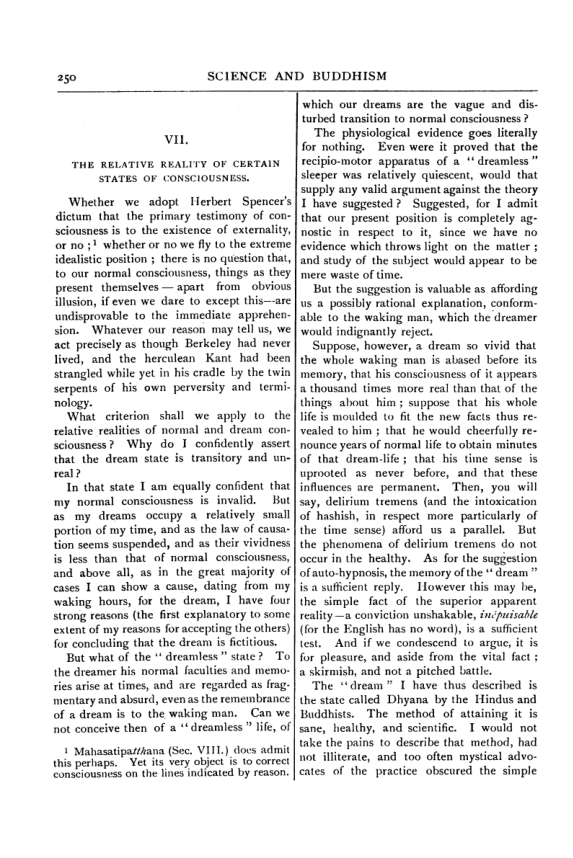
Highlights use the original PDF text layer. OCR-only matches may not be visible on the scan.
Transcription
Download text ↓raw extractionoriginal embedded textReview: unreviewed
250
SCIENCE AND BUDDHISM
Vil.
THE RELATIVE REALITY OF CERTAIN
STATES OF CONSCIOUSNESS.
Whether we adopt Herbert Spencer’s
dictum that the primary testimony of con-
sciousness is to the existence of externality,
or no ;! whether or no we fly to the extreme
idealistic position ; there is no question that,
to our normal consciousness, things as they
present themselves
— apart from obvious
illusion, if even we dare to except this—-are
undisprovable to the immediate apprehen-
sion. Whatever our reason may tell us, we
act precisely as though Berkeley had never
lived, and the herculean Kant had been
strangled while yet in his cradle by the twin
serpents of his own perversity and termi-
nology.
What criterion shall we apply to the
relative realities of normal and dream con-
sciousness? Why do I confidently assert
that the dream state is transitory and un-
real?
In that state I am equally confident that
my normal consciousness is invalid. But
as my dreams occupy a relatively small
portion of my time, and as the law of causa-
tion seems suspended, and as their vividness
is less than that of normal consciousness,
and above all, as in the great majority of
cases I can show a cause, dating from my
waking hours, for the dream, I have four
strong reasons (the first explanatory to some
extent of my reasons for accepting the others)
for concluding that the dream is fictitious.
But what of the ‘‘ dreamless” state? To
the dreamer his normal faculties and memo-
ries arise at times, and are regarded as frag-
mentary and absurd, even as the remembrance
of a dream is to the waking man. Can we
not conceive then of a ‘‘dreamless ” life, of
1 Mahasatipa¢¢hana (Sec. VIII.) does admit
this perhaps. Yet its very object is to correct
consciousness on the lines indicated by reason.
which our dreams are the vague and dis-
turbed transition to normal consciousness ?
The physiological evidence goes literally
for nothing. Even were it proved that the
recipio-motor apparatus of a ‘‘ dreamless ”
sleeper was relatively quiescent, would that
supply any valid argument against the theory
I have suggested? Suggested, for I admit
that our present position is completely ag-
nostic in respect to it, since we have no
evidence which throws light on the matter ;
and study of the subject would appear to be
mere waste of time.
But the suggestion is valuable as affording
us a possibly rational explanation, conform-
able to the waking man, which the dreamer
would indignantly reject.
Suppose, however, a dream so vivid that
the whole waking man is abased before its
memory, that his consciousness of it appears
a thousand times more real than that of the
things about him; suppose that his whole
life is moulded to fit the new facts thus re-
vealed to him ; that he would cheerfully re-
nounce years of normal life to obtain minutes
of that dream-life; that his time sense is
uprooted as never before, and that these
influences are permanent. Then, you will
say, delirium tremens (and the intoxication
of hashish, in respect more particularly of
the time sense) afford us a parallel. But
the phenomena of delirium tremens do not
occur in the healthy. As for the suggestion
of auto-hypnosis, the memory of the ‘‘ dream ”
is a sufficient reply. Ilowever this may be,
the simple fact of the superior apparent
reality—a conviction unshakable, zs‘pzzsable
(for the English has no word), is a sufficient
test. And if we condescend to argue, it is
for pleasure, and aside from the vital fact;
a skirmish, and not a pitched battle.
The ‘‘dream ” I have thus described is
the state called Dhyana by the Hindus and
Buddhists. The method of attaining it is
sane, healthy, and scientific. I would not
take the pains to describe that method, had
not illiterate, and too often mystical advo-
cates of the practice obscured the simple
Page provenance & review flags
Stable page ID: 59a930c2e614ddb0b1a2a000:p00256
Line breaks are preserved. Reading order and OCR accuracy may need review.
Printed page label has not been verified.
- No automated review flags. This does not establish transcription accuracy.