1906 · CLOSE READING
Collected Works (Vol. II)
Collected Works (Vol. II) (1906), PDF p. 253
Original page
Enlarge ↗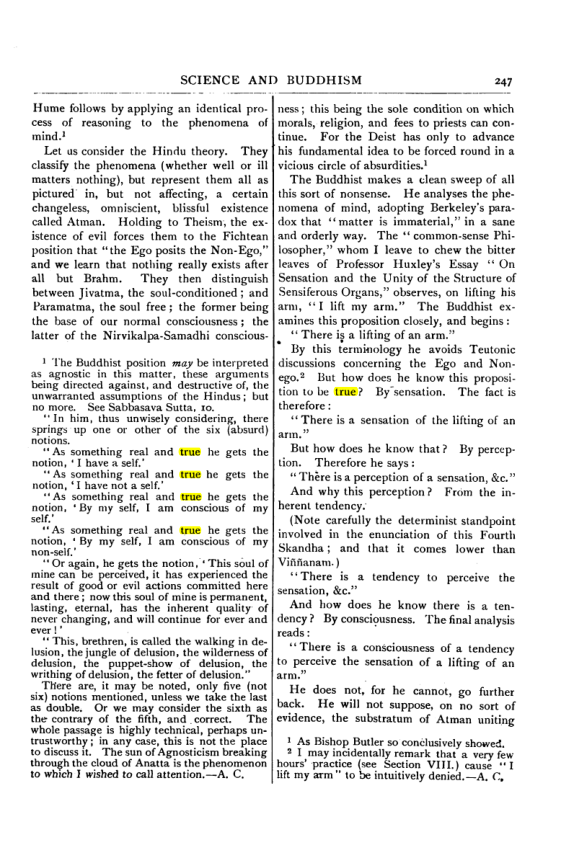
Highlights use the original PDF text layer. OCR-only matches may not be visible on the scan.
Transcription
Download text ↓raw extractionoriginal embedded textReview: unreviewed
SCIENCE AND BUDDHISM
247
Hume follows by applying an identical pro-
cess of reasoning to the phenomena of
mind.!
Let us consider the Hindu theory. They
classify the phenomena (whether well or ill
matters nothing), but represent them all as
pictured in, but not affecting, a certain
changeless, omniscient, blissful existence
called Atman. Holding to Theism, the ex-
istence of evil forces them to the Fichtean
position that “the Ego posits the Non-Ego,”
and we learn that nothing really exists after
all but Brahm. They then distinguish
between Jivatma, the soul-conditioned; and
Paramatma, the soul free; the former being
the base of our normal consciousness; the
latter of the Nirvikalpa-Samadhi conscious-
1 ‘The Buddhist position may be interpreted
as agnostic in this matter, these arguments
being directed against, and destructive of, the
unwarranted assumptions of the Hindus; but
no more. See Sabbasava Sutta, ro.
‘‘In him, thus unwisely considering, there
springs
up one or other of the six (absurd)
notions.
‘**As something real and true he gets the
notion, ‘I have a self.’
‘‘As something real and
notion, ‘I have not a self.’
‘*As something real and
notion, ‘By my self, I am
self,’
‘‘As something real and
notion, ‘ By my self, I am
non-self,’ :
‘Or again, he gets the notion, ‘ This soul of
mine can be perceived, it has experienced the
result of good or evil actions committed here
and there; now this soul of mine is permanent,
lasting, eternal, has the inherent quality of
never changing, and will continue for ever and
ever !'
‘* This, brethren, is called the walking in de-
lusion, the jungle of delusion, the wilderness of
delusion, the puppet-show of delusion, the
writhing of delusion, the fetter of delusion.”
There are, it may be noted, only five (not
six) notions mentioned, unless we take the last
as double. Or we may consider the sixth as
the contrary of the fifth, and correct. The
whole passage is highly technical, perhaps un-
trustworthy; in any case, this is not the place
to discuss it. The sun of Agnosticism breaking
through the cloud of Anatta is the phenomenon
to whichI wished to call attention.—A. C.,
true he gets the
the
my
true he gets
conscious of
the
my
true he gets
conscious of
ness; this being the sole condition on which
morals, religion, and fees to priests can con-
| tinue. For the Deist has only to advance
his fundamental idea to be forced round in a
vicious circle of absurdities.1
The Buddhist makes a clean sweep of all
this sort of nonsense. He analyses the phe-
nomena of mind, adopting Berkeley’s para-
dox that ‘‘ matter is immaterial,’ in a sane
and orderly way. The ‘‘ common-sense Phi-
losopher,” whom I leave to chew the bitter
leaves of Professor Huxley’s Essay ‘‘ On
Sensation and the Unity of the Structure of
Sensiferous Organs,” observes, on lifting his
arm, ‘‘I lift my arm.” The Buddhist ex-
amines this proposition closely, and begins:
‘‘ There is a lifting of an arm.”
By this terminology he avoids Teutonic
discussions concerning the Ego and Non-
ego.” But how does he know this proposi-
tion to be true? By sensation. The fact is
therefore:
‘* There is a sensation of the lifting of an
arm.”
But how does he know that? By percep-
tion. Therefore he says:
‘“ There is a perception of a sensation, &c.”
And why this perception? From the in-
herent tendency.
(Note carefully the determinist standpoint
involved in the enunciation of this Fourth
Skandha; and that it comes lower than
Vififianam. )
‘‘There is a tendency to perceive the
sensation, &c.”’
And how does he know there is a ten-
dency? By consciousness. The final analysis
reads:
‘* There is a consciousness of a tendency
to perceive the sensation of a lifting of an
arm.” . |
He does not, for he cannot, go further
back. He will not suppose, on no sort of
evidence, the substratum of Atman uniting
1 As Bishop Butler so conclusively showed.
2 I may incidentally remark that a very few
hours’ practice (see Section VIII.) cause ‘1
lift my arm”’ to be intuitively denied.—A. C,
Page provenance & review flags
Stable page ID: 59a930c2e614ddb0b1a2a000:p00253
Line breaks are preserved. Reading order and OCR accuracy may need review.
Printed page label has not been verified.
- No automated review flags. This does not establish transcription accuracy.