1906 · CLOSE READING
Collected Works (Vol. II)
Collected Works (Vol. II) (1906), PDF p. 250
Original page
Enlarge ↗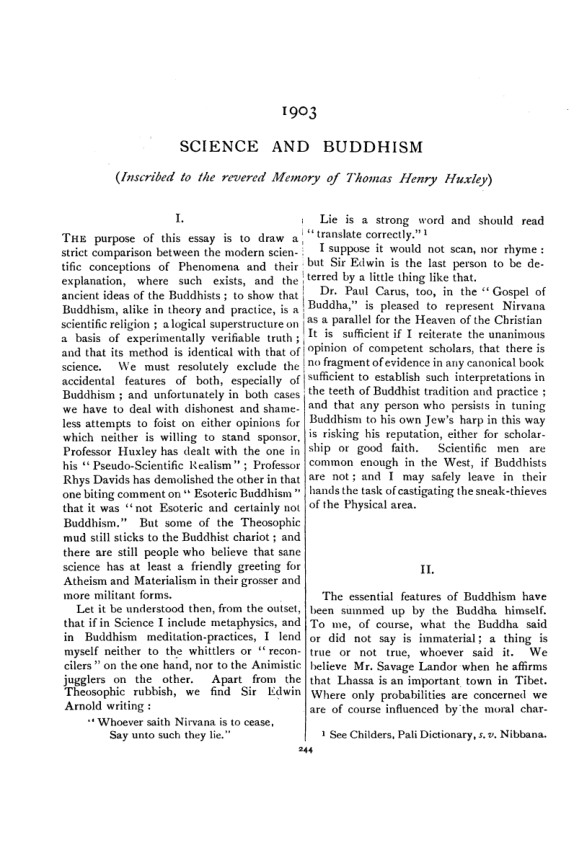
Highlights use the original PDF text layer. OCR-only matches may not be visible on the scan.
Transcription
Download text ↓raw extractionoriginal embedded textReview: unreviewed
1903
SCIENCE
AND BUDDHISM
(Inscribed to the revered Memory of Thomas Henry Huxley)
I.
THE purpose of this essay is to draw a
strict comparison between the modern scien- :
tific conceptions of Phenomena and their'
explanation, where such exists, and the|
ancient ideas of the Buddhists; to show that
Buddhism, alike in theory and practice, is a
scientific religion ; a logical superstructure on
a basis of experimentally verifiable truth;
and that its method is identical with that of
science. We must resolutely exclude the
accidental features of both, especially of
Buddhism; and unfortunately in both cases
we have to deal with dishonest and shame-
less attempts to foist on either opinions for
which neither is willing to stand sponsor,
Professor Huxley has dealt with the one in
his ‘‘ Pseudo-Scientific Kealism”’ ; Professor
Rhys Davids has demolished the other in that
one biting comment on ‘* Esoteric Buddhism ”’
that it was ‘‘not Esoteric and certainly not
Buddhism.’”’ But some of the Theosophic
mud still sticks to the Buddhist chariot ; and
there are still people who believe that sane
science has at least a friendly greeting for
Atheism and Materialism in their grosser and
more militant forms. .
Let it be understood then, from the outset,
that if in Science I include metaphysics, and
in Buddhism meditation-practices, I lend
myself neither to the whittlers or ‘‘ recon-
cilers”’ on the one hand, nor to the Animistic
jugglers on the other. Apart from the
Theosophic rubbish, we find Sir Edwin
Arnold writing : )
‘© Whoever saith Nirvana is to cease,
Say unto such they lie.”
Lie is a strong word and should read
‘‘ translate correctly.” }
I suppose it would not scan, nor rhyme:
but Sir Edwin is the last person to be de-
terred by a little thing like that.
Dr. Paul Carus, too, in the ‘‘ Gospel of
Buddha,” is pleased to represent Nirvana
as a parallel for the Heaven of the Christian
It is sufficient if I reiterate the unanimous
opinion of competent scholars, that there is
no fragment of evidence in any canonical book
sufficient to establish such interpretations in
the teeth of Buddhist tradition and practice ;
and that any person who persists in tuning
Buddhism to his own Jew’s harp in this way
is risking his reputation, either for scholar-
ship or good faith. Scientific men are
common enough in the West, if Buddhists
are not; and I may safely leave in their
hands the task of castigating the sneak-thieves
of the Physical area.
Il.
The essential features of Buddhism have
been summed up by the Buddha himself.
To me, of course, what the Buddha said
or did not say is immaterial; a thing is
true or not true, whoever said it. We
believe Mr. Savage Landor when he affirms
that Lhassa is an important. town in Tibet.
Where only probabilities are concerned we
|are of course influenced by the moral char-
1 See Childers, Pali Dictionary, s.v. Nibbana.
244
Page provenance & review flags
Stable page ID: 59a930c2e614ddb0b1a2a000:p00250
Line breaks are preserved. Reading order and OCR accuracy may need review.
Printed page label has not been verified.
- No automated review flags. This does not establish transcription accuracy.