1906 · CLOSE READING
Collected Works (Vol. II)
Collected Works (Vol. II) (1906), PDF p. 244
Original page
Enlarge ↗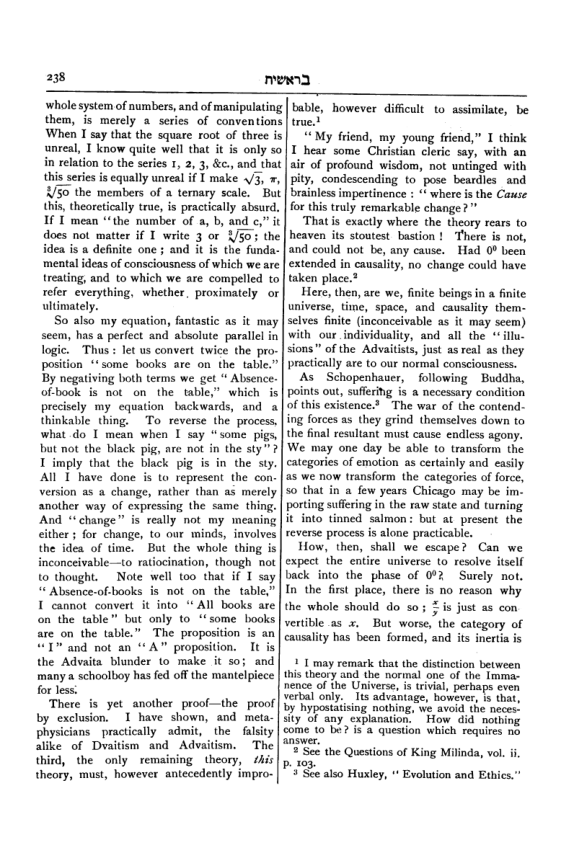
Highlights use the original PDF text layer. OCR-only matches may not be visible on the scan.
Transcription
Download text ↓raw extractionoriginal embedded textReview: unreviewed
238
TYR |
whole system-of numbers, and of manipulating
them, is merely a series of conventions
When I say that the square root of three is
unreal, I know quite well that it is only so
in relation to the series 1, 2, 3, &c., and that
this series is equally unreal if I make 4/3, 7,
2/50 the members of a ternary scale. But
this, theoretically true, is practically absurd.
If I mean ‘‘the number of.a, b, and c,”’ it
does not matter if I write 3 or 3/50; the
idea is a definite one; and it is the funda-
mental ideas of consciousness of which we are
treating, and to which we are compelled to
refer everything, whether, proximately or
ultimately.
So also my equation, fantastic as it may
seem, has a perfect and absolute parallel in
logic. Thus: let us convert twice the pro-
position ‘‘some books are on the table.”
By negativing both terms we get “ Absence-
of-book is not on the table,’ which is
precisely my equation backwards, and a
thinkable thing. To reverse the process,
what .do I mean when I say “some pigs,
but not the black pig, are not in the sty”?
I imply that the black pig is in the sty.
All I have done is to represent the con-
version as a change, rather than as merely
another way of expressing the same thing.
And ‘‘change”’ is really not my meaning
either; for change, to our minds, involves
the idea of time. But the whole thing is
inconceivable—to ratiocination, though not
to thought. Note well too that if I say
‘© Absence-of-books is not on the _ table,”
I cannot convert it into ‘‘ All books are
on the table” but only to ‘‘some_ books
are on the table.” The proposition is an
‘“*T” and not an ‘‘A” proposition. It is
the Advaita blunder to make it so; and
many a schoolboy has fed off the mantelpiece
for less.
There is yet another proof—the proof
by exclusion. I have shown, and meta-
physicians practically admit, the falsity
alike of Dvaitism and Advaitism. The
third, the only remaining theory, ¢hés
theory, must, however antecedently impro-
bable, however difficult to assimilate, be
true.}
‘* My friend, my young friend,” I think
I hear some Christian cleric say, with an
air of profound wisdom, not untinged with
pity, condescending to pose beardles and
brainless impertinence : ‘‘ where is the Cause
for this truly remarkable change ?”’
That is exactly where the theory rears to
heaven its stoutest. bastion! There is not,
and could not be, any cause. Had 0° been
extended in causality, no change could have
taken place.?
Here, then, are we, finite beings in a finite
universe, time, space, and causality them-
selves finite (inconceivable as it may seem)
with our individuality, and all the ‘illu-
sions” of the Advaitists, just as real as they
practically are to our normal consciousness.
As Schopenhauer, following Buddha,
points out, suffering is a necessary condition
of this existence.2 The war of the contend-
ing forces as they grind themselves down to
the final resultant must cause endless agony.
We may one day be able to transform the
categories of emotion as certainly and easily
as we now transform the categories of force,
so that in a few years Chicago may be im-
porting suffering in the raw state and turning
it into tinned salmon: but at present the
reverse process is alone practicable.
How, then, shall we escape? Can we
expect the entire universe to resolve itself
back into the phase of 0°2 Surely not.
In the first place, there is no reason why
the whole should do so; > is just as con.
vertible as x, But worse, the category of
causality has been formed, and its inertia is
1 I may remark that the distinction between
this theory and the normal one of the _Imma-
nence of the Universe, is trivial, perhaps even
verbal only. Its advantage, however, is that,
by hypostatising nothing, we avoid the neces-
sity of any explanation. How did nothing
come to be? is a question which requires no
answer.
2 See the Questions of King Milinda, vol. ii.
p. 103
3 Se also Huxley, ‘‘ Evolution and Ethics."’
Page provenance & review flags
Stable page ID: 59a930c2e614ddb0b1a2a000:p00244
Line breaks are preserved. Reading order and OCR accuracy may need review.
Printed page label has not been verified.
- No automated review flags. This does not establish transcription accuracy.