1906 · CLOSE READING
Collected Works (Vol. II)
Collected Works (Vol. II) (1906), PDF p. 241
Original page
Enlarge ↗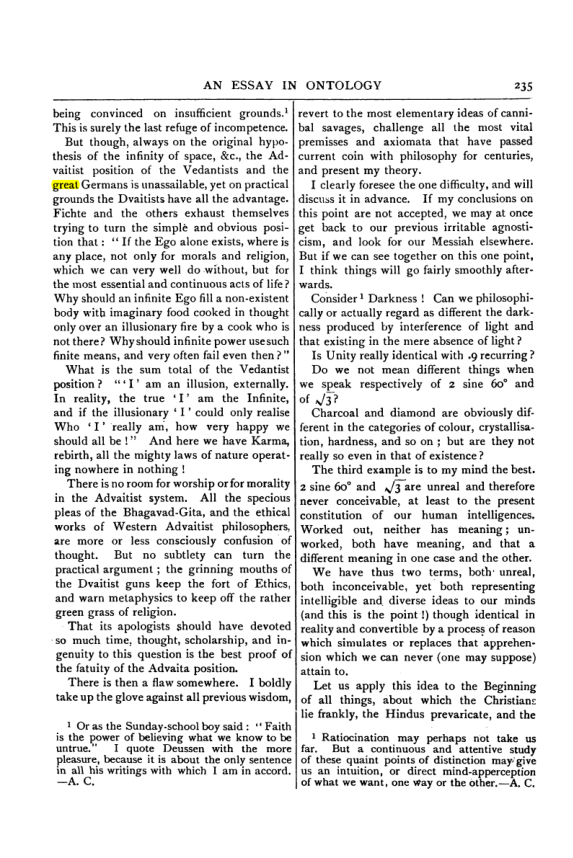
Highlights use the original PDF text layer. OCR-only matches may not be visible on the scan.
Transcription
Download text ↓raw extractionoriginal embedded textReview: unreviewed
AN
ESSAY IN ONTOLOGY 235
being convinced on insufficient grounds.’
This is surely the last refuge of incompetence.
But though, always on the original hypo-
thesis of the infinity of space, &c., the Ad-
vaitist position of the Vedantists and the
great Germans is unassailable, yet on practical
grounds the Dvaitists have all the advantage.
Fichte and the others exhaust themselves
trying to turn the simplé and obvious posi-
tion that: ‘‘ If the Ego alone exists, where is
any place, not only for morals and religion,
which we can very well do without, but for
the most essential and continuous acts of life?
Why should an infinite Ego fill a non-existent
body with imaginary food cooked in thought
only over an illusionary fire by a cook who is
not there? Whyshould infinite power usesuch
finite means, and very often fail even then?”
What is the sum total of the Vedantist
position? ‘‘I’ am an illusion, externally.
In reality, the true ‘I’ am the Infinite,
and if the illusionary ‘1’ could only realise
Who ‘I’ really am, how very happy we
should all be!’ And here we have Karma,
rebirth, all the mighty laws of nature operat-
ing nowhere in nothing !
There is no room for worship or for morality
in the Advaitist system. All the specious
pleas of the Bhagavad-Gita, and the ethical
works of Western Advaitist philosophers,
are more or less consciously confusion of
thought. But no subtlety can turn the
practical argument; the grinning mouths of
the Dvaitist guns keep the fort of Ethics,
and warn metaphysics to keep off the rather
green grass of religion.
-That its apologists should have devoted
-so much time, thought, scholarship, and in-
genuity to this question is the best proof of
the fatuity of the Advaita position.
There is then a flaw somewhere. I boldly
take up the glove against all previous wisdom,
1 Or as the Sunday-school boy said: ‘‘ Faith
is the power of believing what we know to be
untrue.’’ I quote Deussen with the more
pleasure, because it is about the only sentence
In all his writings with which I am in accord.
revert to the most elementary ideas of canni-
bal savages, challenge all the most vital
premisses and axiomata that have passed
current coin with philosophy for centuries,
and present my theory.
I clearly foresee the one difficulty, and will
discuss it in advance. If my conclusions on
this point are not accepted, we may at once
get back to our previous irritable agnosti-
cism, and look for our Messiah elsewhere.
But if we can see together on this one point,
I think things will go fairly smoothly after-
wards.
Consider! Darkness !_ Can we philosophi-
cally or actually regard as different the dark-
ness produced by interference of light and
that existing in the mere absence of light?
Is Unity really identical with .9 recurring?
Do we not mean different things when
we speak respectively of 2 sine 60° and
of 4/3?
Charcoal and diamond are obviously dif-
ferent in the categories of colour, crystallisa-
tion, hardness, and so on ; but are they not
really so even in that of existence?
The third example is to my mind the best.
2 sine 60° and ,/3are unreal and therefore
never conceivable, at least to the present
constitution of our human_ intelligences.
Worked out, neither has meaning; un-
worked, both have meaning, and that a
different meaning in one case and the other.
We have thus two terms, both: unreal,
both inconceivable, yet both representing
intelligible and diverse ideas to our minds
(and this is the point!) though identical in
reality and convertible by a process
of reason
which simulates or replaces that apprehen-
sion which we can never (one may suppose)
attain to. ,
Let us apply this idea to the Beginning
of all things, about which the Christians
lie frankly, the Hindus prevaricate, and the
1 Ratiocination may perhaps not take us
far. But a continuous and attentive study
of these quaint points of distinction may’ give
us an intuition, or direct mind-apperception
of what we want, one way or the other.—A. C.
Page provenance & review flags
Stable page ID: 59a930c2e614ddb0b1a2a000:p00241
Line breaks are preserved. Reading order and OCR accuracy may need review.
Printed page label has not been verified.
- No automated review flags. This does not establish transcription accuracy.