1906 · CLOSE READING
Collected Works (Vol. II)
Collected Works (Vol. II) (1906), PDF p. 239
Original page
Enlarge ↗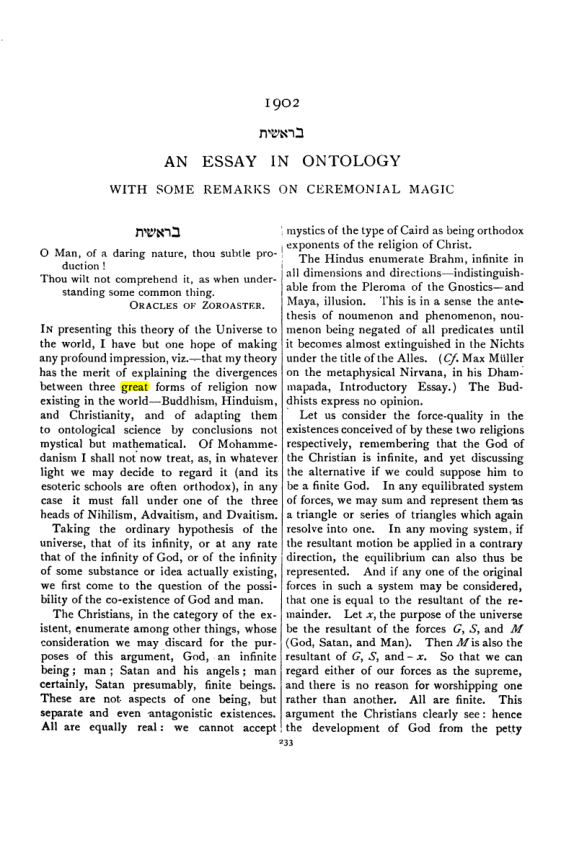
Highlights use the original PDF text layer. OCR-only matches may not be visible on the scan.
Transcription
Download text ↓raw extractionoriginal embedded textReview: unreviewed
1902
mvs
AN
WITH
nye
O Man, of a daring nature, thou subtle pro- |
duction !
Thou wilt not comprehend it, as when under-
standing some common thing.
ORACLES OF ZOROASTER.
IN presenting this theory of the Universe to
the world, I have but one hope of making
any profound impression, viz.—that my theory
has the merit of explaining the divergences
between three great forms of religion now
existing in the world—Buddhism, Hinduism,
and Christianity, and of adapting them
to ontological science by conclusions not
mystical but mathematical. Of Mohamme-
danism I shall not now treat, as, in whatever.
light we may decide to regard it (and its
esoteric schools are often orthodox), in any
case it must fall under one of the three
heads of Nihilism, Advaitism, and Dvaitism.
Taking the ordinary hypothesis of the
universe, that of its infinity, or at any rate
that of the infinity of God, or of the infinity
of some substance or idea actually existing,
we first come to the question of the possi-
bility of the co-existence of God and man.
The Christians, in the category of the ex-
istent, enumerate among other things, whose
consideration we may discard for the pur-
poses of this argument, God, .an_ infinite
being; man; Satan and his angels; man
certainly, Satan presumably, finite beings.
These are not. aspects of one being, but
separate and even antagonistic existences.
ESSAY IN
SOME REMARKS ON CEREMONIAL MAGIC
All are equally real: we cannot accept
ONTOLOGY
mystics of the type of Caird as being orthodox
exponents of the religion of Christ.
The Hindus enumerate Brahm, infinite in
all dimensions and directions—indistinguish-
able from the Pleroma of the Gnostics— and
Maya, illusion. ‘This is in a sense the antes
thesis of noumenon and phenomenon, nou-
menon being negated of all predicates until
it becomes almost extinguished in the Nichts
under the title of the Alles. (Cf Max Miiller
on the metaphysical Nirvana, in his Dham-
mapada, Introductory Essay.) The Bud-
dhists express no opinion.
- Let us consider the force-quality in the
existences conceived of by these two religions
respectively, remembering that the God of
the Christian is infinite, and yet discussing
the alternative if we could suppose him to
be a finite God. In any equilibrated system
of forces, we may sum and represent them as
a triangle or series of triangles which again
resolve into one. In any moving system, if
the resultant motion be applied in a contrary
direction, the equilibrium can also thus be
represented. And if any one of the original
forces in such a system may be considered,
that one is equal to the resultant of the re-
mainder. Let x, the purpose of the universe
be the resultant of the forces G, S, and JZ
(God, Satan, and Man). Then J7is also the
resultant of G, S, and- x. So that we can
regard either of our forces as the supreme,
and there is no reason for worshipping one
rather than another. All are finite. This
argument the Christians clearly see: hence
the development of God from the petty
233
Page provenance & review flags
Stable page ID: 59a930c2e614ddb0b1a2a000:p00239
Line breaks are preserved. Reading order and OCR accuracy may need review.
Printed page label has not been verified.
- No automated review flags. This does not establish transcription accuracy.