1906 · CLOSE READING
Collected Works (Vol. II)
Collected Works (Vol. II) (1906), PDF p. 228
Original page
Enlarge ↗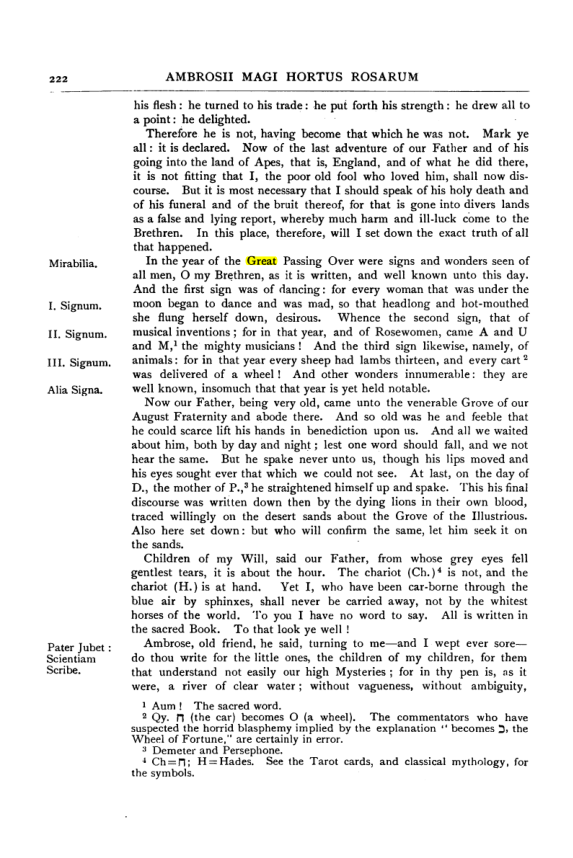
Highlights use the original PDF text layer. OCR-only matches may not be visible on the scan.
Transcription
Download text ↓raw extractionoriginal embedded textReview: unreviewed
222
AMBROSIT MAGI HORTUS ROSARUM
Mirabilia.
I, Signum.
IT. Signum.
III. Signum.
Alia Signa,
Pater Jubet :
Scientiam
Scribe.
his flesh: he turned to his trade: he put forth his strength: he drew all to
a point: he delighted.
Therefore he is not, having become that which he was not. Mark ye
all: it is declared. Now of the last adventure of our Father and of his
going into the land of Apes, that is, England, and of what he did there,
it is not fitting that I, the poor old fool who loved him, shall now dis-
course. But it is most necessary that I should speak of his holy death and
of his funeral and of the bruit thereof, for that is gone into divers lands
as a false and lying report, whereby much harm and ill-luck come to the
Brethren. In this place, therefore, will I set down the exact truth of all
that happened.
In the year of the Great Passing Over were signs and wonders seen of
all men, O my Brethren, as it is written, and well known unto this day.
And the first sign was of dancing: for every woman that was under the
moon began to dance and was mad, so that headlong and hot-mouthed
she flung herself down, desirous. Whence the second sign, that of
musical inventions; for in that year, and of Rosewomen, came A and U
and M,' the mighty musicians! And the third sign likewise, namely, of
animals: for in that year every sheep had lambs thirteen, and every cart ”
was delivered of a wheel! And other wonders innumerable: they are
well known, insomuch that that year is yet held notable.
Now our Father, being very old, came unto the venerable Grove of our
August Fraternity and abode there. And so old was he and feeble that
he could scarce lift his hands in benediction upon us. And all we waited
about him, both by day and night ; lest one word should fall, and we not
hear the same. But he spake never unto us, though his lips moved and
his eyes sought ever that which we could not see. At last, on the day of
D., the mother of P.,? he straightened himself up and spake. This his final
discourse was written down then by the dying lions in their own blood,
traced willingly on the desert sands about the Grove of the Tlustrious.
Also here set down: but who will confirm the same, let him seek it on
the sands.
Children of my Will, said our Father, from whose grey eyes fell
gentlest tears, it is about the hour. The chariot (Ch.)* is not, and the
chariot (H.) is at hand. Yet I, who have been car-borne through the
blue air by sphinxes, shall never be carried away, not by the whitest
horses of the world. ‘To you I have no word to say. All is written in
the sacred Book. To that look ye well !
Ambrose, old friend, he said, turning to me—and I wept ever sore—
do thou write for the little ones, the children of my children, for them
that understand not easily our high Mysteries; for in thy pen is, as it
were, a river of clear water; without vagueness, without ambiguity,
1 Aum! The sacred word.
2 Oy. M (the car) becomes O (a wheel). The commentators who have
suspected the horrid blasphemy implied by the explanation ‘‘ becomes 35, the
Wheel of Fortune,” are certainly in error.
3 Demeter and Persephone.
4 Ch=Mm; H=Hades. See the Tarot cards, and classical mythology, for
the symbols. :
Page provenance & review flags
Stable page ID: 59a930c2e614ddb0b1a2a000:p00228
Line breaks are preserved. Reading order and OCR accuracy may need review.
Printed page label has not been verified.
- No automated review flags. This does not establish transcription accuracy.