1906 · CLOSE READING
Collected Works (Vol. II)
Collected Works (Vol. II) (1906), PDF p. 213
Original page
Enlarge ↗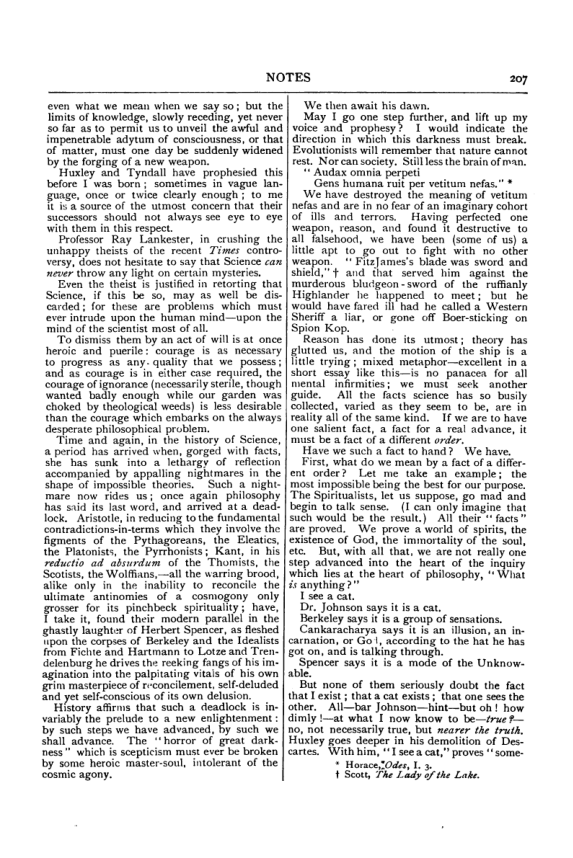
Highlights use the original PDF text layer. OCR-only matches may not be visible on the scan.
Transcription
Download text ↓raw extractionoriginal embedded textReview: unreviewed
NOTES
207
even what we mean when we say so; but the
limits of knowledge, slowly receding, yet never
so far as to permit us to unveil the awful and
impenetrable adytum of consciousness, or that
of matter, must one day be suddenly widened
by the forging of a new weapon.
Huxley and Tyndall have prophesied this
before 1 was born; sometimes in vague lan-
guage, once or twice clearly enough; to me
it is a source of the utmost concern that their
successors should not always see eye to eye
with them in this respect.
Professor Ray Lankester, in crushing the
unhappy theists of the recent Zzmes contro-
versy, does not hesitate to say that Science caz
never throw any light on certain mysteries.
Even the theist is justified in retorting that
Science, if this be so, may as well be dis-
carded; for these are problems which must
ever intrude upon the human mind—upon the
mind of the scientist most of all.
To dismiss them by an act of will is at once
heroic and puerile: courage is as necessary
to progress as any- quality that we possess;
and as courage is in either case required, the
courage of ignorance (necessarily sterile, though
wanted badly enough while our garden was
choked by theological weeds) is less desirable
than the courage which embarks on the always
desperate philosophical problem.
Time and again, in the history of Science,
a period has arrived when, gorged with facts,
she has sunk into a lethargy of reflection
accompanied by appalling nightmares in the
shape of impossible theories. Such a night-
mare now rides us; once again philosophy
has said its last word, and arrived ata dead-
lock. Aristotle, in reducing to the fundamental
contradictions-in-terms which they involve the
figments of the Pythagoreans, the Eleatics,
the Platonists, the Pyrrhonists; Kant, in his
reductio ad absurdum of the Thomists, the
Scotists, the Wolfians,—all the warring brood,
alike only in the inability to reconcile the
ultimate antinomies of a cosmogony only
grosser for its pinchbeck spirituality; have,
I take it, found their modern parallel in the
ghastly laughter of Herbert Spencer, as fleshed
upon the corpses of Berkeley and the Idealists
from Fichte and Hartmann to Lotze and Tren-
delenburg he drives the reeking fangs of his im-
agination into the palpitating vitais of his own
grim masterpiece of reconcilement, self-deluded
and yet self-conscious of its own delusion. _
History affirms that such a deadlock is in-
variably the prelude to a new enlightenment:
by such steps we have advanced, by such we
shall advance. The ‘‘horror of great dark-
ness’ which is scepticism must ever be broken
by some heroic master-soul, intolerant of the
cosmic agony.
We then await his dawn.
May I go one step further, and lift up my
voice and prophesy? I would indicate the
direction in which this darkness must break.
Evolutionists will remember that nature cannot
rest. Norcan society, Stillless the brain of man.
‘* Audax omnia perpeti
Gens humana ruit per vetitum nefas.” *
We have destroyed the meaning of vetitum |
nefas and are in no fear of an imaginary cohort
of ills and terrors. Having perfected one
weapon, reason, and found it destructive to
all falsehood, we have been (some of us) a
little apt to go out to fight with no other
weapon. ‘‘ FitzJames’s blade was sword and
shield,”+ and that served him against the
murderous bludgeon-sword of the ruffianly
Highlander he happened to meet; but he
would have fared ill had he called a Western
Sheriff a liar, or gone off Boer-sticking on
Spion Kop.
Reason has done its utmost; theory has
glutted us, and the motion of the ship is a
little trying; mixed metaphor—excellent ina
short essay like this—is no panacea for all
mental infirmities; we must seek another
guide. All the facts science has so busily
collected, varied as they seem to be, are in
reality all of the same kind. If we are to have
one salient fact, a fact for a real advance, it
must be a fact of a different order.
Have we such a fact to hand? We have.
First, what do we mean by a fact of a differ-
ent order? Let me take an example; the
most impossible being the best for our purpose.
The Spiritualists, let us suppose, go mad and
begin to talk sense. (I can only imagine that
such would be the result.) All their ‘‘ facts”
are proved. We prove a world of spirits, the
existence of God, the immortality of the soul,
etc. But, with all that, we are not really one
step advanced into the heart of the inquiry
which lies at the heart of philosophy, ‘‘ What
zs anything ?”’
I see a cat.
Dr. Johnson says it is a cat.
Berkeley says it is a group of sensations.
Cankaracharya says it is an illusion, an in-
carnation, or Gol, according to the hat he has
got on, and is talking through.
Spencer says it is a mode of the Unknow-
able.
But none of them seriously doubt the fact
that I exist ; that a cat exists; that one sees the
other. All—bar Johnson—hint—but oh! how
dimly !—at what I now know to be—érue 2—
no, not necessarily true, but nearer the truth.
Huxley goes deeper in his demolition of Des-
cartes. With him, ‘‘I seea cat,” proves ‘‘some-
* Horace,:Odes, I. 3.
t Scott, The Lady of the Lake.
Page provenance & review flags
Stable page ID: 59a930c2e614ddb0b1a2a000:p00213
Line breaks are preserved. Reading order and OCR accuracy may need review.
Printed page label has not been verified.
- No automated review flags. This does not establish transcription accuracy.