1906 · CLOSE READING
Collected Works (Vol. II)
Collected Works (Vol. II) (1906), PDF p. 198
Original page
Enlarge ↗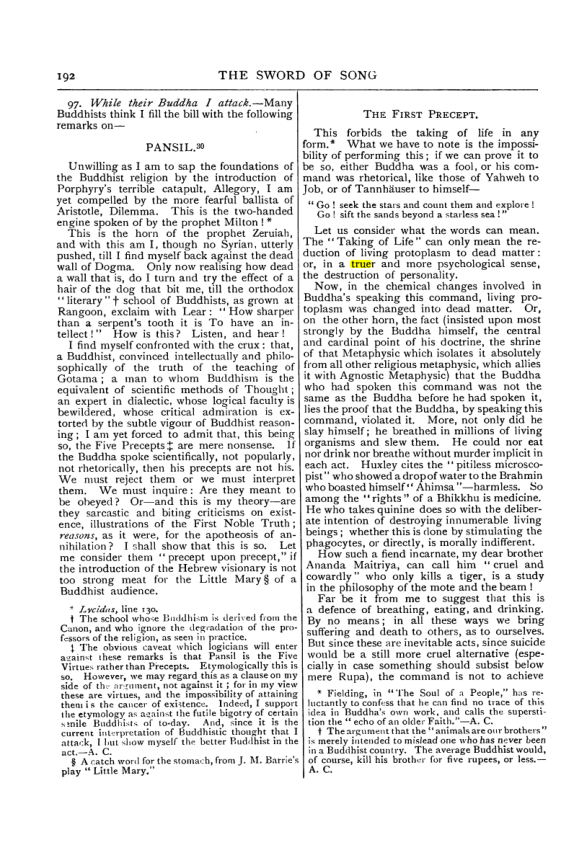
Highlights use the original PDF text layer. OCR-only matches may not be visible on the scan.
Transcription
Download text ↓raw extractionoriginal embedded textReview: unreviewed
192
THE SWORD OF SONG
97. While their Buddha I attack.—Many
Buddhists think I fill the bill with the following
remarks on—
PANSIL.?0
Unwilling as I am to sap the foundations of
the Buddhist religion by the introduction of
Porphyry’s terrible catapult, Allegory, I am
yet compelled by the more fearful ballista of
Aristotle, Dilemma. This is the two-handed
engine spoken of by the prophet Milton ! *
This is the horn of the prophet Zeruiah,
and with this am I, though no Syrian, utterly
pushed, till I find myself back against the dead
wall of Dogma. Only now realising how dead
a wall that is, do I turn and try the effect of a
hair of the dog that bit me, till the orthodox
‘‘literary+ school of Buddhists, as grown at
Rangoon, exclaim with Lear: ‘‘ How sharper
than a serpent’s tooth it is To have an in-
tellect!’’ How is this? Listen, and hear!
I find myself confronted with the crux: that,
a Buddhist, convinced intellectually and philo-
sophically of the truth of the teaching of
Gotama; a man to whom Buddhism is the
equivalent of scientific methods of Thought;
an expert in dialectic, whose logical faculty is
bewildered, whose critical admiration is ex-
torted by the subtle vigour of Buddhist reason-
ing; I am yet forced to admit that, this being
so, the Five Preceptst are mere nonsense. If
the Buddha spoke scientifically, not popularly,
not rhetorically, then his precepts are not his.
We must reject them or we must interpret
them. We must inquire: Are they meant to
be obeyed? Or—and this is my theory—are
they sarcastic and biting criticisms on exist-
ence, illustrations of the First Noble Truth;
reasons, as it were, for the apotheosis of an-
nihilation? I shall show that this is so. Let
me consider them ‘‘ precept upon precept,” if
the introduction of the Hebrew visionary is not
too strong meat for the Little Mary§ of a
Buddhist audience.
* Lycidas, line 130.
+ The school whose Buddhism is derived from the
Canon, and who ignore the degradation of the pro-
fessors of the religion, as seen in practice.
{ The obvious caveat which logicians will enter
against these remarks is that Pansil is the Five
Virtues rather than Precepts. Etymologically this is
so. However, we may regard this as a clause on my
side of the arzument, not against it ; for in my view
these are virtues, and the impossibility of attaining
themis the cancer of existence. Indeed, I support
the etymology as against the futile bigotry of certain
senile Buddhists of to-day. And, since it is the
current interpretation of Buddhistic thought that I
attack, I but show myself the better Buddhist in the
act.—A. C.
§ A catch word for the stomach, from J. M. Barrie's
play ‘‘ Little Mary.”
THE FIRST PRECEPT.
This forbids the taking of life in any
form.* What we have to note is the impossi-
bility of performing this; if we can prove it to
be so, either Buddha was a fool, or his com-
mand was rhetorical, like those of Yahweh to
Job, or of Tannhauser to himself—
“Go! seek the stars and count them and explore!
Go! sift the sands beyond a starless sea!”
Let us consider what the words can mean.
The ‘‘ Taking of Life’’ can only mean the re-
duction of living protoplasm to dead matter:
or, in a truer and more psychological sense,
the destruction of personality.
Now, in the chemical changes involved in
Buddha's speaking this command, living pro-
toplasm was changed into dead matter. Or,
on the other horn, the fact (insisted upon most
strongly by the Buddha himself, the central
and cardinal point of his doctrine, the shrine
of that Metaphysic which isolates it absolutely
from all other religious metaphysic, which allies
it with Agnostic Metaphysic) that the Buddha
who had spoken this command was not the
same as the Buddha before he had spoken it,
lies the proof that the Buddha, by speaking this
command, violated it. More, not only did he
slay himself; he breathed in millions of living
organisms and slew them. He could nor eat
nor drink nor breathe without murder implicit in
each act. Huxley cites the ‘‘ pitiless microsco-
pist’’ who showed a dropof water to the Brahmin
who boasted himself ‘‘ Ahimsa ’’—harmless. So
among the ‘‘rights” of a Bhikkhu is medicine.
He who takes quinine does so with the deliber-
ate intention of destroying innumerable living
beings; whether this is done by stimulating the
phagocytes, or directly, is morally indifferent.
How such a fiend incarnate, my dear brother
Ananda Maitriya, can call him ‘cruel and
cowardly” who only kills a tiger, is a study
in the philosophy of the mote and the beam !
Far be it from me to suggest that this is
a defence of breathing, eating, and drinking.
By no means; in all these ways we bring
suffering and death to others, as to ourselves.
But since these are inevitable acts, since suicide
would be a still more cruel alternative (espe-
cially in case something should subsist below
mere Rupa), the command is not to achieve
* Fielding, in ‘‘he Soul of a People,” has re-
Juctantly to confess that he can find no trace of this
idea in Buddha’s own work, and calls the supersti-
tion the ‘* echo of an older Faith.”—A. C.
+ Theargument that the ‘‘ animals are our brothers”
is merely intended to mislead one who has never been
ina Buddhist country. The average Buddhist would,
of course, kill his brother for five rupees, or less.—
C.
Page provenance & review flags
Stable page ID: 59a930c2e614ddb0b1a2a000:p00198
Line breaks are preserved. Reading order and OCR accuracy may need review.
Printed page label has not been verified.
- No automated review flags. This does not establish transcription accuracy.