1906 · CLOSE READING
Collected Works (Vol. II)
Collected Works (Vol. II) (1906), PDF p. 149
Original page
Enlarge ↗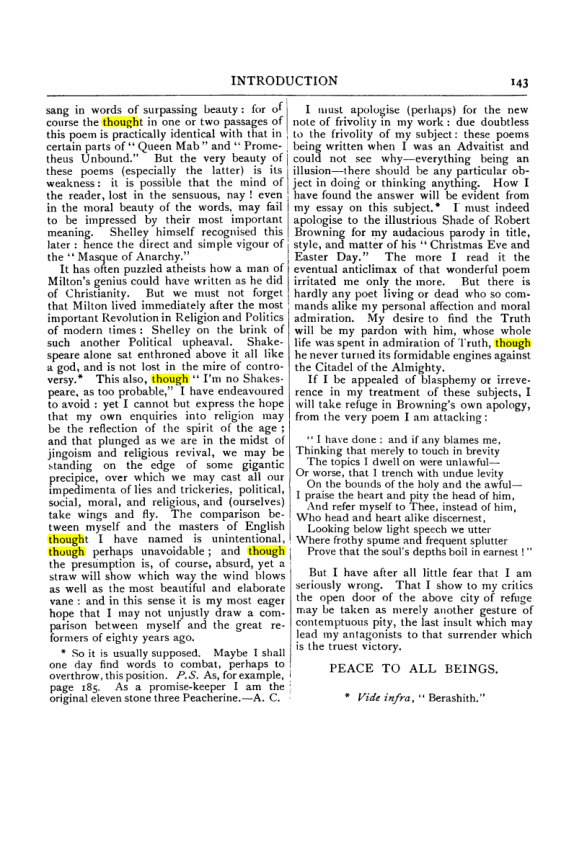
Highlights use the original PDF text layer. OCR-only matches may not be visible on the scan.
Transcription
Download text ↓raw extractionoriginal embedded textReview: unreviewed
INTRODUCTION
143
sang in words of surpassing beauty: for of
course the thought in one or two passages of
this poem is practically identical with that in
certain parts of ‘‘ Queen Mab” and ‘‘ Prome-
theus Unbound.” But the very beauty of
these poems (especially the latter) is its
weakness: it is possible that the mind of
the reader, lost in the sensuous, nay! even
in the moral beauty of the words, may fail
to be impressed by their most important
meaning. Sheiley himself recognised this
later : hence the direct and simple vigour of
the ‘‘ Masque of Anarchy.”
It has often puzzled atheists how a man of
Milton’s genius could have written as he did
of Christianity. But we must not forget
that Milton lived immediately after the most
important Revolution in Religion and Politics
of modern times: Shelley on the brink of
such another Political upheaval. Shake-
speare alone sat enthroned above it all like
a god, and is not lost in the mire of contro-
versy.* This also, though ‘ I’m no Shakes-
peare, as too probable,” I have endeavoured
to avoid : yet I cannot but express the hope
that my own enquiries into religion may
be the reflection of the spirit of the age;
and that plunged as we are in the midst of
jingoism and religious revival, we may be
standing on the edge of some gigantic
precipice, over which we may cast all our
impedimenta of lies and trickeries, political,
social, moral, and religious, and (ourselves)
take wings and fly. The comparison be-
tween myself and the masters of English
thought I have named is unintentional,
though perhaps unavoidable; and though
the presumption is, of course, absurd, yet a
straw will show which way the wind blows
as well as the most beautiful and elaborate
vane : and in this sense it is my most eager
hope that I may not unjustly draw a com-
parison between myself and the great re-
formers of eighty years ago.
* So it is usually supposed. Maybe I shall
one day find words to combat, perhaps to
overthrow, this position. P.S. As, forexample,
page 186.
original eleven stone three Peacherine.—A. C.
As a promise-keeper I am the }
I must apologise (perhaps) for the new
note of frivolity in my work: due doubtless
to the frivolity of my subject: these poems
being written when I was an Advaitist and
could not see why—everything being an
illusion—there should be any particular ob-
ject in doing or thinking anything. How I
have found the answer will be evident from
my essay on this subject.* I must indeed
apologise to the illustrious Shade of Robert
Browning for my audacious parody in title,
style, and matter of his ‘‘ Christmas Eve and
Easter Day.” The more I read it the
eventual anticlimax of that wonderful poem
irritated me only the more. But there is
hardly any poet living or dead who so com-
mands alike my personal affection and moral
admiration. My desire to find the Truth
will be my pardon with him, whose whole
life was spent in admiration of Truth, though
he never turned its formidable engines against
the Citadel of the Almighty.
If I be appealed of blasphemy or irreve-
rence in my treatment of these subjects,I
will take refuge in Browning’s own apology,
from the very poem I am attacking:
‘‘T have done: and if any blames me,
Thinking that merely to touch in brevity
The topics I dwell on were unlawful—
Or worse, that I trench with undue levity
On the bounds of the holy and the awful—
I praise the heart and pity the head of him,
And refer myself to Thee, instead of him,
Who head and heart alike discernest,
Looking below light speech we utter
Where frothy spume and frequent splutter
Prove that the soul’s depths boil in earnest !”’
But.I have after all little fear that I am
seriously wrong. That I show to my critics
the open door of the above city of refuge
may be taken as merely another gesture of
contemptuous pity, the last insult which may
lead my antagonists to that surrender which
is the truest victory.
PEACE TO ALL BEINGS.
* Vide infra, ‘‘ Berashith.”’
Page provenance & review flags
Stable page ID: 59a930c2e614ddb0b1a2a000:p00149
Line breaks are preserved. Reading order and OCR accuracy may need review.
Printed page label has not been verified.
- No automated review flags. This does not establish transcription accuracy.