1928 · CLOSE READING
Little Poems in Prose
Little Poems in Prose (1928), PDF p. 114
Original page
Enlarge ↗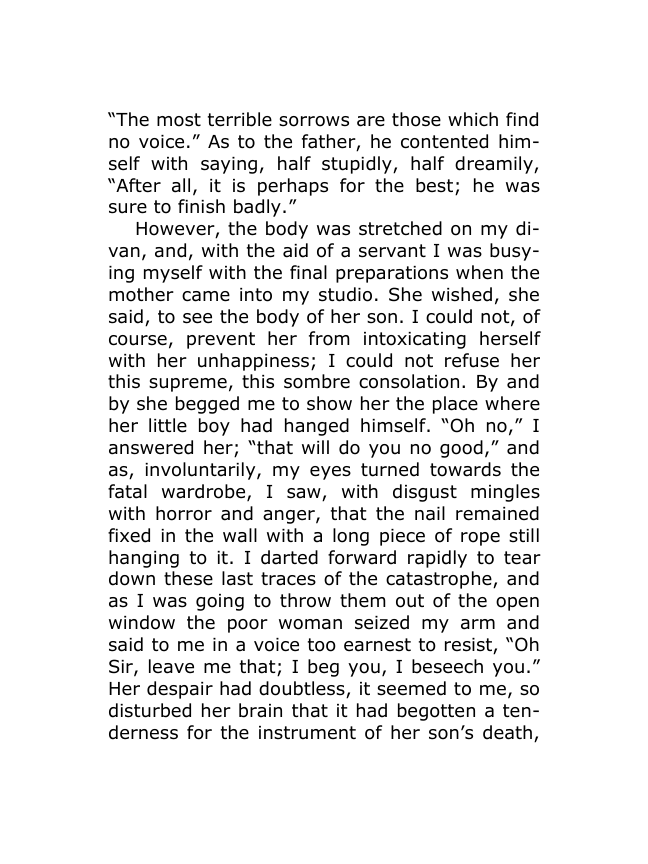
Highlights use the original PDF text layer. OCR-only matches may not be visible on the scan.
Transcription
Download text ↓raw extractionoriginal embedded textReview: unreviewed
The most terrible sorrows are those which find
no voice. As to the father, he contented him-
self with saying, half stupidly, half dreamily,
After all, it is perhaps for the best; he was
sure to finish badly.
However, the body was stretched on my di-
van, and, with the aid of a servant I was busy-
ing myself with the final preparations when the
mother came into my studio. She wished, she
said, to see the body of her son. I could not, of
course, prevent her from intoxicating herself
with her unhappiness; I could not refuse her
this supreme, this sombre consolation. By and
by she begged me to show her the place where
her little boy had hanged himself. Oh no, I
answered her; that will do you no good, and
as, involuntarily, my eyes turned towards the
fatal wardrobe, I saw, with disgust mingles
with horror and anger, that the nail remained
fixed in the wall with a long piece of rope still
hanging to it. I darted forward rapidly to tear
down these last traces of the catastrophe, and
as I was going to throw them out of the open
window the poor woman seized my arm and
said to me in a voice too earnest to resist, Oh
Sir, leave me that; I beg you, I beseech you.
Her despair had doubtless, it seemed to me, so
disturbed her brain that it had begotten a ten-
derness for the instrument of her sons death,
Page provenance & review flags
Stable page ID: 48e75a91539cdde5b461dba1:p00114
Line breaks are preserved. Reading order and OCR accuracy may need review.
Printed page label has not been verified.
- No automated review flags. This does not establish transcription accuracy.