1899 · CLOSE READING
Jephthah and Other Mysteries
Jephthah and Other Mysteries (1899), PDF p. 252
Original page
Enlarge ↗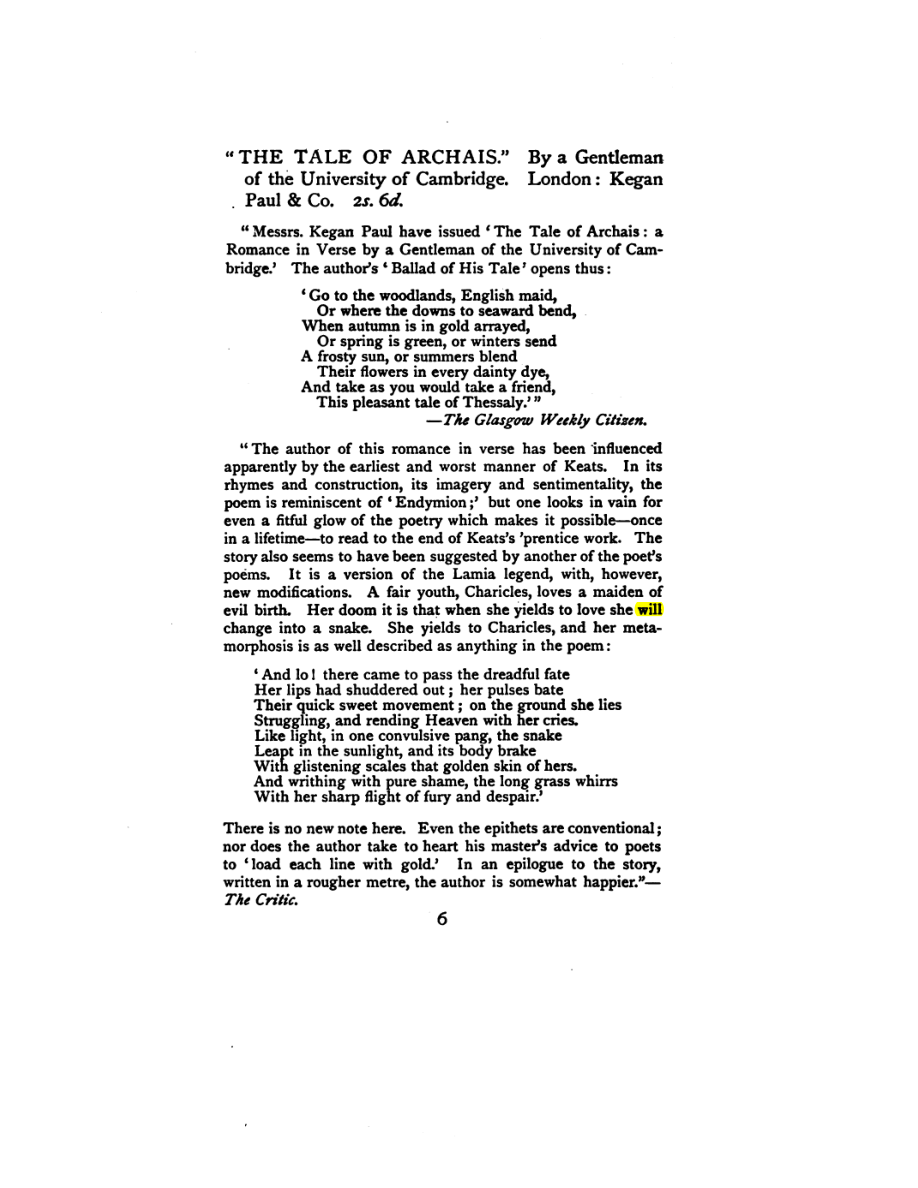
Highlights use the original PDF text layer. OCR-only matches may not be visible on the scan.
Transcription
Download text ↓raw extractionoriginal embedded textReview: unreviewed
“THE TALE OF ARCHAIS.” By a Gentleman
of the University of Cambridge. London: Kegan
. Paul & Co. 2s. 6d.
‘Messrs. Kegan Paul have issued ‘ The Tale of Archais: a
Romance in Verse by a Gentleman of the University of Cam-
bridge.’ The author's ‘ Ballad of His Tale’ opens thus:
‘Go to the woodlands, English maid,
Or where the downs to seaward bend, .
When autumn is in gold arrayed,
Or spring is green, or winters send
A frosty sun, or summers blend
Their flowers in every dainty dye,
And take as you would take a friend,
This pleasant tale of Thessaly.’ ”
—The Glasgow Weekly Citizen.
‘‘The author of this romance in verse has been ‘influenced
apparently by the earliest and worst manner of Keats. In its
rhymes and construction, its imagery and sentimentality, the
poem is reminiscent of ‘Endymion;’ but one looks in vain for
even a fitful glow of the poetry which makes it possible—once
in a lifetime—to read to the end of Keats’s ’prentice work. The
story also seems to have been suggested by another of the poet’s
poéms. It is a version of the Lamia legend, with, however,
new modifications. A fair youth, Charicles, loves a maiden of
evil birth. Her doom it is that when she yields to love she will
change into a snake. She yields to Charicles, and her meta-
morphosis is as well described as anything in the poem:
‘And lo! there came to pass the dreadful fate
Her lips had shuddered out ; her pulses bate
Their quick sweet movement ; on the ground she lies
Struggling, and rending Heaven with her cries.
Like light, in one convulsive pang, the snake
Leapt in the sunlight, and its body brake
With glistening scales that golden skin of hers.
And writhing with pure shame, the long grass whirrs
With her sharp flight of fury and despair.’
There is no new note here. Even the epithets are conventional ;
nor does the author take to heart his master’s advice to poets
to ‘load each line with gold. In an epilogue to the story,
written in a rougher metre, the author is somewhat happier.”—
The Critic.
6
Page provenance & review flags
Stable page ID: 43d1fabda8a3193c0170817c:p00252
Line breaks are preserved. Reading order and OCR accuracy may need review.
Printed page label has not been verified.
- No automated review flags. This does not establish transcription accuracy.