1912 · CLOSE READING
The Equinox (Volume I, Number VII)
The Equinox (Volume I, Number VII) (1912), PDF p. 432
Original page
Enlarge ↗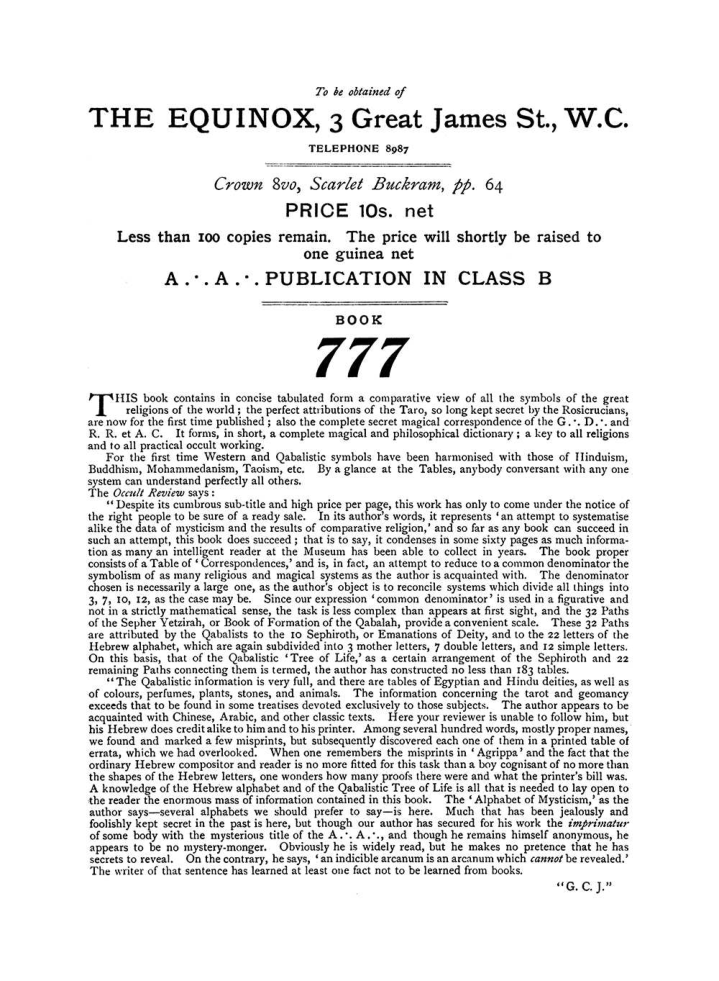
Highlights use the original PDF text layer. OCR-only matches may not be visible on the scan.
Transcription
Download text ↓raw extractionoriginal embedded textReview: unreviewed
Crown 8vo, Scarlet Buckram, pp. 64
PRICE 10s. net
Less than 100 copies remain. The price will shortly be raised to
one guinea net
A.*.A.*.PUBLICATION IN CLASS B
HIS book contains in concise tabulated form a comparative view of all the symbols of the great
religions of the world ; the perfect attributions of the Taro, so long kept secret by the Rosicrucians,
are now for the first time published ; also the complete secret magical correspondence of the G.*. D.*. and
R. R.et A. C. It forms, in short, a complete magical and philosophical dictionary; a key to all religions
and to all practical occult working.
For the first time Western and Qabalistic symbols have been harmonised with those of Iinduism,
Buddhism, Mohammedanism, Taoism, etc. By a glance at the Tables, anybody conversant with any one
system can understand perfectly all others.
The Occult Review says:
“Despite its cumbrous sub-title and high price per page, this work has only to come under the notice of
the right people to be sure of a ready sale. In its author’s words, it represents ‘an attempt to systematise
alike the data of mysticism and the results of comparative religion,’ and so far as any book can succeed in
such an attempt, this book does succeed; that is to say, it condenses in some sixty pages as much informa-
tion as many an intelligent reader at the Museum has been able to collect in years. The book proper
consists of a Table of ‘ Correspondences,’ and is, in fact, an attempt to reduce toa common denominator the
symbolism of as many religious and magical systems as the author is acquainted with. The denominator
chosen is necessarily a large one, as the author's object is to reconcile systems which divide all things into
3, 7, 10, 12, as the case may be.” Since our expression ‘common denominator’ is used in a figurative and
not in a’strictly mathematical sense, the task is less complex than appears at first sight, and the 32 Paths
of the Sepher Yetzirah, or Book of Formation of the Qabalah, provide
a convenient scale. These 32 Paths
are attributed by the Qabalists to the 10 Sephiroth, or Emanations of Deity, and to the 22 letters of the
Hebrew alphabet, which are again subdivided into 3 mother letters, 7 double letters, and 12 simple letters.
On this basis, that of the Qabalistic ‘Tree of Life,’ as a certain’ arrangement of the Sephiroth and 22
remaining Paths connecting them is termed, the author has constructed no less than 183 tables.
“The Qabalistic information is very full, and there are tables of Egyptian and Hindu deities, as well as
of colours, perfumes, plants, stones, and animals. The information concerning the tarot and’geomancy
exceeds that to be found in some treatises devoted exclusively to those subjects. The author appears to be
acquainted with Chinese, Arabic, and other classic texts. Here your reviewer is unable to follow him, but
his Hebrew does credit alike to him and to his printer. Among several hundred words, mostly proper names,
we found and marked a few misprints, but subsequently discovered each one of them in a printed table of
errata, which we had overlooked. When one remembers the misprints in ‘ Agrippa’ and the fact that the
ordinary Hebrew compositor and reader is no more fitted for this task than a boy cognisant of no more than
the shapes of the Hebrew letters, one wonders how many proofs there were and what the printer's bill was.
A knowledge of the Hebrew alphabet and of the Qabalistic Tree of Life is all that is needed to lay open to.
the reader the enormous mass ofinformation contained in this book. ‘The * Alphabet of Mysticism,” as the
author says—several alphabets we should prefer to say—is here. Much that has been jealously and
foolishly kept secret in the past is here, but though our author has secured for his work the imprimatur
of some body with the mysterious title of the A.*. A.*., and though he remains himself anonymous, he
appears to be no mystery-monger. Obviously he is widely read, but he makes no pretence that he has
secrets to reveal. On the contrary, he says, ‘an indicible arcanum is an arcanum which cannot be revealed.’
The writer of that sentence has learned at least one fact not to be learned from books.
“GO”
Page provenance & review flags
Stable page ID: 3bba57e669301798b23a2fc8:p00432
Line breaks are preserved. Reading order and OCR accuracy may need review.
Printed page label has not been verified.
- No automated review flags. This does not establish transcription accuracy.