1911 · CLOSE READING
The Equinox (Volume I, Number VI)
The Equinox (Volume I, Number VI) (1911), PDF p. 304
Original page
Enlarge ↗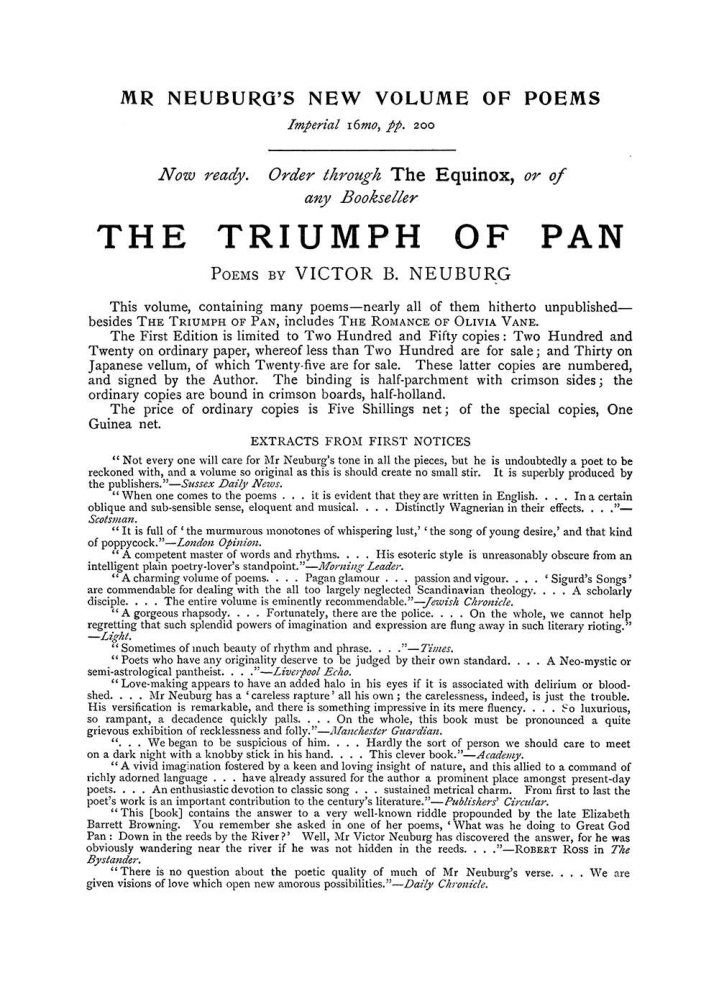
Highlights use the original PDF text layer. OCR-only matches may not be visible on the scan.
Transcription
Download text ↓raw extractionoriginal embedded textReview: unreviewed
MR NEUBURG’S NEW VOLUME OF POEMS
Imperial 16mo, pp. 200
Now ready. Order through The Equinox, or of
any Bookseller
THE TRIUMPH OF PAN
Porms sy VICTOR B. NEUBURG
This volume, containing many poems—nearly all of them hitherto unpublished—
besides Tur TRIUMPH OF Pan, includes THE RomaNcE oF OLIvIA VANE.
The First Edition is limited to Two Hundred and Fifty copies: Two Hundred and
Twenty on ordinary paper, whereof less than Two Hundred are for sale; and Thirty on
Japanese vellum, of which Twenty-five are for sale. These latter copies are numbered,
and signed by the Author. The binding is half-parchment with crimson sides; the
ordinary copies are bound in crimson boards, half-holland.
The price of ordinary copies is Five Shillings net; of the special copies, One
Guinea net.
EXTRACTS FROM FIRST NOTICES
“Not every one will care for Mr Neuburg’s tone in all the pieces, but he is undoubtedly a poet to be
reckoned with, and a volume so original as this is should create no small stir. It is superbly produced by
the publishers.” —Sussex Daily News.
“When one comes to the poems. . . it is evident that they are written in English. . . . Ina certain
oblique and sub-sensible sense, eloquent and musical. . . . Distinctly Wagnerian in their effects... —
Scotsman.
“Tt is full of ‘the murmurous monotones of whispering lust,’ ‘ the song of young desire,’ and that kind
of poppycock.”—London Opinion.
“A competent master of words and rhythms. . . .. His esoteric style i unreasonably obscure from an
intelligent plain poetry-lover’s standpoint.” —Morning Leader.
«A charming volume
of poems. . . . Pagan glamour . . . passion and vigour. . . . ¢ Sigurd’s Songs?
are commendable for dealing with the all too largely neglected Scandinavian theology...
- 4A scholarly
disciple. . . . The entire volume is eminently recommendable.” —Jewish Chronicle.
“A gorgeous rhapsody. Fortunately, there are the polige. . .. On the whole, we cannot help
regretting that such splendid powers of imagination and expression are flung away in such literary rioting.”
—Light.
"Sometimes of much beauty of rhythm and phrase. . . .”—Times.
“Poets who have any originality deserve to be judged by their own standard. . . . A Neo-mystic or
semi-astrological pantheist. . . .”—Liverpool Echo.
“Love-making appears to have an added halo in his eyes if it is associated with delirium or blood-
shed. . . . Mr Neuburg hasa ‘careless rapture’ all his own; the carelessness, indeed, is just the trouble.
His versification is remarkable, and there is something impressive in its mere fluency. . . . £0 luxurious,
so rampant, a decadence quickly pals... . On the whole, this book must be pronounced a quite
grievous exhibition of recklessness and folly” —Alanchester Guardian,
“... We began to be suspicious of him. . . . Hardly the sort of person we should care to meet
ona dark night with
a knobby stick in his hand. . . . This clever book.” —Academy.
“A vivid imagination fostered by a keen and loving insight of nature, and this allied to a command of
richly adorned language . . . have already assured for the author a prominent place amongst present-day
poets. . . . Anenthusiastic devotion to classic song . . . sustained metrical charm. From first to last the
poet’s work is an important contribution to the century's literature.”
— Publishers’ Circular.
“This [book] contains the answer to a very well-known riddle propounded by the late Elizabeth
Barrett Browning. You remember she asked in one of her poems, ‘What was he doing to Great God
Pan: Down in the reeds by the River?” Well, Mr Victor Neuburg has discovered the answer, for he was
obviously wandering near the river if he was not hidden in the reeds. . . .”—Rowert Ross in The
Bystander.
“There is no question about the poetic quality of much of Mr Neuburg’s verse... . We are
given visions of love which open new amorous possibilities.” —Darly Chronicle.
Page provenance & review flags
Stable page ID: 3550a28bd117193eda5934bc:p00304
Line breaks are preserved. Reading order and OCR accuracy may need review.
Printed page label has not been verified.
- No automated review flags. This does not establish transcription accuracy.