1907 · CLOSE READING
Collected Works (Vol. III)
Collected Works (Vol. III) (1907), PDF p. 7
Original page
Enlarge ↗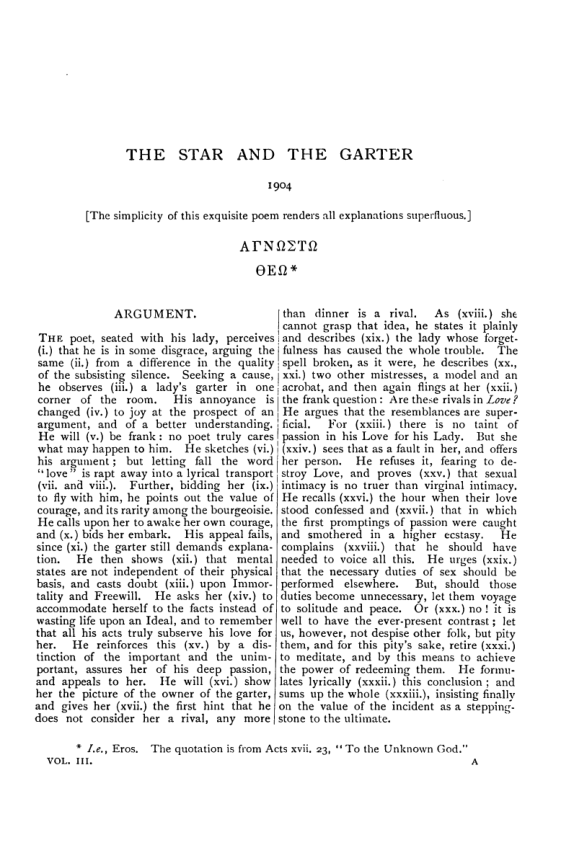
Highlights use the original PDF text layer. OCR-only matches may not be visible on the scan.
Transcription
Download text ↓raw extractionoriginal embedded textReview: unreviewed
THE STAR AND THE GARTER
1904
[The simplicity of this exquisite poem renders all explanations superfluous.|
ATNOQ2ZTQ
OED*
ARGUMENT.
THE poet, seated with his lady, perceives
(i.) that he is in some disgrace, arguing the
same (i.) from a difference in the quality
of the subsisting silence. Seeking a cause,
he observes (iii) a lady’s garter in one
corner of the room. His annoyance is
changed (iv.) to joy at the prospect of an
argument, and of a better understanding.
He will (v.) be frank: no poet truly cares
what may happen to him. He sketches (vi.)
his argument; but letting fall the word
“love” is rapt away into a lyrical transport
(vii. and viii.) Further, bidding her (ix.)
to fly with him, he points out the value of
courage, and its rarity among the bourgeoisie.
He calls upon her to awake her own courage,
and (x.) bids her embark. His appeal fails,
since (xi.) the garter still demands explana-
tion. He then shows (xii.) that mental
states are not independent of their physical
basis, and casts doubt (xiii.) upon Immor-
tality and Freewill. He asks her (xiv.) to
accommodate herself to the facts instead of
wasting life upon an Ideal, and to remember
that all his acts truly subserve his love for
her. He reinforces this (xv.) by a dis-
tinction of the important and the unim-
portant, assures her of his deep passion,
and appeals to her. He will (xvi.) show
her the picture of the owner of the garter,
and gives her (xvii.) the first hint that he
does not consider her a rival, any more
* J.e., Eros.
VOL. III.
than dinner is a rival. As (xviii.) she
cannot grasp that idea, he states it plainly
and describes (xix.) the lady whose forget-
fulness has caused the whole trouble. The
spell broken, as it were, he describes (xx.,
xxl.) two other mistresses, a model and an
acrobat, and then again flings at her (xxii.)
the frank question: Are these rivals in Love ?
He argues that the resemblances are super-
ficial. For (xxiii.) there is no taint of
passion in his Love for his Lady. But she
(xxiv.) sees that as a fault in her, and offers
her person. He refuses it, fearing to de-
stroy Love, and proves (xxv.) that sexual
intimacy is no truer than virginal intimacy.
He recalls (xxvi.) the hour when their love
stood confessed and (xxvil.) that in which
the first promptings of passion were caught
and smothered in a higher ecstasy. He
complains (xxvill.) that he should have
needed to voice all this, He urges (xxix.)
that the necessary duties of sex should be
performed elsewhere. But, should those
duties become unnecessary, let them voyage
to solitude and peace. Or (xxx.) no! it is
well to have the ever-present contrast; let
us, however, not despise other folk, but pity
them, and for this pity’s sake, retire (xxxi.)
to meditate, and by this means to achieve
the power of redeeming them. He formu-
lates lyrically (xxxii.) this conclusion; and
sums up the whole (xxxili.), insisting finally
on the value of the incident as a stepping-
stone to the ultimate.
The quotation is from Acts xvii. 23, ‘‘ To the Unknown God.”
A
Page provenance & review flags
Stable page ID: 213a7871095c12b173519869:p00007
Line breaks are preserved. Reading order and OCR accuracy may need review.
Printed page label has not been verified.
- No automated review flags. This does not establish transcription accuracy.