1907 · CLOSE READING
Collected Works (Vol. III)
Collected Works (Vol. III) (1907), PDF p. 234
Original page
Enlarge ↗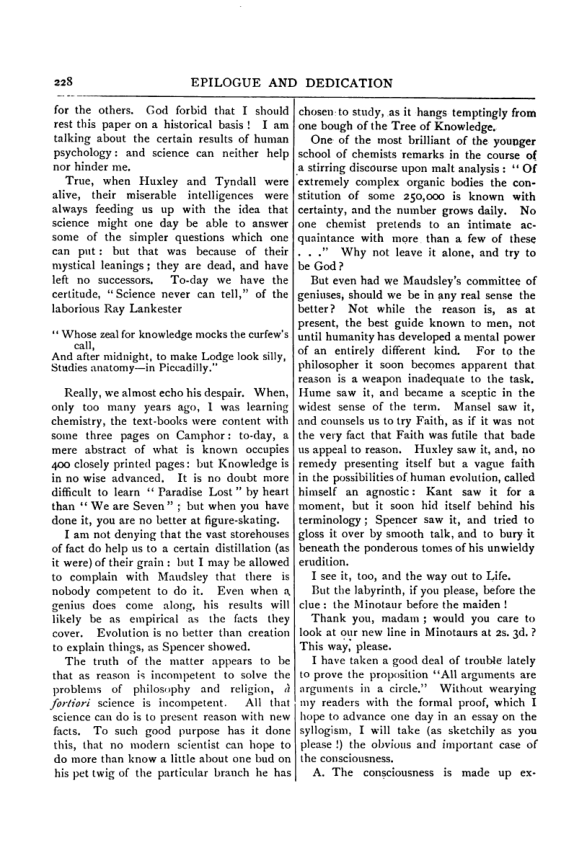
Highlights use the original PDF text layer. OCR-only matches may not be visible on the scan.
Transcription
Download text ↓raw extractionoriginal embedded textReview: unreviewed
228
EPILOGUE AND DEDICATION
for the others. God forbid that I should
rest this paper on a historical basis! I am
talking about the certain results of human
psychology: and science can neither help
nor hinder me.
True, when Huxley and Tyndall were
alive, their miserable intelligences were
always feeding us up with the idea that
science might one day be able to answer
some of the simpler questions which one
can put: but that was because of their
mystical leanings; they are dead, and have
left no successors, To-day we have the
certitude, ‘Science never can tell,” of the
laborious Ray Lankester
‘‘ Whose zeal for knowledge mocks the curfew's.
call,
And after midnight, to make Lodge look silly,
Studies anatomy—in Piccadilly.”
Really, we almost echo his despair. When,
only too many years ago, I was learning
chemistry, the text-books were content with
some three pages on Camphor: to-day, a
mere abstract of what is known occupies
400 closely printed pages: but Knowledge is
in no wise advanced. It is no doubt more
difficult to learn ‘‘ Paradise Lost’”’ by heart
than ‘‘ We are Seven” ; but when you have
done it, you are no better at figure-skating.
I am not denying that the vast storehouses
of fact do help us to a certain distillation (as
it were) of their grain: but I may be allowed
to complain with Maudsley that there is
nobody competent to do it. Even when a
genius does come along, his results will
likely be as empirical as the facts they
cover. Evolution is no better than creation
to explain things, as Spencer showed.
The truth of the matter appears to be
that as reason is incompetent to solve the
problems of philosophy and religion, @
fortiori science is incompetent. All that
science can do is to present reason with new
facts. To such good purpose has it done
this, that no modern scientist can hope to
do more than knowa little about one bud on
his pet twig of the particular branch he has
chosen:
to study, as it hangs. temptingly from
one bough of the Tree of Knowledge.
One of the most brilliant of the younger
school of chemists remarks. in the course of
4 stirring discourse upon malt analysis: ‘‘ Of
extremely complex organic bodies the con-
stitution of some 250,000 is known with
certainty, and the number grows daily. No
one chemist pretends to an intimate ac-
quaintance with more than a few of these
. .. Why not leave it alone, and try to
be God?
But even had we Maudsley’s committee of
geniuses; should we be in any real sense the
better? Not while the reason is, as at
present, the best guide known to men, not
until humanity has developed a mental power
of an entirely different kind. For to the
philosopher it soon becomes apparent that.
reason is a weapon inadequate to the task,
Hume saw it, and became a sceptic in the
widest sense of the term. Mansel saw it,
and counsels us to try Faith, as if it was not
the very fact that Faith was futile that bade
us appeal to reason. Huxley saw it, and, no
remedy presenting itself but a vague faith
in the possibilities of human evolution, called
himself an agnostic: Kant saw it for a
moment, but it soon hid itself behind his
terminology; Spencer saw it, and tried to
gloss it over by smooth talk, and to bury it
beneath the ponderous tomes of his unwieldy
erudition.
I see it, too, and the way out to Life.
But the labyrinth, if you please, before the
clue: the Minotaur before the maiden !
Thank you, madam; would you care to
look at our new line in Minotaurs at 2s. 3d. ?
This way, please.
I have taken a good deal of trouble lately
to prove the proposition ‘‘All arguments are
arguments in a circle.’ Without wearying
my readers with the formal proof, which I
hope to advance one day in an essay on the
syllogism, I will take (as sketchily as you
please !) the obvious and important case of
the consciousness.
A. The consciousness is made up ex-
Page provenance & review flags
Stable page ID: 213a7871095c12b173519869:p00234
Line breaks are preserved. Reading order and OCR accuracy may need review.
Printed page label has not been verified.
- No automated review flags. This does not establish transcription accuracy.