1907 · CLOSE READING
Collected Works (Vol. III)
Collected Works (Vol. III) (1907), PDF p. 228
Original page
Enlarge ↗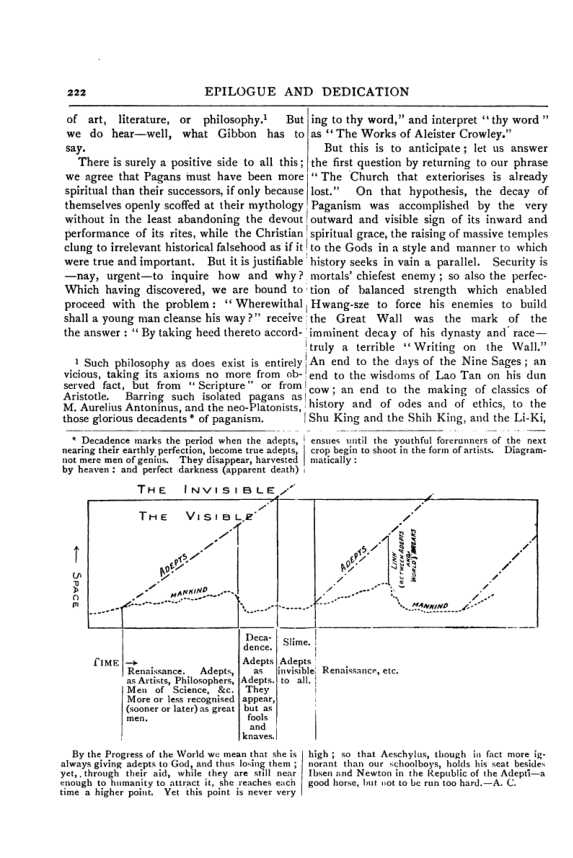
Highlights use the original PDF text layer. OCR-only matches may not be visible on the scan.
Transcription
Download text ↓raw extractionoriginal embedded textReview: unreviewed
EPILOGUE AND DEDICATION
222
of art, literature, or philosophy.! But/ing to thy word,” and interpret ‘‘ thy word ”
we do hear—well, what Gibbon has to/as ‘‘ The Works of Aleister Crowley.”
say. | But this is to anticipate; let us answer
Thereis surely a positive side to all this;
we agree that Pagans must have been more
spiritual than their successors, if only because
themselves openly scoffed at their mythology
without in the least abandoning the devout
performance of its rites, while the Christian
clung to irrelevant historical falsehood as if it
were true and important.
But it is justifiable :
the first question by returning to our phrase
‘‘The Church that exteriorises is already
lost.”” On that hypothesis, the decay of
Paganism was accomplished by the very
outward and visible sign of its inward and
spiritual grace, the raising of massive temples
to the Gods ina style and manner to which
history seeks in vain a parallel. Security is
—nay, urgent—to inquire how and why? mortals’ chiefest enemy; so also the perfec-
Which having discovered, we are bound to‘tion of balanced strength which enabled
proceed with the problem: “* Wherewithal , Hwang- sze to force his enemies to build
shall
a young man cleanse his way?” receive;the Great Wall was the mark of the
the answer: ‘‘ By taking heed thereto accord- ‘imminent decay of his dynasty and race—
‘truly a terrible ‘‘ Writing on the Wall.”
1 Such philosophy as does exist is entirely | An end to the days of the Nine Sages; an
vicious, taking its axioms no more from ob-!end to the wisdoms of Lao Tan on his dun
served fact, but from ‘Scripture’ or from | cow ; an end to the making of classics of
Aristotle. Barring such isolated pagans a5 | History and of odes and of ethics, to the
M. Aurelius Antoninus, and the neo-Platonists, '
those glorious decadents* of paganism. Shu King and the Shih King, and the Li-Ki,
* Decadence marks the period when the adepts, i ensues until the youthful forerunners of the next
nearing their earthly perfection, become true adepts, | crop begin to shootin the form of artists. Diagram-
not mere men of genius. 'They disappear, harvested | matically:
by heaven: and perfect darkness (apparent death) |
THE INVISIBLE
/” y
4
‘ a va
THe VisiB LZ /
a “2 8 }
a 45.7 Sg f
i) 2 ” ae Sid 7
ey’ oe. Suto °
noe RY, NESY 7
a : u /
v A 4 oo ,
6 MANNoo gene ‘ ae
m “tT sneer ene ~ i. enol? Preeesee 2 oa “MANKIND fer
Deca- |} «;:
dence Slime.
CIME |—> Adepts | Adepts ;
Renaissance. Adepts, as jinvisiblei Renaissance, etc.
as Artists, Philosophers, {Adepts.| to all.
Men of Science, &c. |} They
More or less recognised appear,
(sooner or later) as great | but as
men, fools
and
knaves.
By the Progress of the World we mean that sheis
always giving adepts to God, and thus losing them;
yet,, through their aid, while they are still near
enough to humanity to attract it, she reaches each
time a higher point. Yet this point is never very
high; so that Aeschylus, though in fact more ig-
norant than our schoolboys, holds his seat besides
Ibsen and Newtonin the Republic of the Adepti—a
good horse, but not to be run too hard.—A. C.
Page provenance & review flags
Stable page ID: 213a7871095c12b173519869:p00228
Line breaks are preserved. Reading order and OCR accuracy may need review.
Printed page label has not been verified.
- No automated review flags. This does not establish transcription accuracy.