1907 · CLOSE READING
Collected Works (Vol. III)
Collected Works (Vol. III) (1907), PDF p. 133
Original page
Enlarge ↗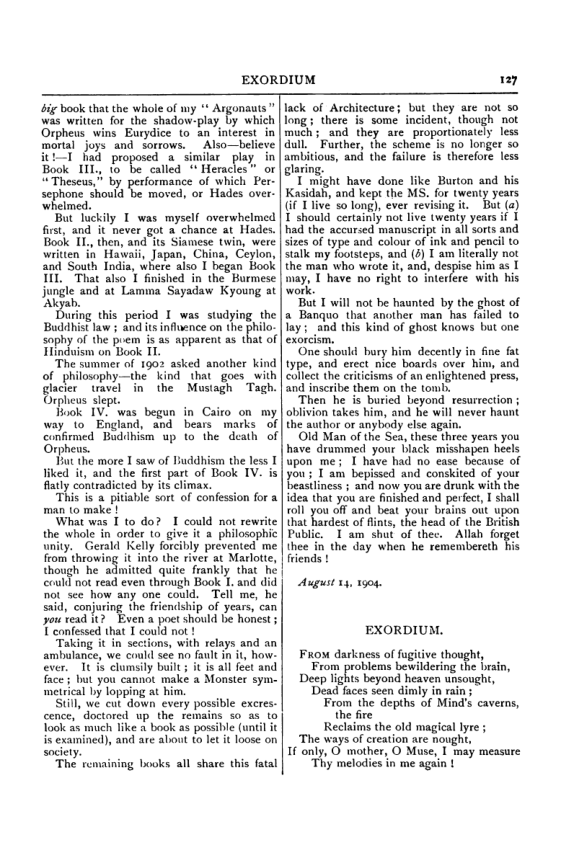
Highlights use the original PDF text layer. OCR-only matches may not be visible on the scan.
Transcription
Download text ↓raw extractionoriginal embedded textReview: unreviewed
EXORDIUM
124
dig book that the whole of my ‘‘ Argonauts ”
was written for the shadow-play by which
Orpheus wins Eurydice to an interest in
mortal joys and sorrows. Also—believe
it!—I had proposed a similar play in
Book III., to be called ‘* Heracles” or
‘‘ Theseus,” by performance of which Per-
sephone should be moved, or Hades over-
whelmed.
But luckily I was myself overwhelmed
first, and it never got a chance at Hades.
Book II., then, and its Siamese twin, were
written in Hawaii, Japan, China, Ceylon,
and South India, where also I began Book
III. That also I finished in the Burmese
jungle and at Lamma Sayadaw Kyoung at
Akyab.
During this period I was studying the
Buddhist law ; and its influence on the philo-
sophy of the poem is as apparent as that of
Hinduism on Book II.
The summer of 1902 asked another kind
of philosophy—the kind that goes with
glacier travel in the Mustagh ‘Tagh.
Orpheus slept.
Book IV. was begun in Cairo on my
way to England, and bears marks of
confirmed Buddhism up to the death of
Orpheus.
3ut the more I saw of Buddhism the less I
liked it, and the first part of Book IV. is
flatly contradicted by its climax.
This is a pitiable sort of confession for a
man to make !
What was I to do? I could not rewrite
the whole in order to give it a philosophic
unity. Gerald Kelly forcibly prevented me
from throwing it into the river at Marlotte,
though he admitted quite frankly that he
could not read even through Book I. and did
not see how any one could. Tell me, he
said, conjuring the friendship of years, can
you read it? Even a poet should be honest ;
I confessed that I could not !
Taking it in sections, with relays and an
ambulance, we could see no fault in it, how-
ever. It is clumsily built; it is all feet and
face; but you cannot make a Monster sym-
metrical by lopping at him.
Still, we cut down every possible excres-
cence, doctored up the remains so as to
look as much like a book as possible (until it
is examined), and are about to let it loose on
society.
The remaining books all share this fatal
lack of Architecture; but they are not so
long; there is some incident, though not
much; and they are proportionately less
dull. Further, the scheme is no longer so
ambitious, and the failure is therefore less
glaring.
I might have done like Burton and his
Kasidah, and kept the MS. for twenty years
(if I live so long), ever revising it. But (a)
I should certainly not live twenty years if I
had the accursed manuscript in all sorts and
sizes of type and colour of ink and pencil to
stalk my footsteps, and (4) I am literally not
the man who wrote it, and, despise him as I
may, I have no right to interfere with his
work.
But I will not be haunted by the ghost of
a Banquo that another man has failed to
lay; and this kind of ghost knows but one
exorcism,
One should bury him decently in fine fat
type, and erect nice boards over him, and
collect the criticisms of an enlightened press,
and inscribe them on the tomb.
Then he is buried beyond resurrection;
oblivion takes him, and he will never haunt
the author or anybody else again.
Old Man of the Sea, these three years you
have drummed your black misshapen heels
upon me; I have had no ease because of
you; I am bepissed and conskited of your
beastliness ; and now you are drunk with the
idea that you are finished and perfect, I shall
roll you off and beat your brains out upon
that hardest of flints, the head of the British
Public. I am shut of thee. Allah forget
thee in the day when he remembereth his
friends !
August 14, 1904.
EXORDIUM.
From darkness of fugitive thought,
From problems bewildering the brain,
Deep lights beyond heaven unsought,
Dead faces seen dimly in rain ;
From the depths of Mind’s caverns,
the fire
Reclaims the old magical lyre ;
The ways of creation are nought,
If only, O mother, O Muse, I may measure
Thy melodies in me again !
Page provenance & review flags
Stable page ID: 213a7871095c12b173519869:p00133
Line breaks are preserved. Reading order and OCR accuracy may need review.
Printed page label has not been verified.
- No automated review flags. This does not establish transcription accuracy.