1939 · CLOSE READING
Eight Lectures on Yoga
Eight Lectures on Yoga (1939), PDF p. 42
Original page
Enlarge ↗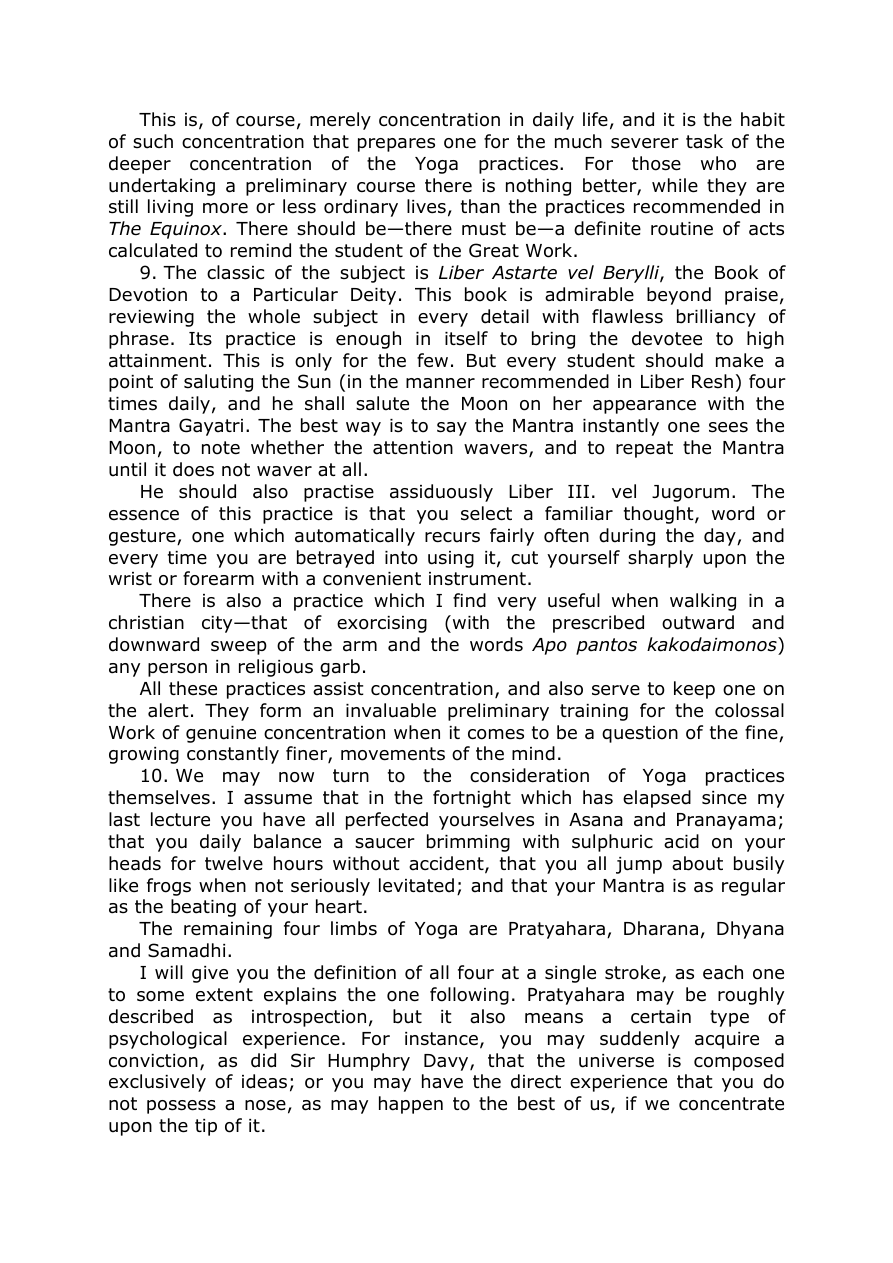
Highlights use the original PDF text layer. OCR-only matches may not be visible on the scan.
Transcription
Download text ↓raw extractionoriginal embedded textReview: unreviewed
This is, of course, merely concentration in daily life, and it is the habit
of such concentration that prepares one for the much severer task of the
deeper concentration of the Yoga practices. For those who are
undertaking a preliminary course there is nothing better, while they are
still living more or less ordinary lives, than the practices recommended in
The Equinox. There should bethere must bea definite routine of acts
calculated to remind the student of the Great Work.
9. The classic of the subject is Liber Astarte vel Berylli, the Book of
Devotion to a Particular Deity. This book is admirable beyond praise,
reviewing the whole subject in every detail with flawless brilliancy of
phrase. Its practice is enough in itself to bring the devotee to high
attainment. This is only for the few. But every student should make a
point of saluting the Sun (in the manner recommended in Liber Resh) four
times daily, and he shall salute the Moon on her appearance with the
Mantra Gayatri. The best way is to say the Mantra instantly one sees the
Moon, to note whether the attention wavers, and to repeat the Mantra
until it does not waver at all.
He should also practise assiduously Liber III. vel Jugorum. The
essence of this practice is that you select a familiar thought, word or
gesture, one which automatically recurs fairly often during the day, and
every time you are betrayed into using it, cut yourself sharply upon the
wrist or forearm with a convenient instrument.
There is also a practice which I find very useful when walking in a
christian citythat of exorcising (with the prescribed outward and
downward sweep of the arm and the words Apo pantos kakodaimonos)
any person in religious garb.
All these practices assist concentration, and also serve to keep one on
the alert. They form an invaluable preliminary training for the colossal
Work of genuine concentration when it comes to be a question of the fine,
growing constantly finer, movements of the mind.
10. We may now turn to the consideration of Yoga practices
themselves. I assume that in the fortnight which has elapsed since my
last lecture you have all perfected yourselves in Asana and Pranayama;
that you daily balance a saucer brimming with sulphuric acid on your
heads for twelve hours without accident, that you all jump about busily
like frogs when not seriously levitated; and that your Mantra is as regular
as the beating of your heart.
The remaining four limbs of Yoga are Pratyahara, Dharana, Dhyana
and Samadhi.
I will give you the definition of all four at a single stroke, as each one
to some extent explains the one following. Pratyahara may be roughly
described as introspection, but it also means a certain type of
psychological experience. For instance, you may suddenly acquire a
conviction, as did Sir Humphry Davy, that the universe is composed
exclusively of ideas; or you may have the direct experience that you do
not possess a nose, as may happen to the best of us, if we concentrate
upon the tip of it.
Page provenance & review flags
Stable page ID: 11ea06f5df920a5b4a5d7e16:p00042
Line breaks are preserved. Reading order and OCR accuracy may need review.
Printed page label has not been verified.
- No automated review flags. This does not establish transcription accuracy.