1939 · CLOSE READING
Eight Lectures on Yoga
Eight Lectures on Yoga (1939), PDF p. 32
Original page
Enlarge ↗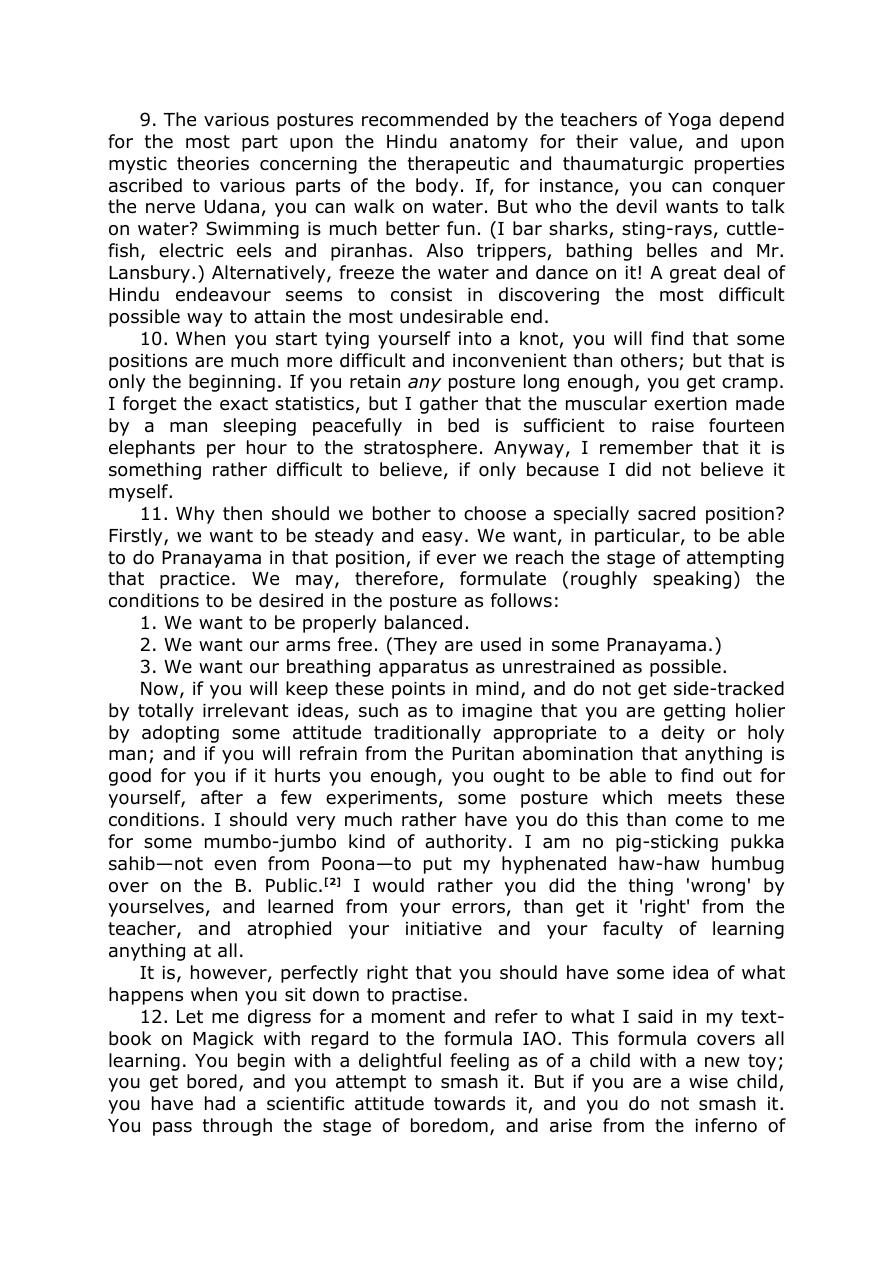
Highlights use the original PDF text layer. OCR-only matches may not be visible on the scan.
Transcription
Download text ↓raw extractionoriginal embedded textReview: unreviewed
9. The various postures recommended by the teachers of Yoga depend
for the most part upon the Hindu anatomy for their value, and upon
mystic theories concerning the therapeutic and thaumaturgic properties
ascribed to various parts of the body. If, for instance, you can conquer
the nerve Udana, you can walk on water. But who the devil wants to talk
on water? Swimming is much better fun. (I bar sharks, sting-rays, cuttle-
fish, electric eels and piranhas. Also trippers, bathing belles and Mr.
Lansbury.) Alternatively, freeze the water and dance on it! A great deal of
Hindu endeavour seems to consist in discovering the most difficult
possible way to attain the most undesirable end.
10. When you start tying yourself into a knot, you will find that some
positions are much more difficult and inconvenient than others; but that is
only the beginning. If you retain any posture long enough, you get cramp.
I forget the exact statistics, but I gather that the muscular exertion made
by a man sleeping peacefully in bed is sufficient to raise fourteen
elephants per hour to the stratosphere. Anyway, I remember that it is
something rather difficult to believe, if only because I did not believe it
myself.
11. Why then should we bother to choose a specially sacred position?
Firstly, we want to be steady and easy. We want, in particular, to be able
to do Pranayama in that position, if ever we reach the stage of attempting
that practice. We may, therefore, formulate (roughly speaking) the
conditions to be desired in the posture as follows:
1. We want to be properly balanced.
2. We want our arms free. (They are used in some Pranayama.)
3. We want our breathing apparatus as unrestrained as possible.
Now, if you will keep these points in mind, and do not get side-tracked
by totally irrelevant ideas, such as to imagine that you are getting holier
by adopting some attitude traditionally appropriate to a deity or holy
man; and if you will refrain from the Puritan abomination that anything is
good for you if it hurts you enough, you ought to be able to find out for
yourself, after a few experiments, some posture which meets these
conditions. I should very much rather have you do this than come to me
for some mumbo-jumbo kind of authority. I am no pig-sticking pukka
sahibnot even from Poonato put my hyphenated haw-haw humbug
over on the B. Public.[2] I would rather you did the thing 'wrong' by
yourselves, and learned from your errors, than get it 'right' from the
teacher, and atrophied your initiative and your faculty of learning
anything at all.
It is, however, perfectly right that you should have some idea of what
happens when you sit down to practise.
12. Let me digress for a moment and refer to what I said in my text-
book on Magick with regard to the formula IAO. This formula covers all
learning. You begin with a delightful feeling as of a child with a new toy;
you get bored, and you attempt to smash it. But if you are a wise child,
you have had a scientific attitude towards it, and you do not smash it.
You pass through the stage of boredom, and arise from the inferno of
Page provenance & review flags
Stable page ID: 11ea06f5df920a5b4a5d7e16:p00032
Line breaks are preserved. Reading order and OCR accuracy may need review.
Printed page label has not been verified.
- No automated review flags. This does not establish transcription accuracy.