1939 · CLOSE READING
Eight Lectures on Yoga
Eight Lectures on Yoga (1939), PDF p. 24
Original page
Enlarge ↗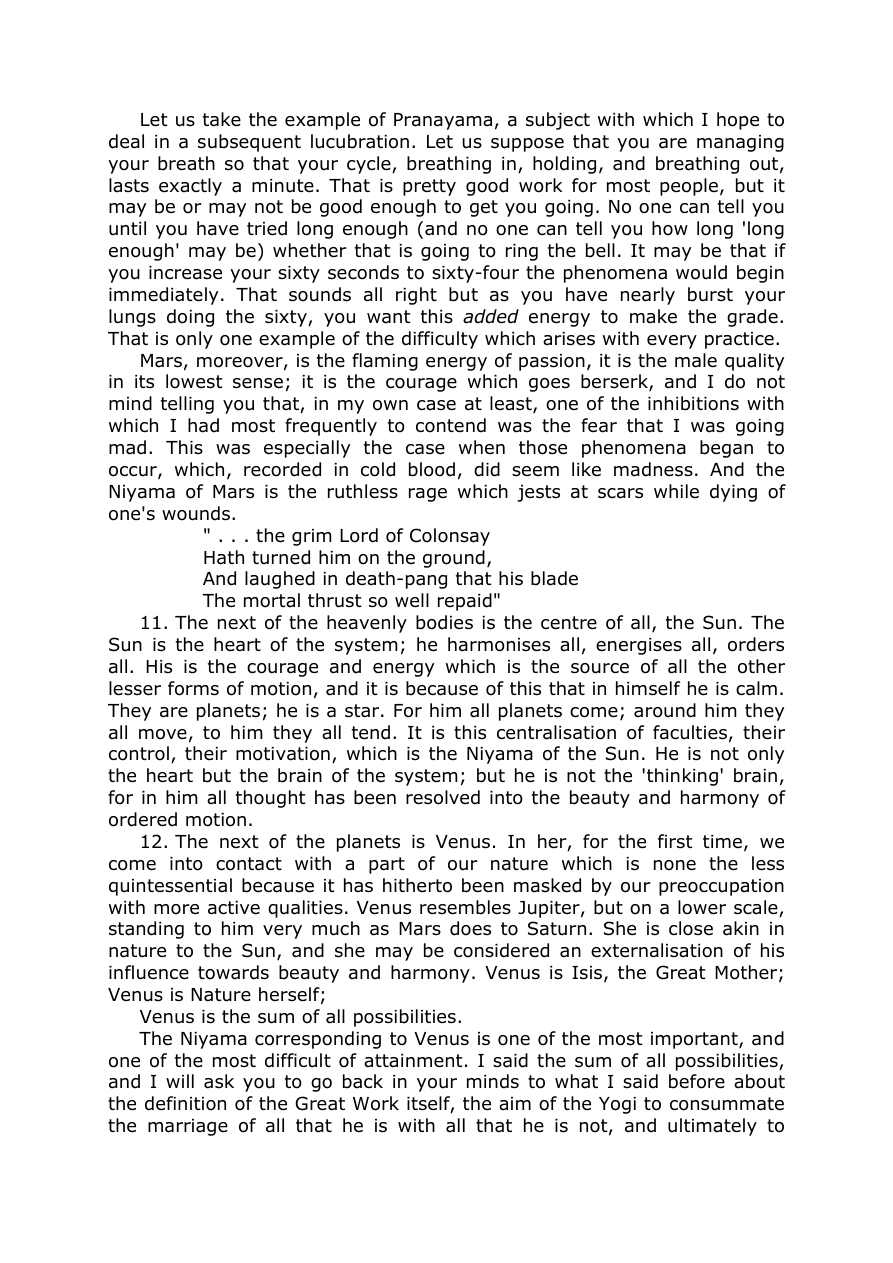
Highlights use the original PDF text layer. OCR-only matches may not be visible on the scan.
Transcription
Download text ↓raw extractionoriginal embedded textReview: unreviewed
Let us take the example of Pranayama, a subject with which I hope to
deal in a subsequent lucubration. Let us suppose that you are managing
your breath so that your cycle, breathing in, holding, and breathing out,
lasts exactly a minute. That is pretty good work for most people, but it
may be or may not be good enough to get you going. No one can tell you
until you have tried long enough (and no one can tell you how long 'long
enough' may be) whether that is going to ring the bell. It may be that if
you increase your sixty seconds to sixty-four the phenomena would begin
immediately. That sounds all right but as you have nearly burst your
lungs doing the sixty, you want this added energy to make the grade.
That is only one example of the difficulty which arises with every practice.
Mars, moreover, is the flaming energy of passion, it is the male quality
in its lowest sense; it is the courage which goes berserk, and I do not
mind telling you that, in my own case at least, one of the inhibitions with
which I had most frequently to contend was the fear that I was going
mad. This was especially the case when those phenomena began to
occur, which, recorded in cold blood, did seem like madness. And the
Niyama of Mars is the ruthless rage which jests at scars while dying of
one's wounds.
" . . . the grim Lord of Colonsay
Hath turned him on the ground,
And laughed in death-pang that his blade
The mortal thrust so well repaid"
11. The next of the heavenly bodies is the centre of all, the Sun. The
Sun is the heart of the system; he harmonises all, energises all, orders
all. His is the courage and energy which is the source of all the other
lesser forms of motion, and it is because of this that in himself he is calm.
They are planets; he is a star. For him all planets come; around him they
all move, to him they all tend. It is this centralisation of faculties, their
control, their motivation, which is the Niyama of the Sun. He is not only
the heart but the brain of the system; but he is not the 'thinking' brain,
for in him all thought has been resolved into the beauty and harmony of
ordered motion.
12. The next of the planets is Venus. In her, for the first time, we
come into contact with a part of our nature which is none the less
quintessential because it has hitherto been masked by our preoccupation
with more active qualities. Venus resembles Jupiter, but on a lower scale,
standing to him very much as Mars does to Saturn. She is close akin in
nature to the Sun, and she may be considered an externalisation of his
influence towards beauty and harmony. Venus is Isis, the Great Mother;
Venus is Nature herself;
Venus is the sum of all possibilities.
The Niyama corresponding to Venus is one of the most important, and
one of the most difficult of attainment. I said the sum of all possibilities,
and I will ask you to go back in your minds to what I said before about
the definition of the Great Work itself, the aim of the Yogi to consummate
the marriage of all that he is with all that he is not, and ultimately to
Page provenance & review flags
Stable page ID: 11ea06f5df920a5b4a5d7e16:p00024
Line breaks are preserved. Reading order and OCR accuracy may need review.
Printed page label has not been verified.
- No automated review flags. This does not establish transcription accuracy.