1913 · CLOSE READING
The Equinox (Volume I, Number X)
The Equinox (Volume I, Number X) (1913), PDF p. 566
Original page
Enlarge ↗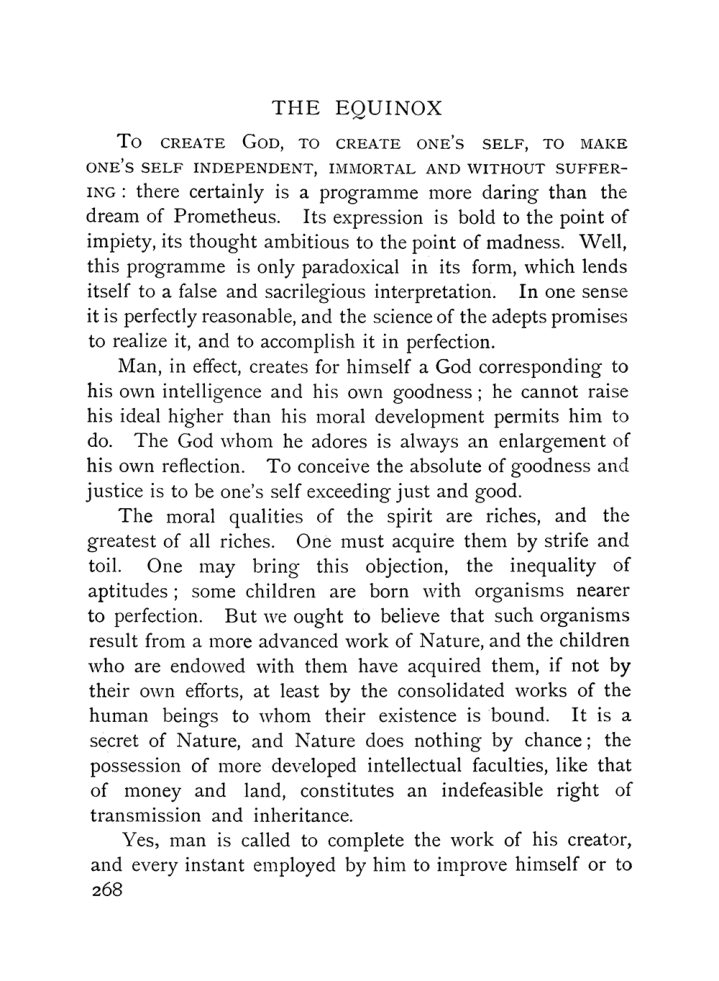
Highlights use the original PDF text layer. OCR-only matches may not be visible on the scan.
Transcription
Download text ↓raw extractionoriginal embedded textReview: unreviewed
THE EQUINOX
To CREATE GOD, TO CREATE ONE'S SELF, TO MAKE
ONE’S SELF INDEPENDENT, IMMORTAL AND WITHOUT SUFFER-
ING: there certainly is a programme more daring than the
dream of Prometheus. Its expression is bold to the point of
impiety, its thought ambitious to the point of madness. Well,
this programme is only paradoxical in its form, which lends
itself to a false and sacrilegious interpretation. In one sense
it is perfectly reasonable, and the science of the adepts promises
to realize it, and to accomplish it in perfection.
Man, in effect, creates for himself a God corresponding to
his own intelligence and his own goodness; he cannot raise
his ideal higher than his moral development permits him to
do. The God whom he adores is always an enlargement of
his own reflection. To conceive the absolute of goodness and
justice is to be one’s self exceeding just and good.
The moral qualities of the spirit are riches, and the
greatest of all riches. One must acquire them by strife and
toil. One may bring this objection, the inequality of
aptitudes; some children are born with organisms nearer
to perfection. But we ought to believe that such organisms
result from a more advanced work of Nature, and the children
who are endowed with them have acquired them, if not by
their own efforts, at least by the consolidated works of the
human beings to whom their existence is bound. It is a
secret of Nature, and Nature does nothing by chance; the
possession of more developed intellectual faculties, like that
of money and land, constitutes an indefeasible right of
transmission and inheritance.
Yes, man is called to complete the work of his creator,
and every instant employed by him to improve himself or to
268
Page provenance & review flags
Stable page ID: 055db0b9f9f14b4b534ea050:p00566
Line breaks are preserved. Reading order and OCR accuracy may need review.
Printed page label has not been verified.
- No automated review flags. This does not establish transcription accuracy.