1913 · CLOSE READING
The Equinox (Volume I, Number X)
The Equinox (Volume I, Number X) (1913), PDF p. 488
Original page
Enlarge ↗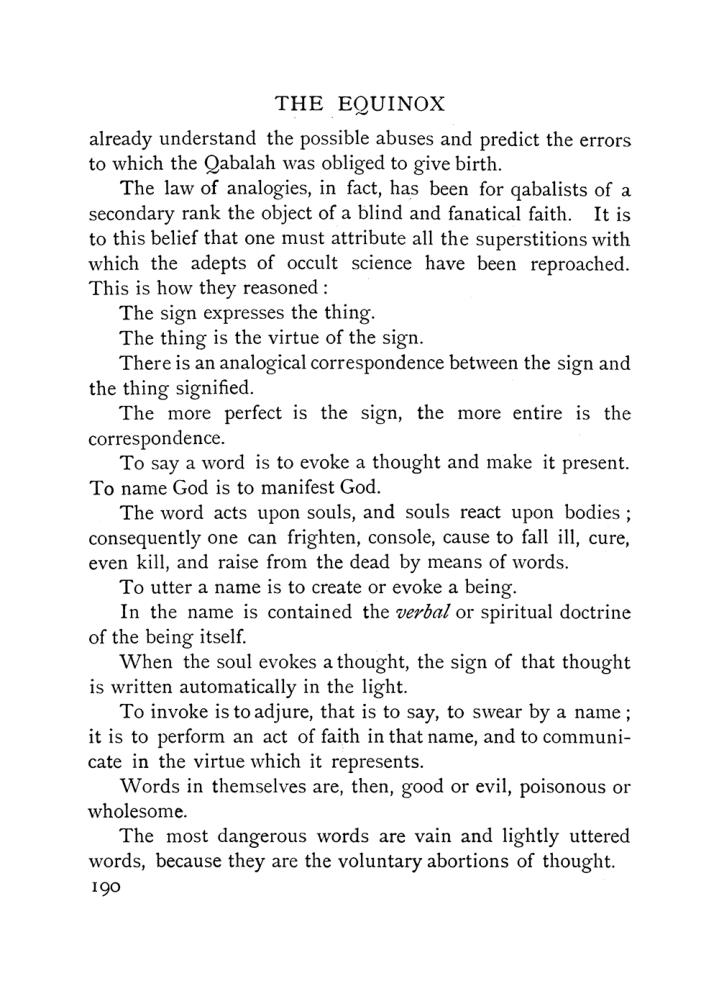
Highlights use the original PDF text layer. OCR-only matches may not be visible on the scan.
Transcription
Download text ↓raw extractionoriginal embedded textReview: unreviewed
THE EQUINOX
already understand the possible abuses and predict the errors
to which the Qabalah was obliged to give birth.
The law of analogies, in fact, has been for qabalists of a
secondary rank the object of a blind and fanatical faith. It is
to this belief that one must attribute all the superstitions with
which the adepts of occult science have been reproached.
This is how they reasoned:
The sign expresses the thing.
The thing is the virtue of the sign.
There is an analogical correspondence between the sign and
the thing signified.
The more perfect is the sign, the more entire is the
correspondence.
To say a word is to evoke a thought and make it present.
To name God is to manifest God.
The word acts upon souls, and souls react upon bodies;
consequently one can frighten, console, cause to fall ill, cure,
even kill, and raise from the dead by means of words.
To utter a name is to create or evoke a being.
In the name is contained the verda/ or spiritual doctrine
of the being itself.
When the soul evokes a thought, the sign of that thought
is written automatically in the light.
To invoke is toadjure, that is to say, to swear by a name;
it is to perform an act of faith in that name, and to communi-
cate in the virtue which it represents.
Words in themselves are, then, good or evil, poisonous or
wholesome.
The most dangerous words are vain and lightly uttered
words, because they are the voluntary abortions of thought.
190
Page provenance & review flags
Stable page ID: 055db0b9f9f14b4b534ea050:p00488
Line breaks are preserved. Reading order and OCR accuracy may need review.
Printed page label has not been verified.
- No automated review flags. This does not establish transcription accuracy.