1913 · CLOSE READING
The Equinox (Volume I, Number X)
The Equinox (Volume I, Number X) (1913), PDF p. 480
Original page
Enlarge ↗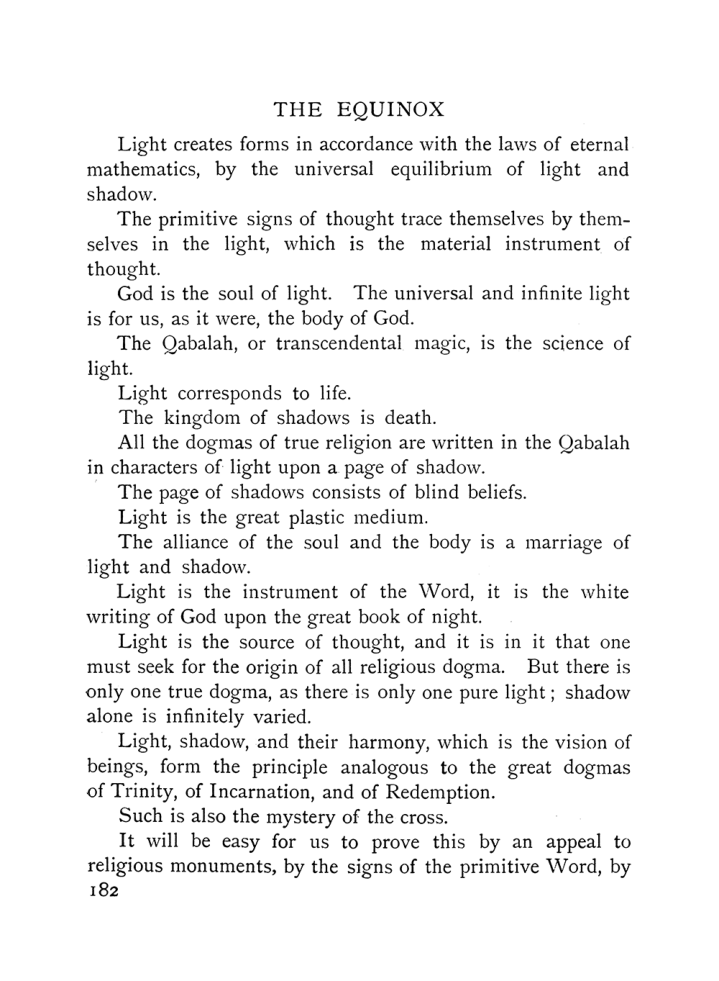
Highlights use the original PDF text layer. OCR-only matches may not be visible on the scan.
Transcription
Download text ↓raw extractionoriginal embedded textReview: unreviewed
THE EQUINOX
Light creates forms in accordance with the laws of eternal
mathematics, by the universal equilibrium of light and
shadow.
The primitive signs of thought trace themselves by them-
selves in the light, which is the material instrument of
thought.
God is the soul of light. The universal and infinite light
is for us, as it were, the body of God.
The Qabalah, or transcendental magic, is the science of
light.
Light corresponds to life.
The kingdom of shadows is death.
All the dogmas of true religion are written in the Qabalah
in characters of light upon a page of shadow.
The page of shadows consists of blind beliefs.
Light is the great plastic medium.
The alliance of the soul and the body is a marriage of
light and shadow.
Light is the instrument of the Word, it is the white
writing of God upon the great book of night.
Light is the source of thought, and it is in it that one
must seek for the origin of all religious dogma. But there is
only one true dogma, as there is only one pure light; shadow
alone is infinitely varied.
Light, shadow, and their harmony, which is the vision of
beings, form the principle analogous to the great dogmas
of Trinity, of Incarnation, and of Redemption.
Such is also the mystery of the cross.
It will be easy for us to prove this by an appeal to
religious monuments, by the signs of the primitive Word, by
182
Page provenance & review flags
Stable page ID: 055db0b9f9f14b4b534ea050:p00480
Line breaks are preserved. Reading order and OCR accuracy may need review.
Printed page label has not been verified.
- No automated review flags. This does not establish transcription accuracy.