1913 · CLOSE READING
The Equinox (Volume I, Number X)
The Equinox (Volume I, Number X) (1913), PDF p. 419
Original page
Enlarge ↗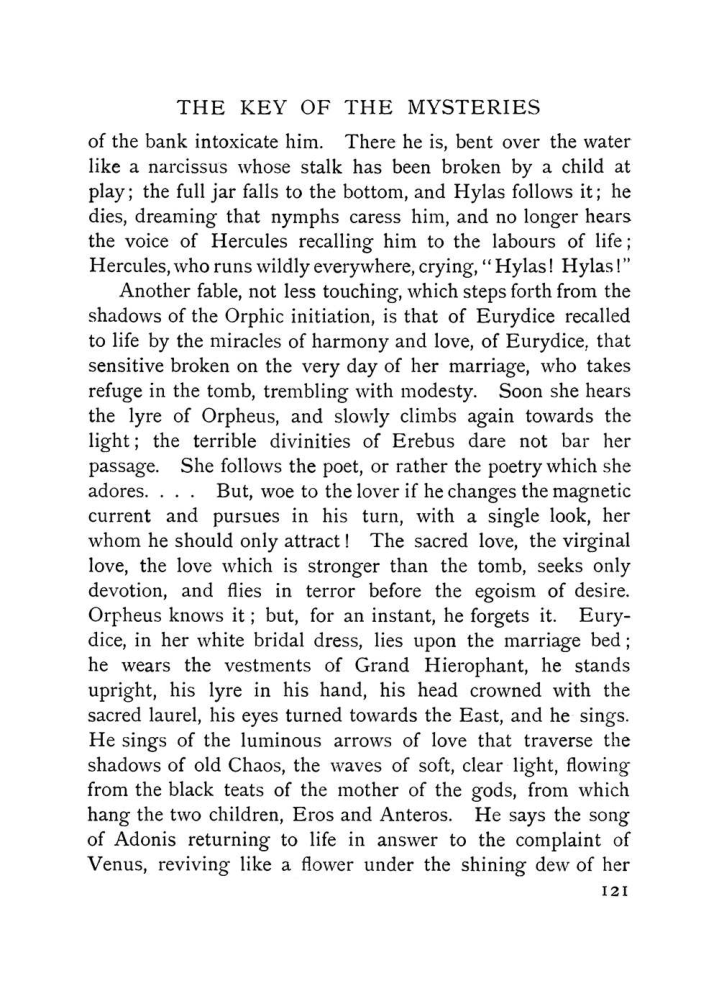
Highlights use the original PDF text layer. OCR-only matches may not be visible on the scan.
Transcription
Download text ↓raw extractionoriginal embedded textReview: unreviewed
THE KEY OF THE MYSTERIES
of the bank intoxicate him. There he is, bent over the water
like a narcissus whose stalk has been broken by a child at
play; the full jar falls to the bottom, and Hylas follows it; he
dies, dreaming that nymphs caress him, and no longer hears
the voice of Hercules recalling him to the labours of life;
Hercules, who runs wildly everywhere, crying, ‘‘Hylas! Hylas!”
Another fable, not less touching, which steps forth from the
shadows of the Orphic initiation, is that of Eurydice recalled
to life by the miracles of harmony and love, of Eurydice, that
sensitive broken on the very day of her marriage, who takes
refuge in the tomb, trembling with modesty. Soon she hears
the lyre of Orpheus, and slowly climbs again towards the
light; the terrible divinities of Erebus dare not bar her
passage. She follows the poet, or rather the poetry which she
adores. ... But, woe to the lover if he changes the magnetic
current and pursues in his turn, with a single look, her
whom he should only attract! The sacred love, the virginal
love, the love which is stronger than the tomb, seeks only
devotion, and flies in terror before the egoism of desire.
Orpheus knows it; but, for an instant, he forgets it. Eury-
dice, in her white bridal dress, lies upon the marriage bed;
he wears the vestments of Grand Hierophant, he stands
upright, his lyre in his hand, his head crowned with the
sacred laurel, his eyes turned towards the East, and he sings.
He sings of the luminous arrows of love that traverse the
shadows of old Chaos, the waves of soft, clear light, flowing
from the black teats of the mother of the gods, from which
hang the two children, Eros and Anteros. He says the song
of Adonis returning to life in answer to the complaint of
Venus, reviving like a flower under the shining dew of her
121
Page provenance & review flags
Stable page ID: 055db0b9f9f14b4b534ea050:p00419
Line breaks are preserved. Reading order and OCR accuracy may need review.
Printed page label has not been verified.
- No automated review flags. This does not establish transcription accuracy.