1913 · CLOSE READING
The Equinox (Volume I, Number X)
The Equinox (Volume I, Number X) (1913), PDF p. 416
Original page
Enlarge ↗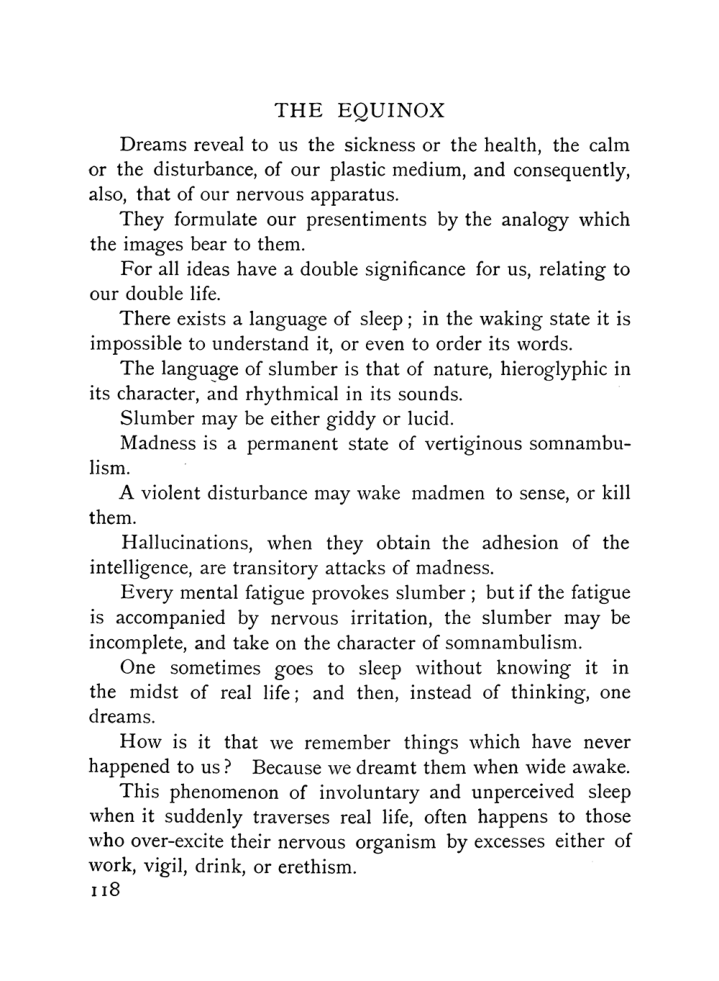
Highlights use the original PDF text layer. OCR-only matches may not be visible on the scan.
Transcription
Download text ↓raw extractionoriginal embedded textReview: unreviewed
THE EQUINOX
Dreams reveal to us the sickness or the health, the calm
or the disturbance, of our plastic medium, and consequently,
also, that of our nervous apparatus.
They formulate our presentiments by the analogy which
the images bear to them.
For all ideas have a double significance for us, relating to
our double life.
There exists a language of sleep; in the waking state it is
impossible to understand it, or even to order its words.
The language of slumber is that of nature, hieroglyphic in
its character, and rhythmical in its sounds.
Slumber may be either giddy or lucid.
Madness is a permanent state of vertiginous somnambu-
lism.
A violent disturbance may wake madmen to sense, or kill
them.
Hallucinations, when they obtain the adhesion of the
intelligence, are transitory attacks of madness.
Every mental fatigue provokes slumber; but if the fatigue
is accompanied by nervous irritation, the slumber may be
incomplete, and take on the character of somnambulism.
One sometimes goes to sleep without knowing it in
the midst of real life; and then, instead of thinking, one
dreams.
How is it that we remember things which have never
happened to us? Because we dreamt them when wide awake.
This phenomenon of involuntary and unperceived sleep
when it suddenly traverses real life, often happens to those
who over-excite their nervous organism by excesses either of
work, vigil, drink, or erethism.
118
Page provenance & review flags
Stable page ID: 055db0b9f9f14b4b534ea050:p00416
Line breaks are preserved. Reading order and OCR accuracy may need review.
Printed page label has not been verified.
- No automated review flags. This does not establish transcription accuracy.