1913 · CLOSE READING
The Equinox (Volume I, Number X)
The Equinox (Volume I, Number X) (1913), PDF p. 345
Original page
Enlarge ↗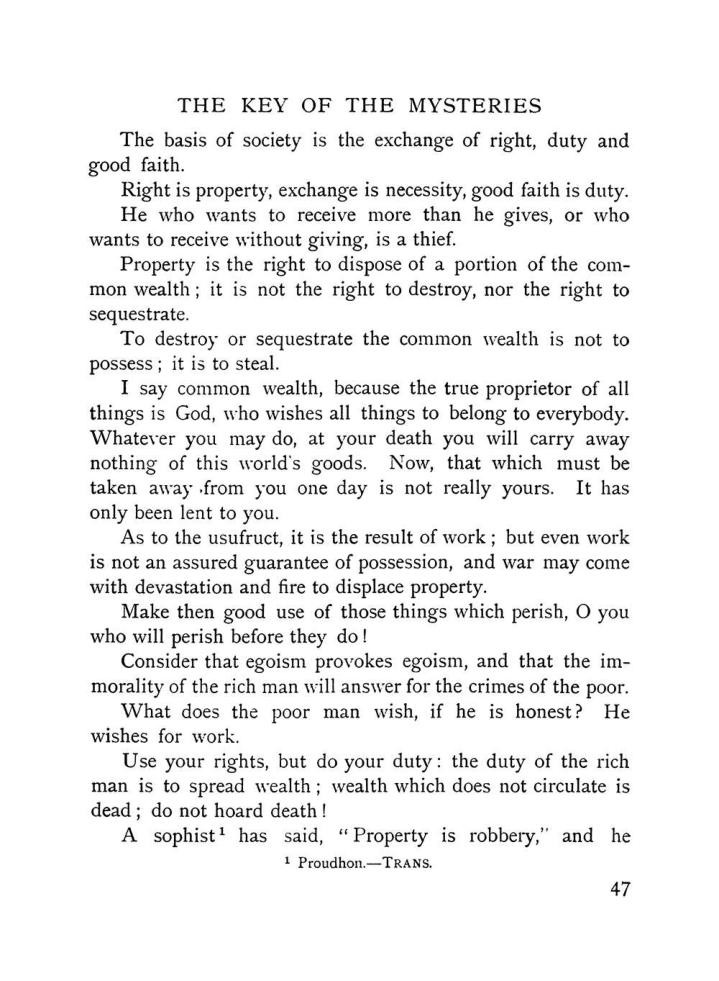
Highlights use the original PDF text layer. OCR-only matches may not be visible on the scan.
Transcription
Download text ↓raw extractionoriginal embedded textReview: unreviewed
THE KEY OF THE MYSTERIES
The basis of society is the exchange of right, duty and
good faith.
Right is property, exchange is necessity, good faith is duty.
He who wants to receive more than he gives, or who
wants to receive without giving, is a thief.
Property is the right to dispose of a portion of the com-
mon wealth; it is not the right to destroy, nor the right to
sequestrate.
To destroy or sequestrate the common wealth is not to
possess; it is to steal.
I say common wealth, because the true proprietor of all
things is God, who wishes all things to belong to everybody.
Whatever you may do, at your death you will carry away
nothing of this world’s goods. Now, that which must be
taken away from you one day is not really yours. It has
only been lent to you.
As to the usufruct, it is the result of work; but even work
is not an assured guarantee of possession, and war may come
with devastation and fire to displace property.
Make then good use of those things which perish, O you
who will perish before they do!
Consider that egoism provokes egoism, and that the im-
morality of the rich man will answer for the crimes of the poor.
What does the poor man wish, if he is honest? He
wishes for work.
Use your rights, but do your duty: the duty of the rich
man is to spread wealth; wealth which does not circulate is
dead; do not hoard death!
A sophist’ has said, “Property is robbery,” and he
1 Proudhon.—TRaNs.
47
Page provenance & review flags
Stable page ID: 055db0b9f9f14b4b534ea050:p00345
Line breaks are preserved. Reading order and OCR accuracy may need review.
Printed page label has not been verified.
- No automated review flags. This does not establish transcription accuracy.