1913 · CLOSE READING
The Equinox (Volume I, Number X)
The Equinox (Volume I, Number X) (1913), PDF p. 316
Original page
Enlarge ↗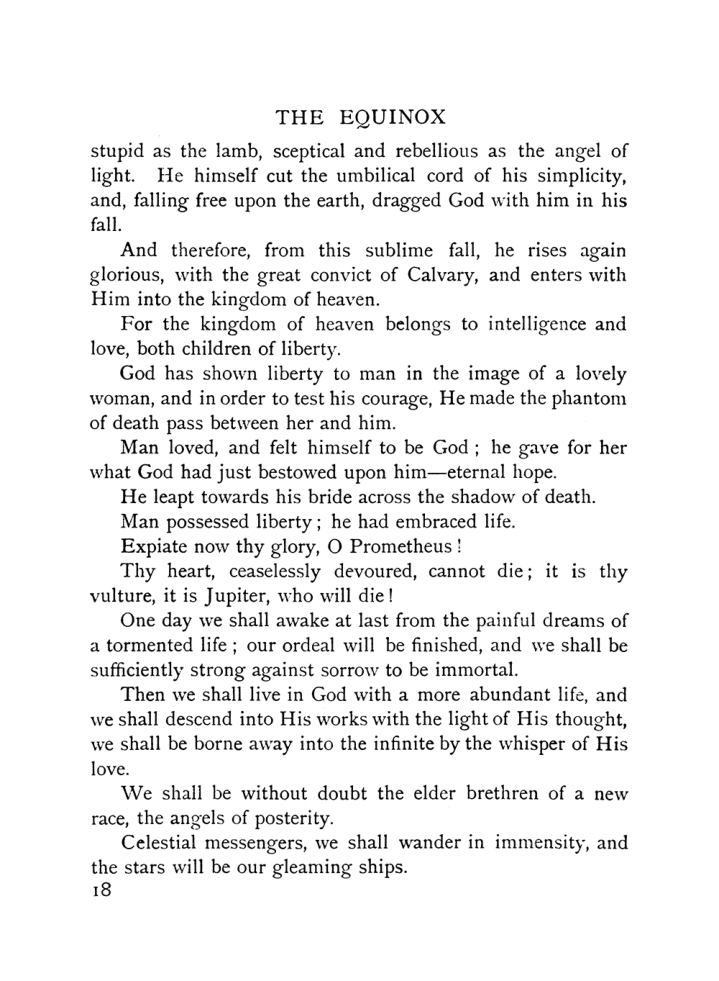
Highlights use the original PDF text layer. OCR-only matches may not be visible on the scan.
Transcription
Download text ↓raw extractionoriginal embedded textReview: unreviewed
THE EQUINOX
stupid as the lamb, sceptical and rebellious as the angel of
light. He himself cut the umbilical cord of his simplicity,
and, falling free upon the earth, dragged God with him in his
fall.
And therefore, from this sublime fall, he rises again
glorious, with the great convict of Calvary, and enters with
Him into the kingdom of heaven.
For the kingdom of heaven belongs to intelligence and
love, both children of liberty.
God has shown liberty to man in the image of a lovely
woman, and in order to test his courage, He made the phantom
of death pass between her and him.
Man loved, and felt himself to be God; he gave for her
what God had just bestowed upon him—eternal hope.
He leapt towards his bride across the shadow of death.
Man possessed liberty; he had embraced life.
Expiate now thy glory, O Prometheus !
Thy heart, ceaselessly devoured, cannot die; it is thy
vulture, it is Jupiter, who will die!
One day we shall awake at last from the painful dreams of
a tormented life ; our ordeal will be finished, and we shall be
sufficiently strong against sorrow to be immortal.
Then we shall live in God with a more abundant life, and
we shall descend into His works with the light of His thought,
we shall be borne away into the infinite by the whisper of His
love.
We shall be without doubt the elder brethren of a new
race, the angels of posterity.
Celestial messengers, we shall wander in immensity, and
the stars will be our gleaming ships.
18
Page provenance & review flags
Stable page ID: 055db0b9f9f14b4b534ea050:p00316
Line breaks are preserved. Reading order and OCR accuracy may need review.
Printed page label has not been verified.
- No automated review flags. This does not establish transcription accuracy.