1919 · CLOSE READING
The Equinox (Volume III, Number I)
The Equinox (Volume III, Number I) (1919), PDF p. 459
Original page
Enlarge ↗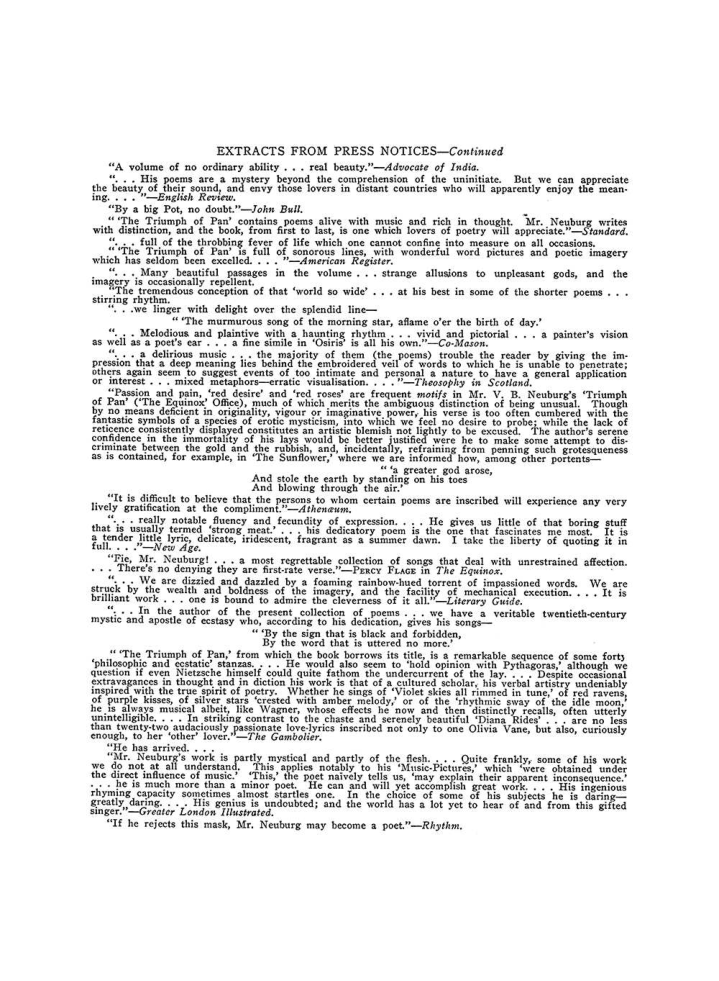
Highlights use the original PDF text layer. OCR-only matches may not be visible on the scan.
Transcription
Download text ↓raw extractionoriginal embedded textReview: unreviewed
EXTRACTS FROM PRESS NOTICES—Continued
“A volume of no ordinary ability « real beauty.”—Advocate of India.
“.... Hig poems are a mystery beyond the comprehension of the uninitiate, But we can appreciate
the beauty of their sound, and envy those lovers in distant countries who will apparently enjoy the mean:
ing... . "—English Review.
“By a big Pot, no doubt."—John Bull. .
“The Triumph of Pan’ contains poems alive with music and rich in thought. “Mr. Neuburg writes
with distinetion, and the book, from first to last, is one which lovers of poetry will appreciate.”—standard.
“, + full of the throbbing fever of life which one cannot confine into measure on all_ occasions,
«‘civie Triumph of Pan’ is full of sonorous lines, with wonderful word pictures and poetic imagery
which has seldom been excelled. « . "American Register,
_‘.. Many beautiful passages in the volume... strange allusions to unpleasant gods, and the
imagery is occasionally repellent ‘ . "
sche fremendous conception of that ‘world so wide’ . .. at his best in some of the shorter poems . . «
stirring ‘rhythm. °
HIS swe linger with delight over the splendid line—
“The murmurous song of the morning star, aflame o'er the birth of day.”
... . Melodious and plaintive with a haunting rhythm... viyid_and pictorial . . . a painter's vision
as well as a poet's ears .”.'a fine simile in “Osiris is all hig own.”—-Co-Mason
“.. «delirious mu the majority of them (the poems) trouble the reader by giving the im-
pression’ that a deep meaning lies behind the embroidered veil of words to which he is unable to penetrates
Others again seem to stiggest events of 00 intimate and ‘personal a nature to have a general application
or interest. . . mixed metaphors—erratic visualisation. . .°. "Theosophy in Scotland.
“Passion and pain, ‘red desire’ and ‘red roses’ are frequent motifs in Mr. V, B. Neuburg’s ‘Triumph
of Pan’ The Equinox’ Office), much of which merits the ambiguous distinction of being unusual, ‘Though
yy no means deficient in originality, vigour or imaginative power, his verse is too often-cumbered with the
fantastic symbols of a species of erotic mysticism, into which we feel no desire to probe; while the lack of
reticence consistently displayed constitutes an artistic blemish not lightly to be excused. ‘The author's serene
confidence in the immortality of his lays would be better justified were he to make some.attempt to dis:
criminate between the gold and the rubbish, and, incidentally, refraining from penning such grotesqueness
as is contained, for example, in ‘The Sunflower,’ ‘where we are informe: how, among other portents—
“| greater god arose,
‘And stole the earth by standing on his toes
And blowing through the air.”
secilt is difficult to believe that the persons to whom certain poems are inscribed will experience any very
lively gratification at ‘the compliment” —dtheneum.
“.. . really notable fluency and fecundity of expression.
that is usually termed ‘strong meat.’ . . ; his dedicatory pocm is'the one that fascinates me moste ft is
a tender Jittle lyric, delicate, iridescent, fragrant as a summer dawn, I take the liberty of quoting it in
full « New Age,
ie, Mr, Neubury a most regrettable collection of songs that deal with unrestrained affection.
++, There’s no denying ‘they are frsterate verse."——Pency Face in The Equinox.
+4 We are dizzied and dazzled by a foaming rainbow-hued torrent of impassioned words. We are
struck’ by the wealth and. boldness of the imagery, and the facility of mechanical execution. . . ft" is
brilliant ‘work ... . one is bound to admire the cleverness of it all.” Literary Guide.
“...In the author of the present collection of poems... we have a veritable twentieth-century
mystic’ and apostle of ecstasy who, according to his dedication, gives his songs
“By the sign that is black and forbidden,
By the word that is uttered no more.’
“ ‘The Triumph of Pan,’ from which the book borrows its title, is a remarkable sequence of some forty
‘philosophic and ecstatic’ ‘stanzas... « He would also seem to ‘hold opinion with Pythagoras, although we
question if even Nietesche himself could quite fathom the undercurrent of the lay... Despite “oseasrona
extravagances in thought and jn diction his work is that of a cultured scholar, his verbal artistry. undeniably
inspired with the true spirit of poetry. Whether he sings of ‘Violet skies all rimmed in tune,’ of red ravens,
of purple kisses, of silver. stars “crested with amber melody,’ or of the ‘rhythmic sway of the idle moom
he ts always musical albeit, like Wagner, whose effects he’ now and then ‘distinctly. recalls, often utterly
unintelligible, In striking contrast to the chaste and serenely beautiful “Diana Rides’. . . are no less
He gives us little of that boring stuf
we do not at all understan \is applies notably to his ‘Music-Pictures,’ wi ‘were obtained under
the direct influence of music.” “This, the poet naively tells us, ‘may explain their apparent incongequence,
+. he is much more than a minor poet, He can and will yet accomplish great work... . His ingenious
rhyming capacity sometimes almost startles one. In the choice of some of his subjects ‘he is daring
greatly, daring. . . . His genius is undoubted; and the world has a lot yet to hear of and from this gifted
singer.” —Greater London Illustrated.
“If he rejects this mask, Mr. Neuburg may become a poet.”—Rhythm,
Page provenance & review flags
Stable page ID: 053f3d738822ceadcedffd98:p00459
Line breaks are preserved. Reading order and OCR accuracy may need review.
Printed page label has not been verified.
- No automated review flags. This does not establish transcription accuracy.