1919 · CLOSE READING
The Equinox (Volume III, Number I)
The Equinox (Volume III, Number I) (1919), PDF p. 444
Original page
Enlarge ↗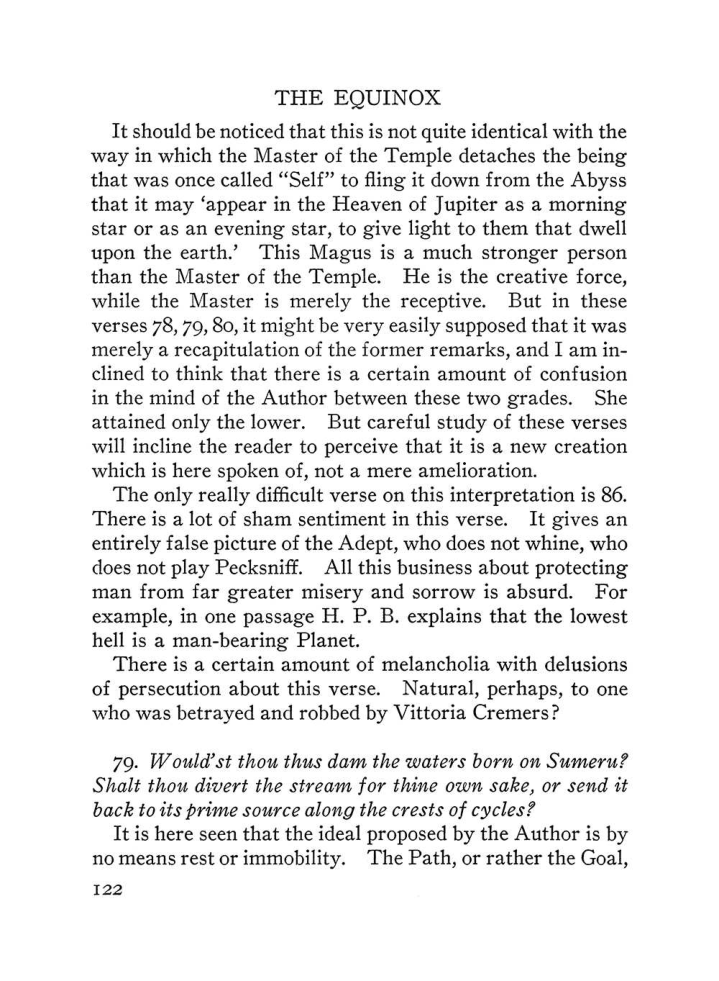
Highlights use the original PDF text layer. OCR-only matches may not be visible on the scan.
Transcription
Download text ↓raw extractionoriginal embedded textReview: unreviewed
THE EQUINOX
It should be noticed that this is not quite identical with the
way in which the Master of the Temple detaches the being
that was once called “Self” to fling it down from the Abyss
that it may ‘appear in the Heaven of Jupiter as a morning
star or as an evening star, to give light to them that dwell
upon the earth.’ This Magus is a much stronger person
than the Master of the Temple. He is the creative force,
while the Master is merely the receptive. But in these
verses 78, 79, 80, it might be very easily supposed that it was
merely a recapitulation of the former remarks, and I am in-
clined to think that there is a certain amount of confusion
in the mind of the Author between these two grades. She
attained only the lower. But careful study of these verses
will incline the reader to perceive that it is a new creation
which is here spoken of, not a mere amelioration.
The only really difficult verse on this interpretation is 86.
There is a lot of sham sentiment in this verse. It gives an
entirely false picture of the Adept, who does not whine, who
does not play Pecksniff. All this business about protecting
man from far greater misery and sorrow is absurd. For
example, in one passage H. P. B. explains that the lowest
hell is a man-bearing Planet.
There is a certain amount of melancholia with delusions
of persecution about this verse. Natural, perhaps, to one
who was betrayed and robbed by Vittoria Cremers?
79. Would’st thou thus dam the waters born on Sumeru?
Shalt thou divert the stream for thine own sake, or send it
back to its prime source along the crests of cycles?
It is here seen that the ideal proposed by the Author is by
no means rest or immobility. The Path, or rather the Goal,
122
Page provenance & review flags
Stable page ID: 053f3d738822ceadcedffd98:p00444
Line breaks are preserved. Reading order and OCR accuracy may need review.
Printed page label has not been verified.
- No automated review flags. This does not establish transcription accuracy.