1919 · CLOSE READING
The Equinox (Volume III, Number I)
The Equinox (Volume III, Number I) (1919), PDF p. 412
Original page
Enlarge ↗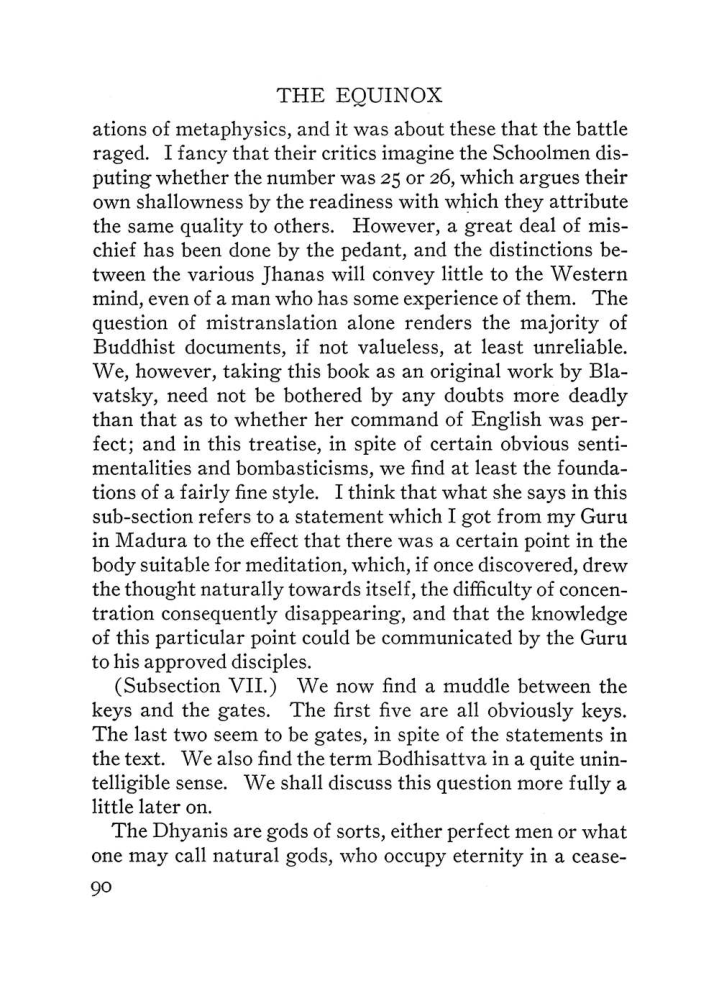
Highlights use the original PDF text layer. OCR-only matches may not be visible on the scan.
Transcription
Download text ↓raw extractionoriginal embedded textReview: unreviewed
THE EQUINOX
ations of metaphysics, and it was about these that the battle
raged. I fancy that their critics imagine the Schoolmen dis-
puting whether the number was 25 or 26, which argues their
own shallowness by the readiness with which they attribute
the same quality to others. However, a great deal of mis-
chief has been done by the pedant, and the distinctions be-
tween the various Jhanas will convey little to the Western
mind, even of a man who has some experience of them. The
question of mistranslation alone renders the majority of
Buddhist documents, if not valueless, at least unreliable.
We, however, taking this book as an original work by Bla-
vatsky, need not be bothered by any doubts more deadly
than that as to whether her command of English was per-
fect; and in this treatise, in spite of certain obvious senti-
mentalities and bombasticisms, we find at least the founda-
tions of a fairly fine style. I think that what she says in this
sub-section refers to a statement which I got from my Guru
in Madura to the effect that there was a certain point in the
body suitable for meditation, which, if once discovered, drew
the thought naturally towards itself, the difficulty of concen-
tration consequently disappearing, and that the knowledge
of this particular point could be communicated by the Guru
to his approved disciples.
(Subsection VII.) We now find a muddle between the
keys and the gates. The first five are all obviously keys.
The last two seem to be gates, in spite of the statements in
the text. We also find the term Bodhisattva in a quite unin-
telligible sense. We shall discuss this question more fully a
little later on.
The Dhyanis are gods of sorts, either perfect men or what
one may call natural gods, who occupy eternity in a cease-
90
Page provenance & review flags
Stable page ID: 053f3d738822ceadcedffd98:p00412
Line breaks are preserved. Reading order and OCR accuracy may need review.
Printed page label has not been verified.
- No automated review flags. This does not establish transcription accuracy.