1919 · CLOSE READING
The Equinox (Volume III, Number I)
The Equinox (Volume III, Number I) (1919), PDF p. 410
Original page
Enlarge ↗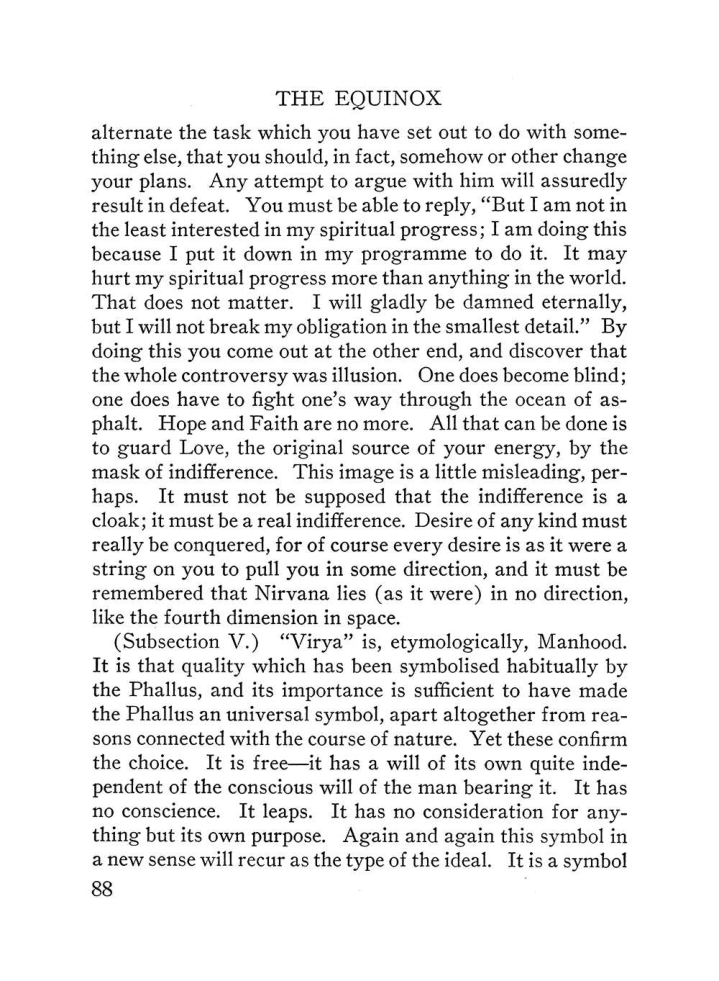
Highlights use the original PDF text layer. OCR-only matches may not be visible on the scan.
Transcription
Download text ↓raw extractionoriginal embedded textReview: unreviewed
THE EQUINOX
alternate the task which you have set out to do with some-
thing else, that you should, in fact, somehow or other change
your plans. Any attempt to argue with him will assuredly
result in defeat. You must be able to reply, “But I am not in
the least interested in my spiritual progress; I am doing this
because I put it down in my programme to do it. It may
hurt my spiritual progress more than anything in the world.
That does not matter. I will gladly be damned eternally,
but I will not break my obligation in the smallest detail.” By
doing this you come out at the other end, and discover that
the whole controversy was illusion. One does become blind;
one does have to fight one’s way through the ocean of as-
phalt. Hope and Faith areno more. All that can be done is
to guard Love, the original source of your energy, by the
mask of indifference. This image is a little misleading, per-
haps. It must not be supposed that the indifference is a
cloak; it must be a real indifference. Desire of any kind must
really be conquered, for of course every desire is as it were a
string on you to pull you in some direction, and it must be
remembered that Nirvana lies (as it were) in no direction,
like the fourth dimension in space.
(Subsection V.) “Virya” is, etymologically, Manhood.
It is that quality which has been symbolised habitually by
the Phallus, and its importance is sufficient to have made
the Phallus an universal symbol, apart altogether from rea-
sons connected with the course of nature. Yet these confirm
the choice. It is free—it has a will of its own quite inde-
pendent of the conscious will of the man bearing it. It has
no conscience. It leaps. It has no consideration for any-
thing but its own purpose. Again and again this symbol in
a new sense will recur as the type of the ideal. It isa symbol
88
Page provenance & review flags
Stable page ID: 053f3d738822ceadcedffd98:p00410
Line breaks are preserved. Reading order and OCR accuracy may need review.
Printed page label has not been verified.
- No automated review flags. This does not establish transcription accuracy.