1919 · CLOSE READING
The Equinox (Volume III, Number I)
The Equinox (Volume III, Number I) (1919), PDF p. 333
Original page
Enlarge ↗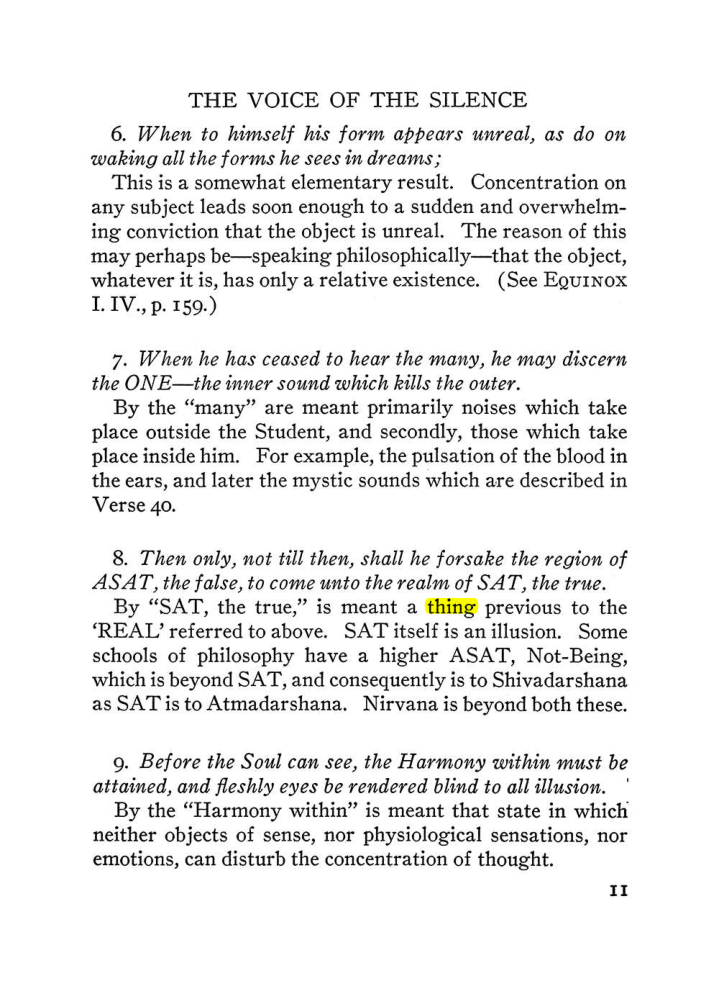
Highlights use the original PDF text layer. OCR-only matches may not be visible on the scan.
Transcription
Download text ↓raw extractionoriginal embedded textReview: unreviewed
THE VOICE OF THE SILENCE
6. When to himself his form appears unreal, as do on
waking all the forms he sees in dreams ;
This is a somewhat elementary result. Concentration on
any subject leads soon enough to a sudden and overwhelm-
ing conviction that the object is unreal. The reason of this
may perhaps be—speaking philosophically—that the object,
whatever it is, has only a relative existence. (See Equinox
LIV., p. 159.)
7. When he has ceased to hear the many, he may discern
the ONE—the inner sound which kills the outer.
By the “many” are meant primarily noises which take
place outside the Student, and secondly, those which take
place inside him. For example, the pulsation of the blood in
the ears, and later the mystic sounds which are described in
Verse 40.
8. Then only, not till then, shall he forsake the region of
ASAT, the false, to come unto the realm of SAT, the true.
By “SAT, the true,” is meant a thing previous to the
‘REAL’ referred to above. SAT itself is an illusion. Some
schools of philosophy have a higher ASAT, Not-Being,
which is beyond SAT, and consequently is to Shivadarshana
as SAT isto Atmadarshana. Nirvana is beyond both these.
9. Before the Soul can see, the Harmony within must be
attained, and fleshly eyes be rendered blind to all illusion.
By the “Harmony within” is meant that state in which
neither objects of sense, nor physiological sensations, nor
emotions, can disturb the concentration of thought.
II
Page provenance & review flags
Stable page ID: 053f3d738822ceadcedffd98:p00333
Line breaks are preserved. Reading order and OCR accuracy may need review.
Printed page label has not been verified.
- No automated review flags. This does not establish transcription accuracy.