1919 · CLOSE READING
The Equinox (Volume III, Number I)
The Equinox (Volume III, Number I) (1919), PDF p. 316
Original page
Enlarge ↗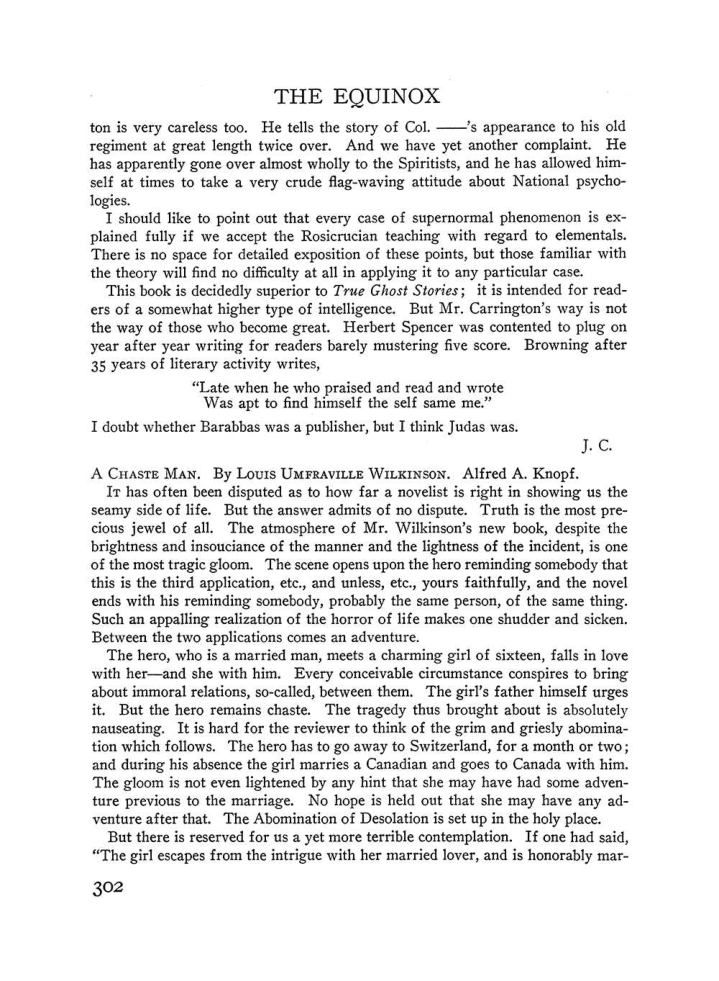
Highlights use the original PDF text layer. OCR-only matches may not be visible on the scan.
Transcription
Download text ↓raw extractionoriginal embedded textReview: unreviewed
THE EQUINOX
ton is very careless too. He tells the story of Col. ——’s appearance to his old
regiment at great length twice over. And we have yet another complaint. He
has apparently gone over almost wholly to the Spiritists, and he has allowed him-
self at times to take a very crude flag-waving attitude about National psycho-
logies.
I should like to point out that every case of supernormal phenomenon is ex-
plained fully if we accept the Rosicrucian teaching with regard to elementals.
There is no space for detailed exposition of these points, but those familiar with
the theory will find no difficulty at all in applying it to any particular case.
This book is decidedly superior to True Ghost Stories; it is intended for read-
ers of a somewhat higher type of intelligence. But Mr. Carrington’s way is not
the way of those who become great. Herbert Spencer was contented to plug on
year after year writing for readers barely mustering five score. Browning after
35 years of literary activity writes,
“Late when he who praised and read and wrote
Was apt to find himself the self same me.”
I doubt whether Barabbas was a publisher, but I think Judas was.
j.c.
A Cuaste Man. By Louis Umrravitte Witxinson. Alfred A. Knopf.
Ir has often been disputed as to how far a novelist is right in showing us the
seamy side of life. But the answer admits of no dispute. Truth is the most pre-
cious jewel of all. The atmosphere of Mr. Wilkinson’s new book, despite the
brightness and insouciance of the manner and the lightness of the incident, is one
of the most tragic gloom. The scene opens upon the hero reminding somebody that
this is the third application, etc., and unless, etc., yours faithfully, and the novel
ends with his reminding somebody, probably the same person, of the same thing.
Such an appalling realization of the horror of life makes one shudder and sicken.
Between the two applications comes an adventure.
The hero, who is a married man, meets a charming girl of sixteen, falls in love
with her—and she with him. Every conceivable circumstance conspires to bring
about immoral relations, so-called, between them. The girl’s father himself urges
it. But the hero remains chaste. The tragedy thus brought about is absolutely
nauseating. It is hard for the reviewer to think of the grim and griesly abomina-
tion which follows. The hero has to go away to Switzerland, for a month or two;
and during his absence the girl marries a Canadian and goes to Canada with him.
The gloom is not even lightened by any hint that she may have had some adven-
ture previous to the marriage. No hope is held out that she may have any ad-
venture after that. The Abomination of Desolation is set up in the holy place.
But there is reserved for us a yet more terrible contemplation. If one had said,
“The girl escapes from the intrigue with her married lover, and is honorably mar-
302
Page provenance & review flags
Stable page ID: 053f3d738822ceadcedffd98:p00316
Line breaks are preserved. Reading order and OCR accuracy may need review.
Printed page label has not been verified.
- No automated review flags. This does not establish transcription accuracy.