1919 · CLOSE READING
The Equinox (Volume III, Number I)
The Equinox (Volume III, Number I) (1919), PDF p. 315
Original page
Enlarge ↗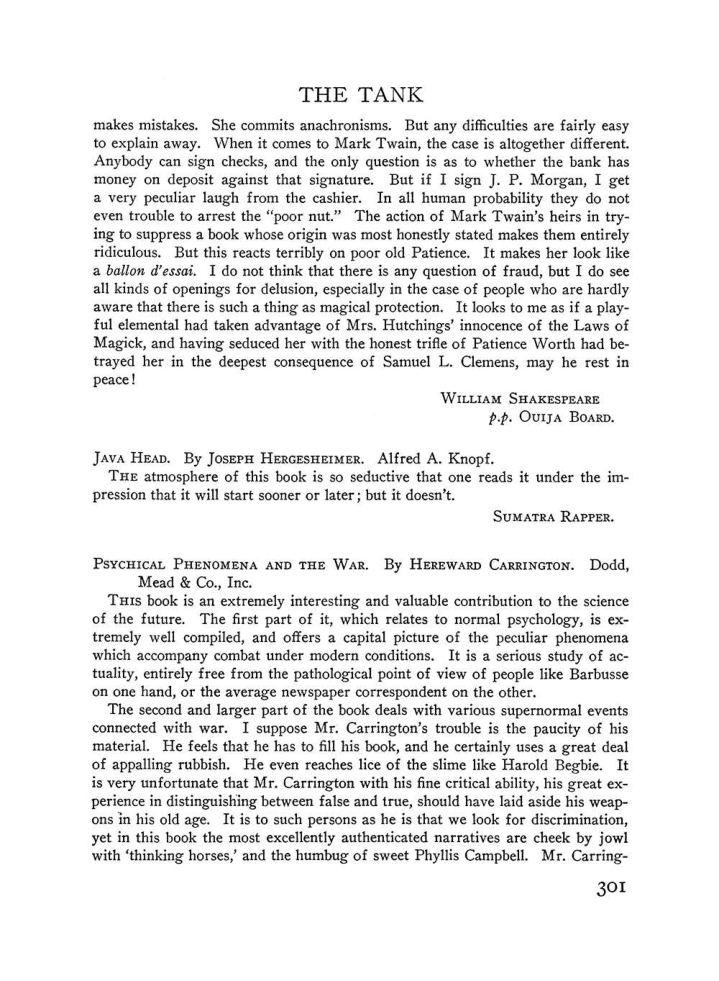
Highlights use the original PDF text layer. OCR-only matches may not be visible on the scan.
Transcription
Download text ↓raw extractionoriginal embedded textReview: unreviewed
THE TANK
makes mistakes. She commits anachronisms. But any difficulties are fairly easy
to explain away. When it comes to Mark Twain, the case is altogether different.
Anybody can sign checks, and the only question is as to whether the bank has
money on deposit against that signature. But if I sign J. P. Morgan, I get
a very peculiar laugh from the cashier. In all human probability they do not
even trouble to arrest the “poor nut.” The action of Mark Twain’s heirs in try-
ing to suppress a book whose origin was most honestly stated makes them entirely
ridiculous. But this reacts terribly on poor old Patience. It makes her look like
a ballon d’essai. I do not think that there is any question of fraud, but I do see
all kinds of openings for delusion, especially in the case of people who are hardly
aware that there is such a thing as magical protection. It looks to me as if a play-
ful elemental had taken advantage of Mrs. Hutchings’ innocence of the Laws of
Magick, and having seduced her with the honest trifle of Patience Worth had be-
trayed her in the deepest consequence of Samuel L. Clemens, may he rest in
peace!
WILLIAM SHAKESPEARE
p.p. Ourya Boar.
Java Heap. By JosepH Hercesuermer. Alfred A. Knopf.
THE atmosphere of this book is so seductive that one reads it under the im-
pression that it will start sooner or later; but it doesn’t.
Sumatra Rapper.
PsycHICAL PHENOMENA AND THE War. By Herewarp Carrincton. Dodd,
Mead & Co., Inc.
Tuts book is an extremely interesting and valuable contribution to the science
of the future. The first part of it, which relates to normal psychology, is ex-
tremely well compiled, and offers a capital picture of the peculiar phenomena
which accompany combat under modern conditions. It is a serious study of ac-
tuality, entirely free from the pathological point of view of people like Barbusse
on one hand, or the average newspaper correspondent on the other.
The second and larger part of the book deals with various supernormal events
connected with war. I suppose Mr. Carrington’s trouble is the paucity of his
material. He feels that he has to fill his book, and he certainly uses a great deal
of appalling rubbish. He even reaches lice of the slime like Harold Begbie. It
is very unfortunate that Mr. Carrington with his fine critical ability, his great ex-
perience in distinguishing between false and true, should have laid aside his weap-
ons in his old age. It is to such persons as he is that we look for discrimination,
yet in this book the most excellently authenticated narratives are cheek by jowl
with ‘thinking horses,’ and the humbug of sweet Phyllis Campbell. Mr. Carring-
301
Page provenance & review flags
Stable page ID: 053f3d738822ceadcedffd98:p00315
Line breaks are preserved. Reading order and OCR accuracy may need review.
Printed page label has not been verified.
- No automated review flags. This does not establish transcription accuracy.