1919 · CLOSE READING
The Equinox (Volume III, Number I)
The Equinox (Volume III, Number I) (1919), PDF p. 313
Original page
Enlarge ↗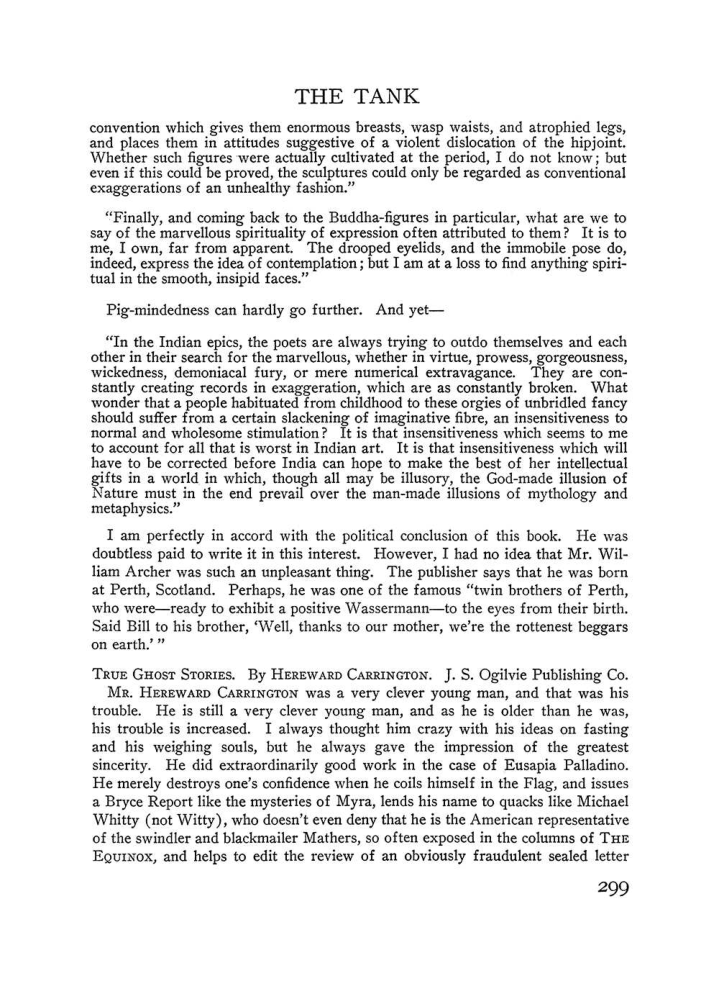
Highlights use the original PDF text layer. OCR-only matches may not be visible on the scan.
Transcription
Download text ↓raw extractionoriginal embedded textReview: unreviewed
THE TANK
convention which gives them enormous breasts, wasp waists, and atrophied legs,
and places them in attitudes suggestive of a violent dislocation of the hipjoint.
Whether such figures were actually cultivated at the period, I do not know; but
even if this could be proved, the sculptures could only be regarded as conventional
exaggerations of an unhealthy fashion.”
“Finally, and coming back to the Buddha-figures in particular, what are we to
say of the marvellous spirituality of expression often attributed to them? It is to
me, I own, far from apparent. The drooped eyelids, and the immobile pose do,
indeed, express the idea of contemplation; but I am at a loss to find anything spiri-
tual in the smooth, insipid faces.”
Pig-mindedness can hardly go further. And yet—
“In the Indian epics, the poets are always trying to outdo themselves and each
other in their search for the marvellous, whether in virtue, prowess, gorgeousness,
wickedness, demoniacal fury, or mere numerical extravagance. They are con-
stantly creating records in exaggeration, which are as constantly broken. What
wonder that a people habituated from childhood to these orgies of unbridled fancy
should suffer from a certain slackening of imaginative fibre, an insensitiveness to
normal and wholesome stimulation? It is that insensitiveness which seems to me
to account for all that is worst in Indian art. It is that insensitiveness which will
have to be corrected before India can hope to make the best of her intellectual
gifts in a world in which, though all may be illusory, the God-made illusion of
Nature must in the end prevail over the man-made illusions of mythology and
metaphysics.”
I am perfectly in accord with the political conclusion of this book. He was
doubtless paid to write it in this interest. However, I had no idea that Mr. Wil-
liam Archer was such an unpleasant thing. The publisher says that he was born
at Perth, Scotland. Perhaps, he was one of the famous “twin brothers of Perth,
who were—ready to exhibit a positive Wassermann—to the eyes from their birth.
Said Bill to his brother, ‘Well, thanks to our mother, we’re the rottenest beggars
on earth.’”
True Guost Stories. By Herewarp Carrincron. J. S. Ogilvie Publishing Co.
Mr. Herewarp CarRINGTON was a very clever young man, and that was his
trouble. He is still a very clever young man, and as he is older than he was,
his trouble is increased. I always thought him crazy with his ideas on fasting
and his weighing souls, but he always gave the impression of the greatest
sincerity. He did extraordinarily good work in the case of Eusapia Palladino.
He merely destroys one’s confidence when he coils himself in the Flag, and issues
a Bryce Report like the mysteries of Myra, lends his name to quacks like Michael
Whitty (not Witty), who doesn’t even deny that he is the American representative
of the swindler and blackmailer Mathers, so often exposed in the columns of THE
Egurnox, and helps to edit the review of an obviously fraudulent sealed letter
299
Page provenance & review flags
Stable page ID: 053f3d738822ceadcedffd98:p00313
Line breaks are preserved. Reading order and OCR accuracy may need review.
Printed page label has not been verified.
- No automated review flags. This does not establish transcription accuracy.