1919 · CLOSE READING
The Equinox (Volume III, Number I)
The Equinox (Volume III, Number I) (1919), PDF p. 307
Original page
Enlarge ↗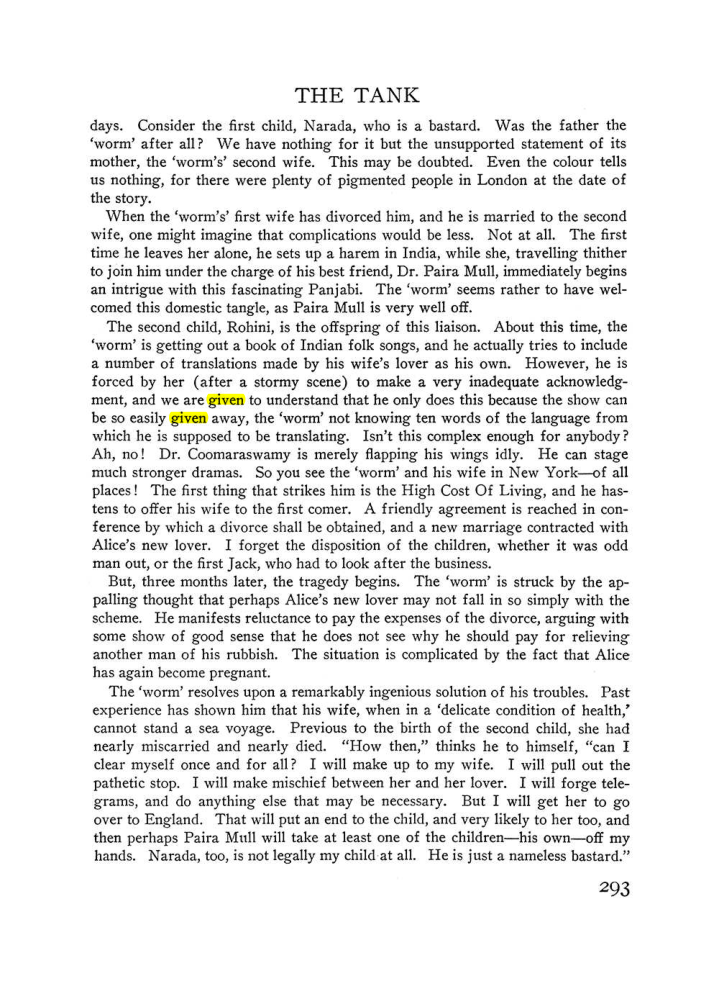
Highlights use the original PDF text layer. OCR-only matches may not be visible on the scan.
Transcription
Download text ↓raw extractionoriginal embedded textReview: unreviewed
THE TANK
days. Consider the first child, Narada, who is a bastard. Was the father the
‘worm’ after all? We have nothing for it but the unsupported statement of its
mother, the ‘worm’s’ second wife. This may be doubted. Even the colour tells
us nothing, for there were plenty of pigmented people in London at the date of
the story.
When the ‘worm’s’ first wife has divorced him, and he is married to the second
wife, one might imagine that complications would be less. Not at all. The first
time he leaves her alone, he sets up a harem in India, while she, travelling thither
to join him under the charge of his best friend, Dr. Paira Mull, immediately begins
an intrigue with this fascinating Panjabi. The ‘worm’ seems rather to have wel-
comed this domestic tangle, as Paira Mull is very well off.
The second child, Rohini, is the offspring of this liaison. About this time, the
‘worm’ is getting out a book of Indian folk songs, and he actually tries to include
a number of translations made by his wife’s lover as his own. However, he is
forced by her (after a stormy scene) to make a very inadequate acknowledg-
ment, and we are given to understand that he only does this because the show can
be so easily given away, the ‘worm’ not knowing ten words of the language from
which he is supposed to be translating. Isn’t this complex enough for anybody?
Ah, no! Dr. Coomaraswamy is merely flapping his wings idly. He can stage
much stronger dramas. So you see the ‘worm’ and his wife in New York—of all
places! The first thing that strikes him is the High Cost Of Living, and he has-
tens to offer his wife to the first comer. A friendly agreement is reached in con-
ference by which a divorce shall be obtained, and a new marriage contracted with
Alice’s new lover. I forget the disposition of the children, whether it was odd
man out, or the first Jack, who had to look after the business.
But, three months later, the tragedy begins. The ‘worm’ is struck by the ap-
palling thought that perhaps Alice’s new lover may not fall in so simply with the
scheme. He manifests reluctance to pay the expenses of the divorce, arguing with
some show of good sense that he does not see why he should pay for relieving
another man of his rubbish. The situation is complicated by the fact that Alice
has again become pregnant.
The ‘worm’ resolves upon a remarkably ingenious solution of his troubles. Past
experience has shown him that his wife, when in a ‘delicate condition of health,’
cannot stand a sea voyage. Previous to the birth of the second child, she had
nearly miscarried and nearly died. “How then,” thinks he to himself, “can I
clear myself once and for all? I will make up to my wife. I will pull out the
pathetic stop. I will make mischief between her and her lover. I will forge tele-
grams, and do anything else that may be necessary. But I will get her to go
over to England. That will put an end to the child, and very likely to her too, and
then perhaps Paira Mull will take at least one of the children—his own—off my
hands. Narada, too, is not legally my child.at all. He is just a nameless bastard.”
293
Page provenance & review flags
Stable page ID: 053f3d738822ceadcedffd98:p00307
Line breaks are preserved. Reading order and OCR accuracy may need review.
Printed page label has not been verified.
- No automated review flags. This does not establish transcription accuracy.