1919 · CLOSE READING
The Equinox (Volume III, Number I)
The Equinox (Volume III, Number I) (1919), PDF p. 300
Original page
Enlarge ↗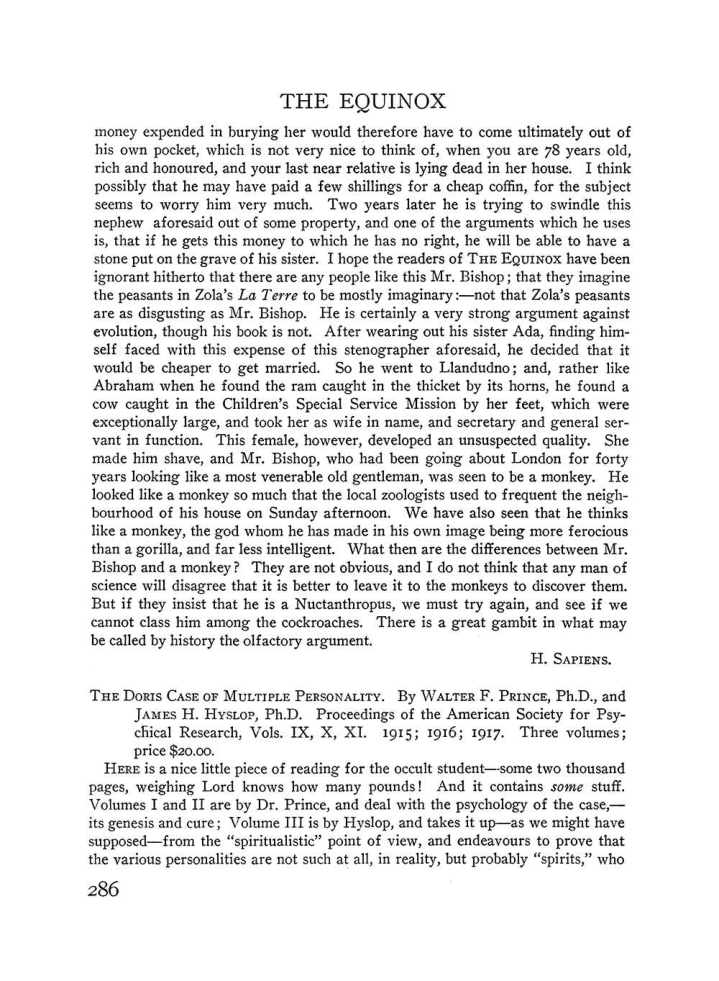
Highlights use the original PDF text layer. OCR-only matches may not be visible on the scan.
Transcription
Download text ↓raw extractionoriginal embedded textReview: unreviewed
THE EQUINOX
money expended in burying her would therefore have to come ultimately out of
his own pocket, which is not very nice to think of, when you are 78 years old,
rich and honoured, and your last near relative is lying dead in her house. I think
possibly that he may have paid a few shillings for a cheap coffin, for the subject
seems to worry him very much. Two years later he is trying to swindle this
nephew aforesaid out of some property, and one of the arguments which he uses
is, that if he gets this money to which he has no right, he will be able to have a
stone put on the grave of his sister. I hope the readers of THE Egurnox have been
ignorant hitherto that there are any people like this Mr. Bishop; that they imagine
the peasants in Zola’s La Terre to be mostly imaginary :—not that Zola’s peasants
are as disgusting as Mr. Bishop. He is certainly a very strong argument against
evolution, though his book is not. After wearing out his sister Ada, finding him-
self faced with this expense of this stenographer aforesaid, he decided that it
would be cheaper to get married. So he went to Llandudno; and, rather like
Abraham when he found the ram caught in the thicket by its horns, he found a
cow caught in the Children’s Special Service Mission by her feet, which were
exceptionally large, and took her as wife in name, and secretary and general ser-
vant in function. This female, however, developed an unsuspected quality. She
made him shave, and Mr. Bishop, who had been going about London for forty
years looking like a most venerable old gentleman, was seen to be a monkey. He
looked like a monkey so much that the local zoologists used to frequent the neigh-
bourhood of his house on Sunday afternoon. We have also seen that he thinks
like a monkey, the god whom he has made in his own image being more ferocious
than a gorilla, and far less intelligent. What then are the differences between Mr.
Bishop and a monkey? They are not obvious, and I do not think that any man of
science will disagree that it is better to leave it to the monkeys to discover them.
But if they insist that he is a Nuctanthropus, we must try again, and see if we
cannot class him among the cockroaches. There is a great gambit in what may
be called by history the olfactory argument.
H. Sapiens.
Tue Dorts Case oF MuttrpLe Personatity. By WALTER F. Prince, Ph.D., and
James H. Hystop, Ph.D. Proceedings of the American Society for Psy-
chical Research, Vols. IX, X, XI. 1915; 1916; 1917. Three volumes;
price $20.00.
Herz is a nice little piece of reading for the occult student—-some two thousand
pages, weighing Lord knows how many pounds! And it contains some stuff.
Volumes I and II are by Dr. Prince, and deal with the psychology of the case,—
its genesis and cure; Volume III is by Hyslop, and takes it up—as we might have
supposed—from the “spiritualistic” point of view, and endeavours to prove that
the various personalities are not such at all, in reality, but probably “spirits,” who
286
Page provenance & review flags
Stable page ID: 053f3d738822ceadcedffd98:p00300
Line breaks are preserved. Reading order and OCR accuracy may need review.
Printed page label has not been verified.
- No automated review flags. This does not establish transcription accuracy.