1919 · CLOSE READING
The Equinox (Volume III, Number I)
The Equinox (Volume III, Number I) (1919), PDF p. 296
Original page
Enlarge ↗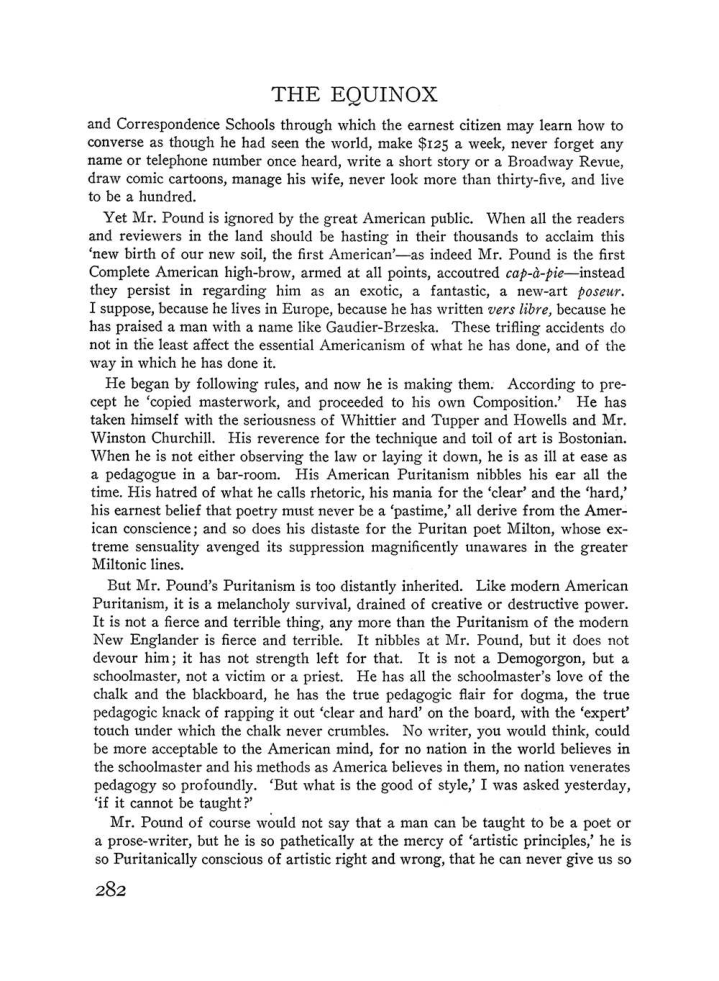
Highlights use the original PDF text layer. OCR-only matches may not be visible on the scan.
Transcription
Download text ↓raw extractionoriginal embedded textReview: unreviewed
THE EQUINOX
and Correspondence Schools through which the earnest citizen may learn how to
converse as though he had seen the world, make $125 a week, never forget any
name or telephone number once heard, write a short story or a Broadway Revue,
draw comic cartoons, manage his wife, never look more than thirty-five, and live
to be a hundred.
Yet Mr. Pound is ignored by the great American public. When all the readers
and reviewers in the land should be hasting in their thousands to acclaim this
‘new birth of our new soil, the first American’—as indeed Mr. Pound is the first
Complete American high-brow, armed at all points, accoutred cap-d-pie—instead
they persist in regarding him as an exotic, a fantastic, a new-art poseur.
I suppose, because he lives in Europe, because he has written vers libre, because he
has praised a man with a name like Gaudier-Brzeska. These trifling accidents do
not in the least affect the essential Americanism of what he has done, and of the
way in which he has done it.
He began by following rules, and now he is making them. According to pre-
cept he ‘copied masterwork, and proceeded to his own Composition.’ He has
taken himself with the seriousness of Whittier and Tupper and Howells and Mr.
Winston Churchill. His reverence for the technique and toil of art is Bostonian.
When he is not either observing the law or laying it down, he is as ill at ease as
a pedagogue in a bar-room. His American Puritanism nibbles his ear all the
time. His hatred of what he calls rhetoric, his mania for the ‘clear’ and the ‘hard,’
his earnest belief that poetry must never be a ‘pastime,’ all derive from the Amer-
ican conscience; and so does his distaste for the Puritan poet Milton, whose ex-
treme sensuality avenged its suppression magnificently unawares in the greater
Miltonic lines,
But Mr. Pound’s Puritanism is too distantly inherited. Like modern American
Puritanism, it is a melancholy survival, drained of creative or destructive power.
It is not a fierce and terrible thing, any more than the Puritanism of the modern
New Englander is fierce and terrible. It nibbles at Mr. Pound, but it does not
devour him; it has not strength left for that. It is not a Demogorgon, but a
schoolmaster, not a victim or a priest. He has all the schoolmaster’s love of the
chalk and the blackboard, he has the true pedagogic flair for dogma, the true
pedagogic knack of rapping it out ‘clear and hard’ on the board, with the ‘expert’
touch under which the chalk never crumbles. No writer, you would think, could
be more acceptable to the American mind, for no nation in the world believes in
the schoolmaster and his methods as America believes in them, no nation venerates
pedagogy so profoundly. ‘But what is the good of style,’ I was asked yesterday,
‘if it cannot be taught?”
Mr. Pound of course would not say that a man can be taught to be a poet or
a prose-writer, but he is so pathetically at the mercy of ‘artistic principles,’ he is
so Puritanically conscious of artistic right and wrong, that he can never give us so
282
Page provenance & review flags
Stable page ID: 053f3d738822ceadcedffd98:p00296
Line breaks are preserved. Reading order and OCR accuracy may need review.
Printed page label has not been verified.
- No automated review flags. This does not establish transcription accuracy.