1919 · CLOSE READING
The Equinox (Volume III, Number I)
The Equinox (Volume III, Number I) (1919), PDF p. 292
Original page
Enlarge ↗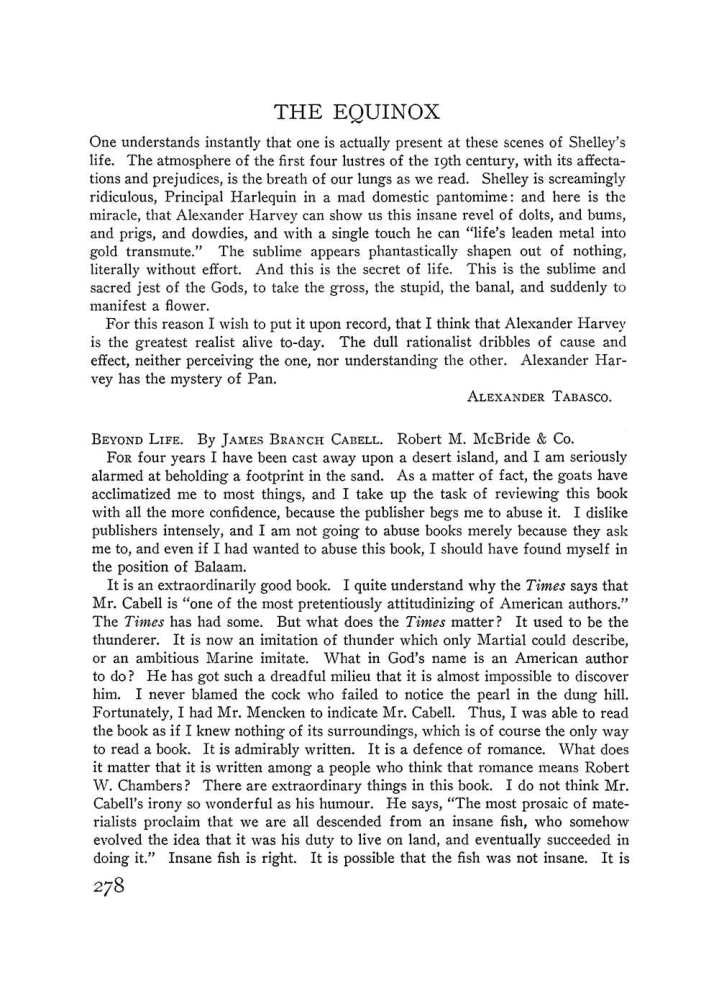
Highlights use the original PDF text layer. OCR-only matches may not be visible on the scan.
Transcription
Download text ↓raw extractionoriginal embedded textReview: unreviewed
THE EQUINOX
One understands instantly that one is actually present at these scenes of Shelley’s
life. The atmosphere of the first four lustres of the rth century, with its affecta-
tions and prejudices, is the breath of our lungs as we read. Shelley is screamingly
ridiculous, Principal Harlequin in a mad domestic pantomime: and here is the
miracle, that Alexander Harvey can show us this insane revel of dolts, and bums,
and prigs, and dowdies, and with a single touch he can “life’s leaden metal into
gold transmute.” The sublime appears phantastically shapen out of nothing,
literally without effort. And this is the secret of life. This is the sublime and
sacred jest of the Gods, to take the gross, the stupid, the banal, and suddenly to
manifest a flower.
For this reason I wish to put it upon record, that I think that Alexander Harvey
is the greatest realist alive to-day. The dull rationalist dribbles of cause and
effect, neither perceiving the one, nor understanding the other. Alexander Har-
vey has the mystery of Pan.
ALEXANDER TABASCO.
Beyonp Lire. By James Brancu Cazett. Robert M. McBride & Co.
For four years I have been cast away upon a desert island, and I am seriously
alarmed at beholding a footprint in the sand. As a matter of fact, the goats have
acclimatized me to most things, and I take up the task of reviewing this book
with all the more confidence, because the publisher begs me to abuse it. I dislike
publishers intensely, and I am not going to abuse books merely because they ask
me to, and even if I had wanted to abuse this book, I should have found myself in
the position of Balaam.
It is an extraordinarily good book. I quite understand why the Times says that
Mr. Cabell is “one of the most pretentiously attitudinizing of American authors.”
The Times has had some. But what does the Times matter? It used to be the
thunderer. It is now an imitation of thunder which only Martial could describe,
or an ambitious Marine imitate. What in God’s name is an American author
to do? He has got such a dreadful milieu that it is almost impossible to discover
him. I never blamed the cock who failed to notice the pearl in the dung hill.
Fortunately, I had Mr. Mencken to indicate Mr. Cabell. Thus, I was able to read
the book as if I knew nothing of its surroundings, which is of course the only way
to read a book. It is admirably written. It is a defence of romance. What does
it matter that it is written among a people who think that romance means Robert
W. Chambers? There are extraordinary things in this book. I do not think Mr.
Cabell’s irony so wonderful as his humour. He says, “The most prosaic of mate-
rialists proclaim that we are all descended from an insane fish, who somehow
evolved the idea that it was his duty to live on land, and eventually succeeded in
doing it.” Insane fish is right. It is possible that the fish was not insane. It is
278
Page provenance & review flags
Stable page ID: 053f3d738822ceadcedffd98:p00292
Line breaks are preserved. Reading order and OCR accuracy may need review.
Printed page label has not been verified.
- No automated review flags. This does not establish transcription accuracy.